


Writer: Lynn Cadet


Editor: Lillian Castro


Reviewer: Cristian Lopez

Key Takeaways
- 64% of surveyed customers over the age of 30 report dissatisfaction with AI chatbots, with baby boomers (76%) reporting the highest dissatisfaction rate.
- Women (33%) were far less likely to express contentment with chatbot use compared to men (43%), suggesting that women may experience more frustration with current AI service models.
- Residents of the Midwest (42%) reported the highest satisfaction rate among AI chatbot users. In contrast, only 1 in 3 customers in the Northeast and the West were satisfied with AI use in customer service.
Millions of businesses worldwide have turned to AI models to improve operations, boost efficiency, and reduce costs. Among their primary investments? AI chatbots.
For companies, AI chatbots offer a way to enhance support, providing 24/7 availability, instant responsiveness, and the ability to handle high volumes of customer queries. But while businesses may see unparalleled value in these tools, their audience base doesn’t exactly share the same sentiment.
A recent HostingAdvice.com survey found that 92% of surveyed business owners believe investing in AI chatbots can improve customer experience. Yet 62% of surveyed customers say otherwise, expressing dissatisfaction with AI customer interactions.
These results reveal a stark disconnect between how customers and businesses view AI chatbots and their roles in customer service. Our study also reveals key differences in attitudes across demographics, revealing that not all consumers feel the same way about AI implementations.
64% of Customers Over 30 Are Dissatisfied with AI Chatbots
Our responses showed a strong relationship between age and support of AI chatbots in customer service. While younger respondents report mixed experiences, dissatisfaction increases steadily with age, reaching its highest levels among baby boomers.
Gen Z was nearly evenly split in its opinion, with 42% expressing positive views of AI chatbots compared to the 52% who expressed dissatisfaction. On the other hand, those over 30 showed far more opposition to the use of AI chatbots in their customer service interactions.
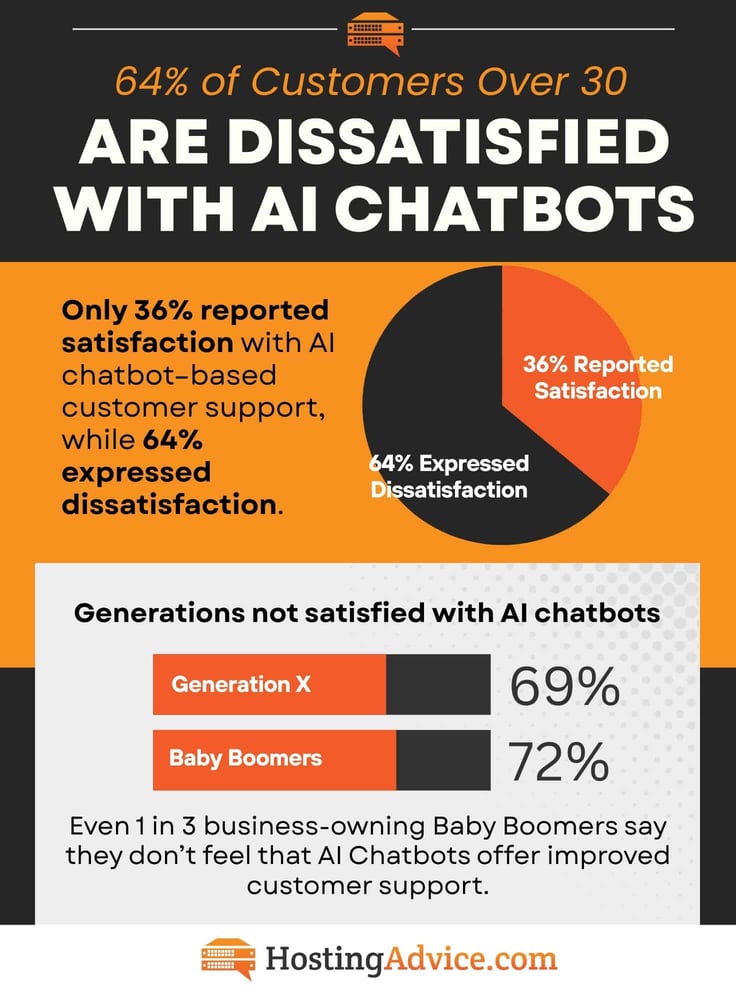
Among those in the 30+ demographic, only 36% reported satisfaction with AI customer support, compared to 48% of Gen Z who did. Boomers, however, stood out for their disapproval across both business and customer perspectives.
About 76% of boomers expressed discontent with their experience with AI chatbots. Another third of business-owning boomers also said they don’t believe AI chatbots bring value to the customer experience, indicating that their dissatisfaction with these tools also extends to business strategy.
“The increased dissatisfaction in older age groups, particularly boomers, says more to me about broken promises from the tech world than it does about any tech discomfort from those consumers,” says Joe Warnimont, Senior Analyst at HostingAdvice.
“Boomers can recall a time when they’d ‘press 1 to speak with a support representative, ‘ and the system actually sent them to a living, breathing, knowledgeable person. Now, AI chatbots force customers to navigate, and sometimes troubleshoot, their limitations on top of their original problem. When 76% of customers say you’re alienating them, that’s a design issue, not a user issue.”
It’s clear that the older a respondent is, the more likely they are to be dissatisfied with AI chatbots. Still, we can’t ignore how familiarity with technology could be shaping attitudes toward these chatbot tools and influencing this generational gap.
Unlike their older counterparts, younger Americans grew up in an increasingly digital environment, making them more tolerant and comfortable with emerging tools. This could help explain why they are more open to AI integration.
Boomers, in contrast, may be less satisfied with AI tools due to lower interest in or flexibility with new technologies. This presents an opportunity for companies to find ways to make AI more seamless and user-friendly for all their users.
Only 1 in 3 Female Customers Are Happy with AI Chatbot Support
Our data makes it clear: Most customers favor human interactions over AI when it comes to customer service experience. Yet, some demographics show a higher preference or tolerance for AI chatbots than others. And we found a similar gap within gender groups.
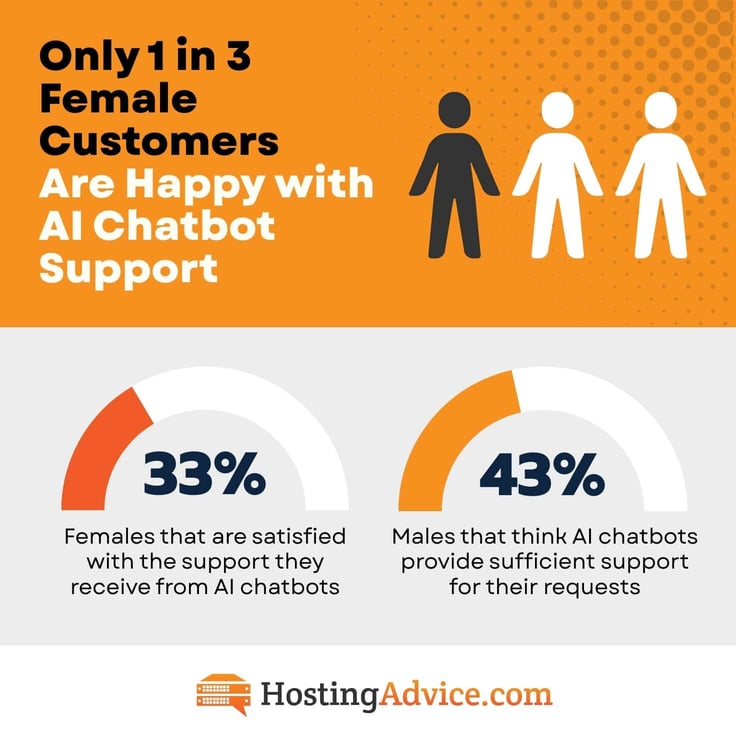
Though both genders expressed some level of displeasure with AI, our study found that AI chatbots were less popular among women than men.
While 43% of men said they are satisfied with chatbots, just 33% of women felt the same — a 10-point difference in satisfaction. These results suggest that women may experience more frustration when using AI chatbots than men, which may explain why they are more likely to think AI chatbots aren’t always sufficient to solve requests.
Midwestern Customers Are the Least Dissatisfied, But Still Far From Sold on AI Chatbots
Satisfaction with AI chatbots also varied across all U.S. regions. Midwestern and Southern residents were the least dissatisfied with AI, but those from the Northeast and the West were more likely to report negative interactions.
The Midwest stood out in its support, with 42% of Midwesterners reporting satisfaction in AI’s ability to improve customer support and user experience. The South showed satisfaction at a slightly lower rate, with 39% of Southerners reporting positive AI interactions.
We found a sharper decline in support among the West and Northeast regions. Both regions showed the highest dissatisfaction, with only 1 in 3 residents saying they are satisfied with AI customer support.
For businesses, it’s hard to overlook the benefits of implementing AI chatbots. Not only does AI help accelerate complaint resolution time, but it also helps reduce costs associated with sales and customer service.
Yet the gap between how customers view these AI implementations has caused quite a dilemma for teams.
While a fair share of customers report positive interactions with AI tools, the majority remain hesitant about AI chatbots. By combining AI chatbots with thoughtful human experiences, businesses can help bridge the gap between hesitancy and willingness, as AI increasingly becomes a larger part of the world’s digital ecosystem.
Methodology
This survey was conducted in January 2026 among 500 U.S.-based business owners and 55 non-business owners. Respondents were selected from a third-party research panel.
To ensure the integrity of data collection, the researcher developed a proprietary machine-learning algorithm that can detect fraudulent responses early and remove inauthentic respondents immediately. The overall margin of error is ±3.1 percentage points at the 95% confidence level. Margins of error increase for subgroups such as age or gender.
For media inquiries, please reach out to dennis@hostingadvice.com.