



Writer: Surajdeep Singh


Editor: Britain Simons


Reviewer: Cristian Lopez

When I was in the second year of my engineering degree, I launched a blog dedicated to all things Manchester United (huge fan). I purchased a domain and set up shared hosting with GoDaddy, then built and maintained my website using WordPress CMS (Content Management System). This was about 12 years ago, but I still remember how easy WordPress made my life.
Even though I’m a senior web developer, I didn’t have to write a single line of code to develop a WordPress site. Mind you, this was well before AI vibe coding. In two days, I picked and tweaked a pre-built theme and integrated core plugins for SEO optimization, social media, caching, and analytics tracking.
Now, it’s even easier to build sites. Many web hosting providers include chat-based AI website builders in their plans — just type a prompt and voilà! A rough draft of your website will be ready in minutes. You can also take a more hands-on approach using a CMS (like I did), or code from scratch using HTML, CSS, and JavaScript.
While you don’t have to use a CMS for site maintenance (more on this soon), most sites rely on one because it simplifies publishing, updates, and day-to-day management. Through my CMS market share stats, I’ll show you how content management systems play a pivotal role in website creation and maintenance, business adoption, and the evolution of the internet.
1. About 70.8% of All Websites Use a Content Management System
According to W3Techs data, approximately 70.8% of all websites on the Internet use content management systems like WordPress, Shopify, Wix, Squarespace, and Joomla — there are hundreds of options on the market.1
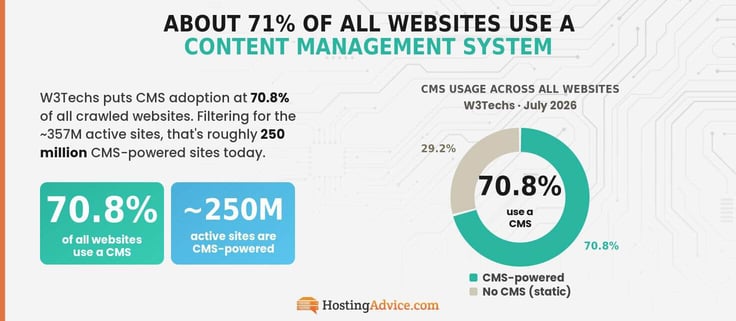
Since there are around 1.43 billion websites according to a recent Netcraft survey, on paper, this should mean that roughly one billion of them use a CMS.2 In practice it’s lower, because “all websites” in W3Techs’ dataset doesn’t mean every registered domain — it means the sites they could actually crawl and identify, which skews toward active ones.²
Active websites make up only about 25% of that 1.43 billion — roughly 357 million. Applying the 70.8% CMS share to that smaller, active pool gives a real number closer to 250 million CMS-powered websites. The “80 million” figure that keeps circulating on competing blogs comes from an even older, misinterpreted version of this data, and is now well out of date.
WordPress’s own download numbers back up how large the active base really is: WordPress 6.9 alone has been downloaded more than 56.7 million times.

Downloads don’t equal live installations — and plenty of existing WordPress sites are still running versions that are months or years old, but the volume still points to a CMS install base in the hundreds of millions, not the tens of millions (~80M) some outlets keep citing, based on the 70.8% CMS adoption. 1,2,3,4
2. Roughly 29% of Websites Still Operate Without a CMS
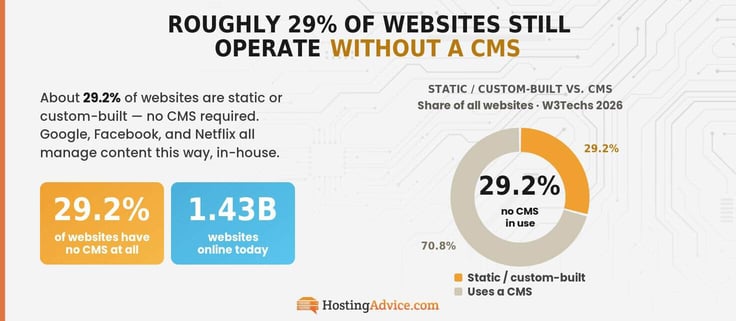
Around 29.2% of websites are static, custom-built, or managed without a traditional CMS.1 Static websites are just pages with .html, .css, and .js files. You might have heard of GitHub or Netlify.
A developer could create a simple portfolio site — I’ve tried this myself — with a homepage file (index.html) and an about page file (about.html), along with a CSS file (styles.css) for design and a JavaScript file (script.js) for interactivity. They can then upload these files to a repository (folder) on GitHub (for free static hosting) and connect a cheap custom domain.
If they want to make changes to the site, all they have to do is edit the files directly — no CMS needed. Custom-built sites are a similar story. They use HTML, CSS, JavaScript, modern frameworks like Next.js, and are connected to databases, with APIs used to fetch and deliver dynamic content.
This way, developers can manage content and update features directly in code — unlike the setup I used for my blog! Some of the most popular websites in the world are custom-built — sites like Google, Facebook, or Netflix can’t be realistically managed on a traditional CMS like WordPress (they do use internal, CMS-like systems).
That’s why 29.2% don’t need a traditional CMS, and one of the reasons they pay their engineers the big bucks!
3. WordPress Powers Around 42% of All Websites Globally
There’s a greatest of all time (GOAT) debate in pretty much every sport. Messi vs Ronaldo in football, AKA soccer (Ronaldo just edges it imo), Michael Jordan vs LeBron James in basketball, and Novak Djokovic vs Rafael Nadal vs Roger Federer in tennis.
Just like Tom Brady is the undisputed GOAT of American football (he’s won the Super Bowl seven times!) WordPress is head and shoulders above all other content management systems — it’s used by around 42.2% of all active websites, or, in other words, roughly 151 million (websites!1
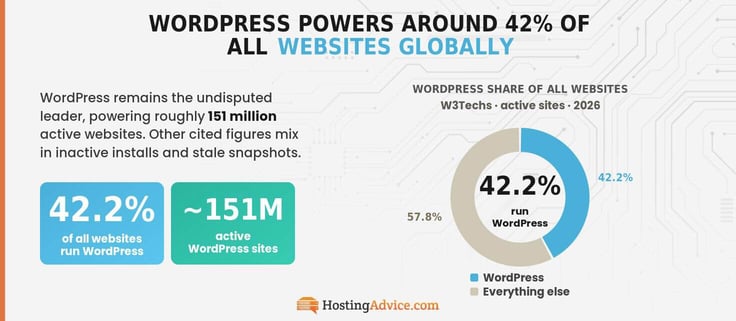
The data can get a bit muddy when you go beyond “active websites” with varying sources citing between 455 million and 810 million.5,6 The most accurate number of 151 million active WordPress sites is backed by current data.1
4. WordPress Holds About 60% Total CMS Market Share
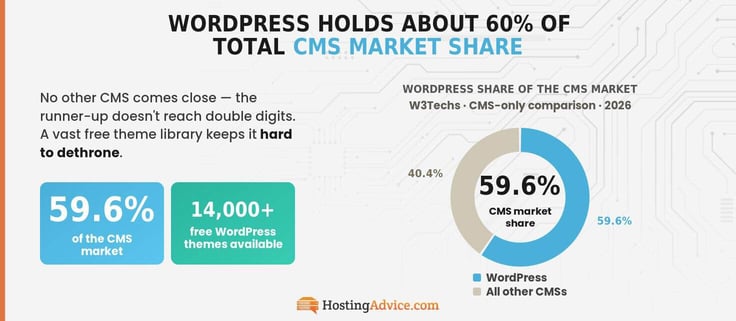
WordPress has a CMS market share of about 59.6%.1 No other content management system has a double-digit share! While its dominance might look wild at first glance, it’s a result of timing (first-mover advantage), philosophy (a free and open-source ecosystem), and flexibility (it can do almost anything).
Once you’ve purchased a domain name and set up hosting, you can build a WordPress website with a free theme (there are more than 14,000 options) and plugins and maintain it without spending another penny. Of course, paid themes and plugins are available (and many of them are excellent), but you don’t have to purchase them.
You can also build a fully custom site with WordPress — more on this soon. Three of its closest “competitors,” Shopify, Wix, and Squarespace, make money via subscriptions and limit customization. Joomla is free and open-source like WordPress, but it is less beginner-friendly with a much smaller ecosystem.
Once WordPress got big in the early 2010s, its community-driven ecosystem became difficult to dethrone, similar to how iPhone and iOS established dominance. And as things are, it should remain the undisputed CMS king for many years to come.
5. The Top 5 CMS Platforms Control Approximately 78% of the Market
You probably want to know how much of the market each of the top five CMS platforms I mentioned controls. From the heading of this CMS market share stat, you know they dominate around 78.3%. WordPress is used by 41.2% (grey) of all the websites monitored by Web3Techs’ extensive market research, which is a CMS market share of 59.6% (green).1
Top 5 CMS Platforms
W3Techs Data
Top 5 CMS Marketshare breakdown:
- WordPress: 59.2% (Dominant CMS)
- Shopify: 7.5% (eCommerce segment)
- Wix: 6.1% (Fast growing)
- Squarespace: 3.5%
- Joomla: 1.7%
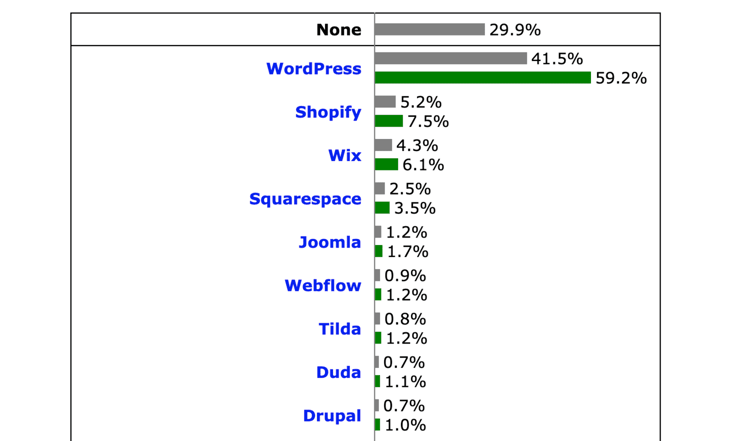
Key: Green - CMS Market Share, Grey - Absolute Usage Percentage
Webflow (1.2%), Tilda (1.2%), Duda (1%), and Drupal (1%) are the only other content management systems with a share of at least 1%. Adobe Systems completes the top ten with a CMS market share of 0.9%.1 How many of these platforms have you heard of?
Note: As the market pivots, the Web3Techs market report is currently about 6 months more up-to-date than the typically cited Landbase data.1,7
6. WooCommerce Has 7M+ Active Installations
If you want to build an eCommerce platform, there are few better options than WordPress and Shopify. Building with WordPress can be more hands-on. I recommend purchasing a managed WordPress hosting plan (check out Bluehost’s plans) with heavy WooCommerce optimizations — WordPress’s “unofficial” eCommerce plugin, with more than seven million active installations.
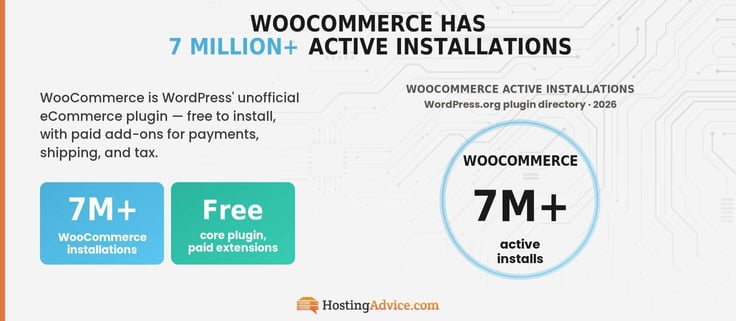
This means there are at least seven million WordPress eCommerce websites. With several other eCommerce plugins to choose from, WooCommerce is still king!5 With a managed WordPress plan, updates, backups, and security are typically automated. You’ll have significant control over hosting, the database, code, checkout flow, and design.
Basically, if you can code it, you can build it. Or take advantage of available themes, site builders, and plugins.8 If you want to start from scratch, I recommend using the AI Builder plugin to generate components like pages, text blocks, media, widgets, and embeds. You can then customize them with your own code in the Gutenberg editor.
While some plugins are free (AI Builder is credit-based), you might have to pay for eCommerce features like payment gateways, shipping tools, subscription and booking systems, tax calculators, and marketing tools, but it’s significantly cheaper than an online marketplace that you don’t own.
Managing all of this can become complex, especially if you’re a solo builder or part of a small team without technical experience, so no shame if you do jump on board an eCommerce platform. That’s where Shopify comes into the picture.
7. Shopify Accounts for 7.5% of CMS Market Share
Shopify is synonymous with eCommerce — almost all of its ~19 million websites are online stores. While you won’t have the same level of control over your web development stack as you would with WordPress, with Shopify, hosting, security, and infrastructure are managed for you.
You can use Shopify’s AI website builder or customize your store’s design and functionality through themes (there are ~1126 options) and apps (Shopify’s version of plugins), with core features like payments, checkout, security, and scaling built in.
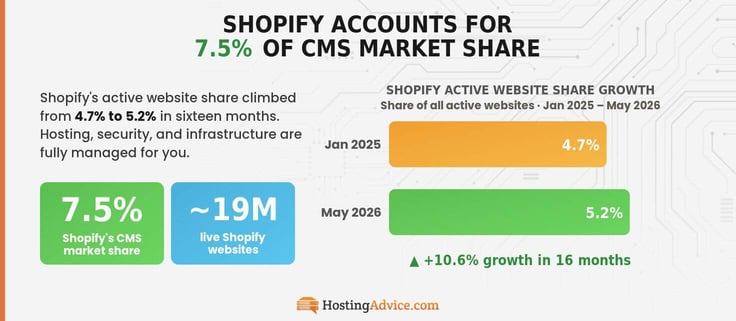
A Shopify store is much simpler to set up, which is one of the reasons why its usage has jumped from 4.7% in January 2025 to 5.2% in May 2026 of active websites.7,9 The ease of setup creates an enticing option, leading to a 7.5% CMS Market Share.
You can design the storefront UI yourself and connect custom apps via APIs that extend parts of the store — like products, orders, customer data, checkout rules, and data flows.
Shopify still controls the backend. If you think of it like a house, this means you can redesign each room with furniture and decor to your style preference, but you can’t rebuild or remodel it. For context, with WordPress + WooCommerce, you can build the whole house yourself exactly to specification.
8. Wix has a Global CMS Market Share of Around 6.1%
With about 15 million websites to its name, Wix is the easiest CMS to use out of the three. It’s a fully hosted drag-and-drop website builder specially designed for non-technical users.3,6 All you have to do is pick a template (900+ are available), drag-and-drop elements like text, images (often placeholders), and buttons onto a page, and add built-in tools and apps for extra features.
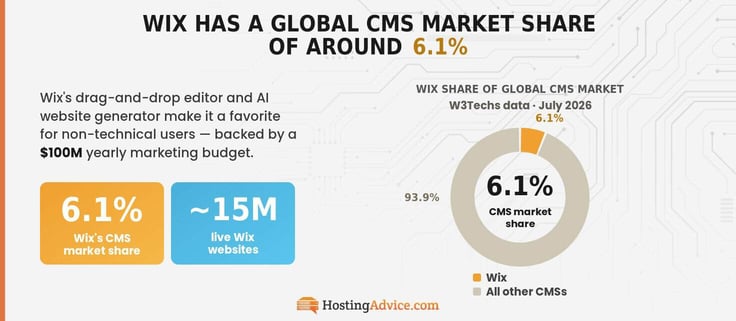
You can also take the easier route with its AI website generator. Once you type a detailed prompt to create a site, you can use Wix’s AI tools to personalize it to your taste. Wix is a solid option if you want to launch something simple, like a small business site, portfolio, or store. It’s an intuitive CMS, and AI may be the biggest reason it’s climbed to 6.1% CMS market share.
Like Shopify, Wix also has a developer layer. While you can design a UI and build custom apps outside of Shopify (like on your own server) and connect them to it via APIs, on Wix, you design your site in the editor and add features by writing code in it or integrating external APIs to extend parts of the site.
9. Squarespace Makes Up 3.5% of CMS Market Share
Around 2.5% of all active websites use Squarespace — and for good reason.3,6 It’s one of the simplest platforms to create and manage a site on. If you’re a creative who wants to build a minimalistic, professional website, Squarespace is a good shout. A solid mid-range option that makes up 3.5% of the CMS market share.
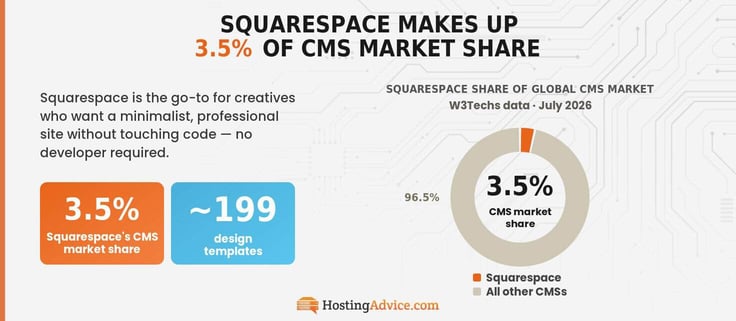
You can either use its AI tools to build a personalized website or choose from its library of ~199 templates and customize accordingly. From my experience, Squarespace is very easy to use. You can also create custom templates on the Developer Platform and integrate third-party tools.
If you want to generate a website mostly with AI, I found Wix to be a better option. If you’re a little more comfortable managing your site, give Hostinger or Bluehost a try. You can use the CMS of your choice for these hosts.
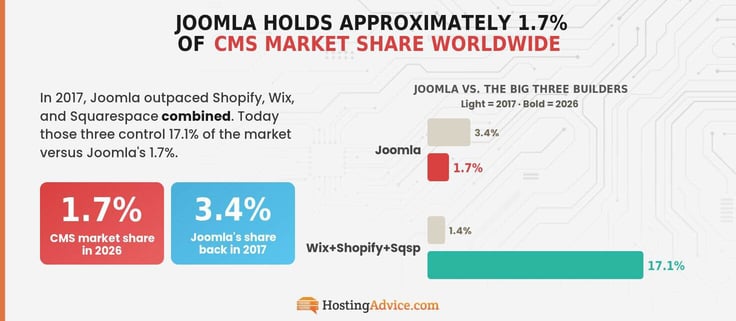
10. Joomla Holds Approximately 1.7% of CMS Market Share Worldwide
Back in 2017, Joomla was used by more websites than Shopify, Wix, and Squarespace combined (3.4% vs 1.4%). Now, it’s fallen behind all of them to 1.7% CMS market share. When I first started coding in the early 2010s, I thought Joomla would give WordPress a run for its money (which is ironic, since both are open-source projects). Far from it.
Joomla has a library of templates and extensions, similar to WordPress. But if you don’t understand how Joomla’s system works, customizing it becomes difficult. Like all cult heroes, Joomla does have its fair share of followers (1.2% of all active sites is still a lot!).9
It’s a good fit for complex, permission-heavy websites, including government portals, enterprise intranets, membership systems, and structured content-heavy platforms. Definitely not the CMS you’re looking for to build that blog!
11. CMS Adoption Increased by About 85% Since 2015
Only about 38.3% of all websites used a CMS in January 2015, according to historical W3Techs data — roughly 61% of these CMS sites were powered by WordPress. Since 2015, we’ve seen an increase of around 85% in CMS adoption. I’ve seen this drastic change firsthand. I started my professional career as a freelance writer on platforms like Freelancer and Upwork.
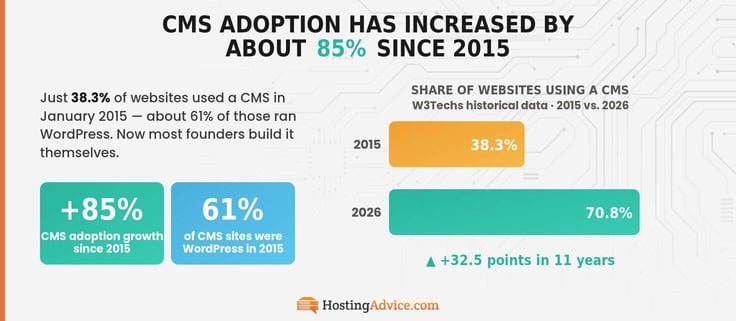
There were loads of requests for website development on them. Custom-coded websites built from scratch were trendy — hiring a developer to build a site was normal. While platforms with website builders like Shopify, Wix, and Squarespace were around, they were used by only ~0.6% of all websites, and were seen as amateur options for building a “serious website.”9
WordPress was still a powerful tool in 2016, but it wasn’t as user-friendly and intuitive as it is now. Some might even have called it “clunky.” I have no complaints, though. I built my site around that time and quite enjoyed the experience. Now, many founders create websites themselves using these tools (or hire marketers and content creators)!
12. The Number of Websites Using WordPress Has Declined by Around 3.2% Since 2025
In January 2025, WordPress experienced its peak website usage — approximately 43.6% of all websites on the Internet used the content management system. As of May 2026, this figure has dropped to around 42.2%, which is still stellar but represents a decline of about 3.2%.
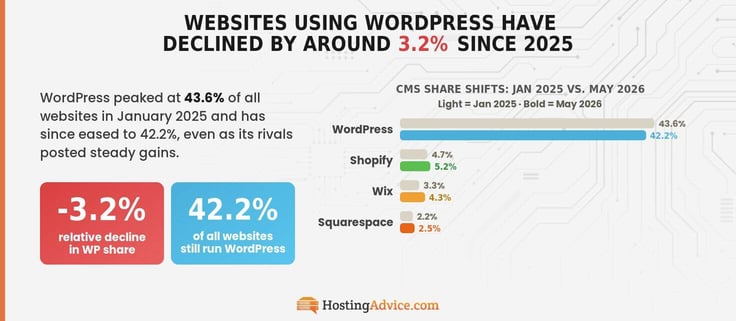
In the same period, Shopify’s usage has jumped from 4.7% to 5.2%, Wix’s from 3.3% to 4.3%, and Squarespace’s from 2.2% to 2.5%. Since the number of websites using a CMS is largely unchanged (70.4% then vs 70.8% today), these platforms, in particular, have witnessed steady growth.6
One major factor is the AI rush. While WordPress has some native AI features on its core platform (like its recent AI assistant rollout) and a huge library of AI plugins, the other CMSs I mentioned have pushed AI as a core, built-in feature. If WordPress offers a fully integrated AI website builder experience soon, the numbers could shift back in its favor.
13. Wix Grew by Approximately 231% Between 2020 and 2026
In 2020, just 1.3% of websites used Wix. It’s grown by around 230.8% as of mid-2026, making it one of the fastest-growing content management systems in recent years — alongside Shopify, which I’ll cover in the next CMS market share stat.
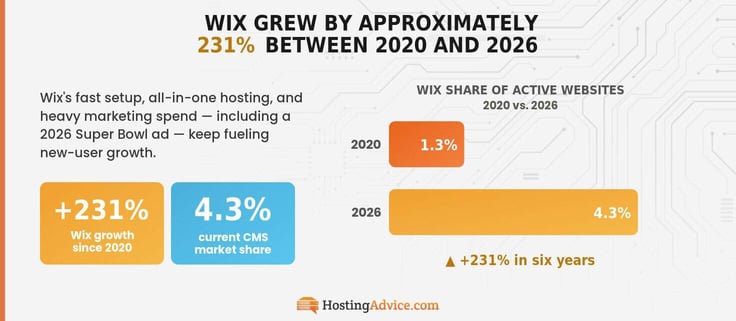
Wix’s product strategy is a winning one: an intuitive drag-and-drop editor, fast setup, and all-in-one hosting, security, and maintenance make it easy for non-technical users to build and maintain their site. Wix aggressively outspends competitors with a yearly $100 million marketing budget, and it’s working.9
Add to that AI as a front-door feature, the shift to more founders, content creators, and small businesses building websites themselves (accelerated by the COVID-19 pandemic), and the proactive marketing (take its $8 million ad at the 2026 Super Bowl, for example), and you can see why the new wave of site creators like it.10,11
14. Shopify Website Share Increased by About 174% Since 2020
In the same period as the last CMS market share stat, Shopify’s website share has increased by approximately 173.7%.6 While the same macro trends apply to Shopify’s growth, the core driver is different: Wix’s proposition is building a website easily. Shopify’s is to start and scale an online business.
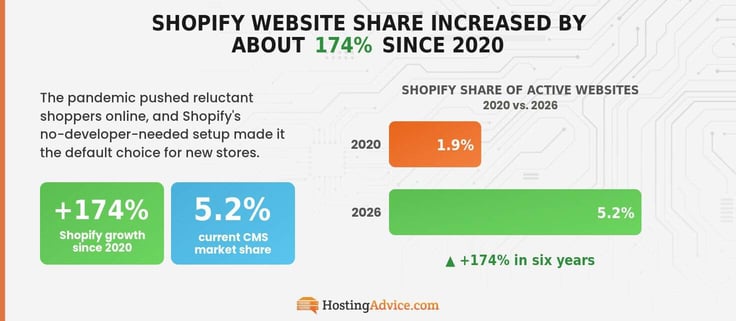
I’ll admit I was one of the late adopters of eCommerce — while I bought the occasional clothing item online, I preferred shopping at a mall. Now, I order almost everything online and only visit the mall to bowl and play “King of the Hammer!” The pandemic accelerated eCommerce. Businesses had to survive online or not at all — forcing even reluctant customers like me online.
Once people started buying online, it became a habit. Shopify makes it possible to set up an online store in hours, and you don’t need a developer. Better payment infrastructure, logistical setups, and product discovery pipelines through social media have caught up. Shopify made the most of what this shift created.
15. Joomla Usage Declined by Roughly 60% Over the Past Decade
I’ve already highlighted Joomla’s decline — its usage has decreased by around 60.6% since 2015.6 I know so many people on X using AI website builders to earn from their sites and tools. Why would any new user bother with its relative complexity? Joomla is AI-capable, since it’s an open-source platform.
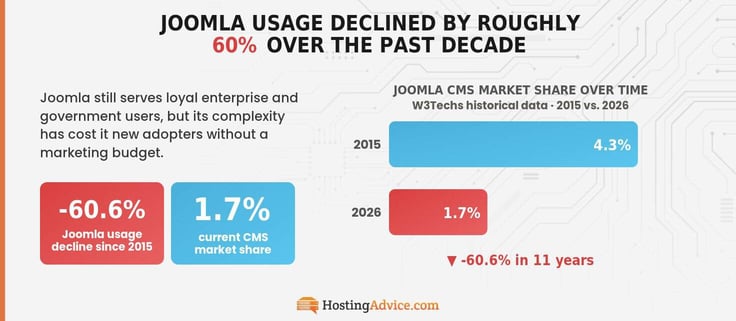
But it’s currently surviving on existing use cases. Mind you, Joomla does support AI through extensions — you still need to know how Joomla works to use them. It’s open-source, so there’s no massive corporate marketing budget to spread the word. It’s survived on merit and community-driven reach alone.
If anyone from the Joomla developer community is reading this, now’s the time to help Joomla reposition itself with a clear, intuitive AI-forward experience. Otherwise, the numbers could continue to decline.
16. Drupal Market Share Dropped by About 70% Since Its Peak in 2018
Speaking of repositioning, Drupal, another open-source CMS, was once even more complex to use than Joomla! You had to understand content types, fields, taxonomies, and system architecture before you could even get started.
Through an official AI initiative (announced in June 2025) and community-driven effort, a new version of Drupal, Drupal CMS, was launched in early 2026. Drupal Core is still available for advanced users and developers (and is as complicated as ever for non-technical users). With Drupal CMS, you can edit pages visually through Drupal Canvas and use integrated AI tools.
One of the AI features I like is AI page generation. While you can tell Wix to build a website for a bakery and it’ll generate a full site draft in minutes, Drupal can generate individual pages for you from prompts.
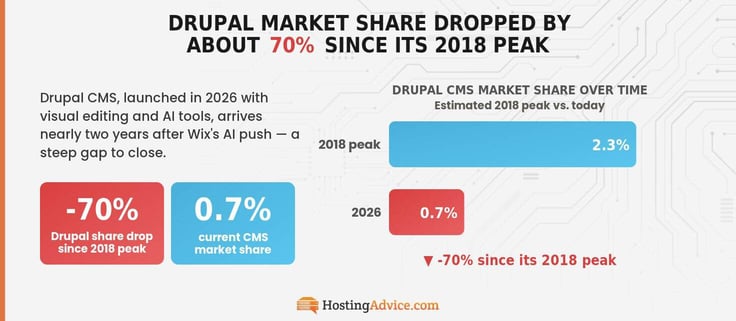
The thing is, it might take some time for the new look Drupal to make waves in the CMS market — if at all. For context, Wix launched its AI website builder in March 2024. Drupal launched its AI offering in January 2026. That’s a gap of nearly two years, in which Wix’s website usage increased from around 2.6% to 4.3%.
The early bird gets the worm. Drupal, on the other hand, has seen its share fall from 0.8% to 0.7% following the launch of Drupal CMS!10,12,13
17. CMS-Based Websites Represent 71.7% of Top One Million Sites
According to BuiltWith data, around 717,000, or 71.7% of the top one million websites use a content management system. Since around 70.8% of all websites are CMS-based, the top million show slightly higher adoption.10,14
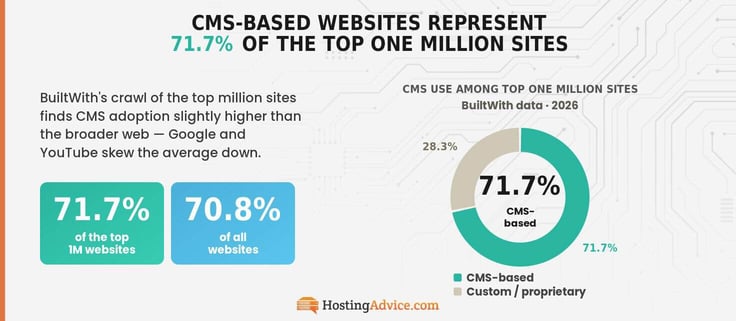
Like I mentioned earlier, many of the top websites — like Google, YouTube, and Facebook are custom-built and rely on proprietary systems with built-in content management tools. So, technically, CMS market share stats only capture traditional CMSs — not custom-built ones.
18. 10%+ of All Websites Use Website Builders
Let’s say you want to build a portfolio website but don’t know where to begin. It doesn’t make sense to watch YouTube tutorials on highly technical web coding — unless you want to learn HTML, CSS, and JavaScript and build a truly custom website from scratch.
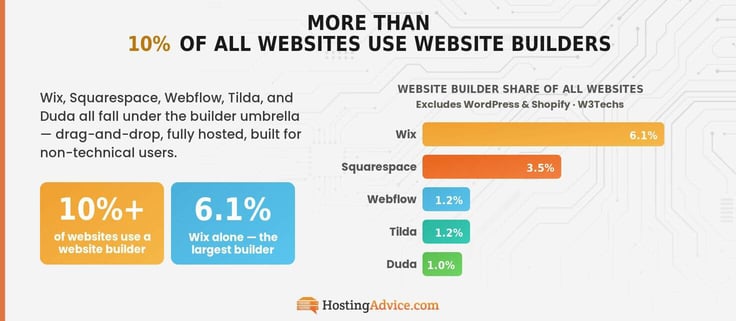
Many people prefer using drag-and-drop and AI-powered website builders like Wix, Squarespace, Webflow, Tilda, and Duda (me included).
It’s no secret that the rapid growth of many website builders has coincided with the AI rush — just refer to stats 13 and 14. More than 10% of all websites use a website builder (I haven’t included WordPress and Shopify, as they aren’t “pure builders”), and this figure is likely to grow in the coming years.6
19. Roughly 60% of WordPress Websites Use a Page Builder
While I didn’t include WordPress as a site builder in the previous stat, around 60% of its sites rely on page builders. You can use plugins like Elementor, WPBakery, and Divi to drag-and-drop elements and design pages visually — many of which now include AI features.
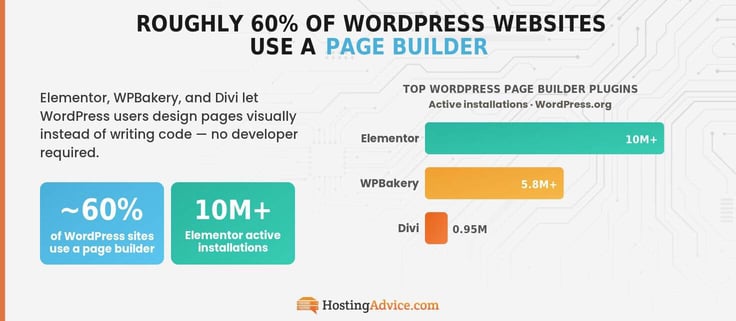
To put it into perspective, Elementor has more than 10 million active installations, followed by WPBakery (around 5.8 million), and Divi (about 950,000).15,16,17,18 Elementor is available for free, while WPBakery and Divi are paid plugins. It takes a bit more getting used to than Wix’s drag-and-drop site builder, but just as effective.
WordPress uses a Block Editor (Gutenberg) and easily integrates with advanced plugins for anything you can think of, from site security to professional newsletters to AI site builders. Its versatility makes it more attractive for those who want more power over the backend ownership of their website.
20. Only About 45% of WordPress Mobile Sites Pass Core Web Vitals
Google has defined three metrics under the umbrella term Core Web Vitals (CWVs):
- Largest Contentful Paint (LCP): 2.5 seconds or less to display main content
- Interaction to Next Paint (INP): 200 milliseconds latency for site interactions
- Cumulative Layout Shift (CLS): 0.1 score or less for unexpected layout movement
Each metric relates to webpage loading speed, interactivity, and visual stability, respectively. If your website passes all three metrics, you’ll have good Core Web Vitals.
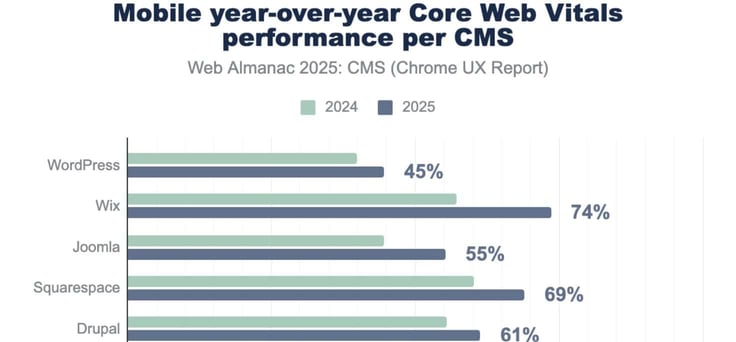
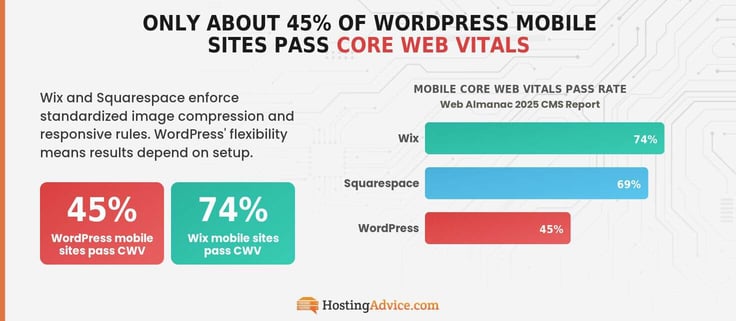
According to Web Almanac data, only about 45% of WordPress mobile websites meet Core Web Vitals. Wix and Squarespace websites fare better at 74% and 69%, respectively.15 This doesn’t mean WordPress sites are “poor.” Because of its flexibility, CWV performance depends on how well you set up your site.
With “closed” platforms like Wix and Squarespace, you get a more standardized performance baseline. For example, if you use several plugins and media files on your WordPress site, they increase your page weight and can slow your mobile performance if not optimized.
In comparison, platforms like Wix and Squarespace auto-compress images, auto-optimize layouts, and enforce responsive design rules.
Here’s your WordPress optimization checklist:
- Reliable web hosting: Use Bluehost, Hostinger, or SiteGround
- Lightweight theme: Choose a download size under 50 KB
- Compress images: Convert JPG or PNG files into the WebP format using Squoosh.app to resize them to the exact width and height you will display them at, or slightly larger.
- Compress or embed videos: Use HandBrake, or embed video links from YouTube or Vimeo.
- Enable caching: Use WP Fastest Cache and click on the “Delay JS” option to delay loading of non-critical third-party scripts (like ads)
- Use Cloudflare: a content delivery network (CDN) to reduce latency
- Clean your database: Regularly delete outdated revisions, duplicate records, and tables.
- Install Updates: Regularly check for updates for WordPress, themes, and plugins
Once you’ve ticked off everything on this list, you can test your Core Web Vitals on PageSpeed Insights. Remember, with great power comes great responsibility.
21. CMS Market Value Reaches Approximately $23 Billion Globally
With approximately 70.8% of all websites using a content management system, the CMS market is valued at around $22.9 billion according to Market Reports World — and is projected to reach about $40 billion by 2034.
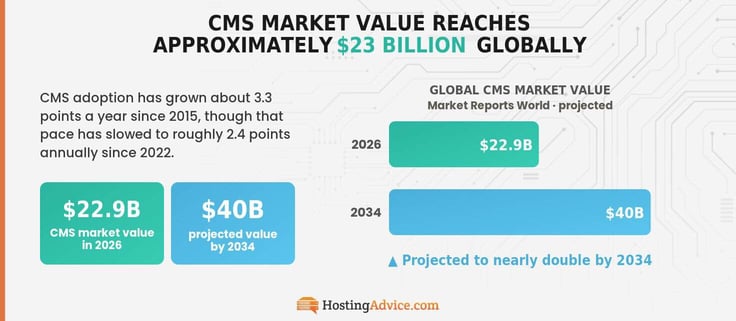
On average, CMS adoption has increased by roughly 3.3 percentage points each year (38.3% in 2015 vs 70.8% today). Linear estimations show that around 97% of websites will use a CMS in 2034. Although 70.8% CMS adoption is unlikely to hit that projection, as we factor in that many websites use custom-built systems — and will continue to do so.
A more realistic estimate is between 80% and 88% — gradual saturation is already happening, with just around a 2.4 percentage point increase per year between 2022 and 2026.10,19
22. Headless CMS Platforms Account for Approximately 58% of Enterprise CMS Adoptions
If you go through the W3Techs datasets I have referenced, you won’t find a single mention of Contentful, one of the most popular enterprise headless CMS platforms. You’ll also find that other popular options, like Sanity and Strapi, have a CMS market share of less than 0.1% each.
Headless CMS Platforms are a content-first architecture that uses APIs, instead of a built-in presentation layer, to separate the backend from the frontend for mobile apps, websites, and smart devices.
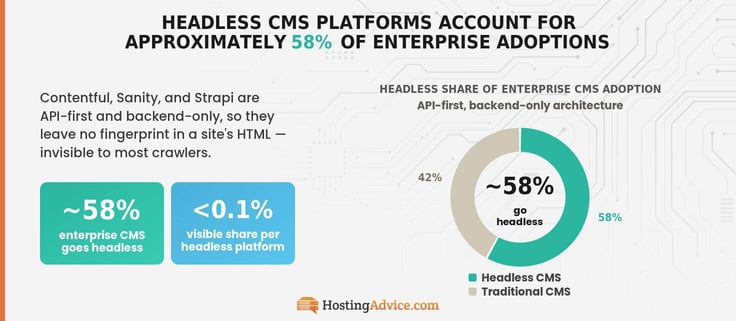
So, technically, while headless CMSs likely have a larger footprint, they appear underrepresented. The reason lies in their architecture: these API-first platforms are backend-only, meaning they don’t leave fingerprints in HTML. Basically, you aren’t tied to the CMS for website design or frontend rendering, like in the case of traditional CMSs.
You create content in the backend and can deliver it to any frontend (websites, apps, etc.) through APIs. In other words, any crawler that relies on frontend signals (HTML, scripts, metadata) might not be able to detect them, since the frontend is decoupled — it hides the CMS behind it.
To conclude, this might mean that the percentage of CMS-powered websites out there might be even higher than 70.8%, since around 58% of enterprise CMS adoptions go headless!3,20
What These CMS Market Share Statistics Mean for Website Platforms
All things said and done, you need to reflect on which platforms align with your goals. Here are a few questions to ask yourself:
- Are you building alone or with a team?
- What’s your budget, and how quickly do you need a site?
- Do you or your team have the technical capabilities to build a website from the ground up?
- Does a headless setup appeal to you?
- Would you rather have a framework in place and develop custom website elements through code or AI?
- Or do you think a simple website builder with AI integration is the way to go?
- Perhaps an AI website builder that’ll publish an editable draft through a simple prompt is your best option?
Answer these questions and you’ll have a clearer idea of the type of CMS you need. CMS Market Share statistics for 2026 show a consolidating landscape: WordPress dominates, Shopify and Wix are gaining fastest, and legacy platforms like Joomla and Drupal are shrinking as AI-first builders take over the entry-level market.
Here's how they stack up for your own site decision:
| CMS | CMS Market Share | Best For | Technical Skill Needed | Budget |
|---|---|---|---|---|
| WordPress | 59.6% | Full control, custom builds, blogs, WooCommerce stores | Low–High (scales with plugins/code) | Free core; pay only for premium themes/plugins/hosting |
| Shopify | 7.5% | Scaling a dedicated online store fast | None to moderate (apps/APIs for customization) | Subscription-based |
| Wix | 6.1% | Non-technical users, simple sites, AI-generated drafts | None | Subscription-based |
| Squarespace | 3.5% | Creatives, portfolios, minimalist professional sites | None | Subscription-based |
| Joomla | 1.7% | Complex, permission-heavy sites (government, intranets, membership systems) | Moderate–High | Free core; open-source |
| Drupal | 0.7% | Enterprise-grade, highly structured content sites | High (Drupal Core) / Moderate (new Drupal CMS) | Free core; open-source |
| Headless | ~58% of enterprise CMS adoptions (Contentful, Sanity, Strapi, etc.) | Multi-channel content delivery (web, mobile, IoT) via API | High (developer-driven) | Varies; often usage-based pricing |
From there, just pick one that I’ve covered in these CMS market share stats! Thank you for your time.
I invite you to read our in-depth guides on CMS platforms like WordPress, Shopify, Wix, and Squarespace, so you can make a more informed decision. Feel free to use our smart tool HostHelper™ to instantly access accurate, expert-backed answers drawn from thousands of in-depth guides and reviews, and follow us on social media for hosting, security, and tech tips!
Sources
1. https://w3techs.com/technologies/overview/content_management
2. https://www.netcraft.com/blog/march-2026-web-server-survey
3. https://wordpress.org/download/counter
4. https://www.internetlivestats.com
5. https://cmscrawler.com/tool/wordpress/
6. https://colorlib.com/wp/cms-market-share/
7. https://www.landbase.com/blog/cms-market-share-statistics
8. https://wordpress.org/plugins/woocommerce
9. https://mycodelesswebsite.com/wix-statistics/
10. https://w3techs.com/technologies/history_overview/content_management/all/y
11. https://www.techradar.com/pro/website-building/forget-seahawks-vs-patriots-wix-vs-squarespace-is-the-real-showdown-at-super-bowl-2026
12. https://www.drupal.org/blog/drupal-cms-20-is-here-visual-building-ai-and-site-templates-transform-drupal
13. https://www.gadgets360.com/ai/news/wix-ai-website-builder-chatbot-uses-text-prompts-launched-5181136
14. https://trends.builtwith.com/cms
15. https://almanac.httparchive.org/en/2025/cms
16. https://wordpress.org/plugins/elementor
17. https://wpbakery.com
18. https://www.elegantthemes.com/gallery/divi
19. https://www.marketreportsworld.com/market-reports/content-management-systems-cms-market-14722408
20. https://dataintelo.com/report/global-headless-cms-software-market