


Writer: Lynn Cadet


Editor: Lillian Castro


Reviewer: Cristian Lopez

Key Takeaways
Thanks to social media, anyone can have an online presence, whether you’re a daring acrobat or a cat that plays the piano unusually well. But before the cute and furry Insta profiles and the daredevil YouTube shorts, something more independent ruled the internet: personal websites.
In the mid-2000s, personal blogging was one of the main ways people chose to connect online. Since then, social media has largely overtaken the traditional “personal diary” blog space, also decreasing the visibility of their complementary asset: the legal-name domain, e.g., JaneDoe.com.
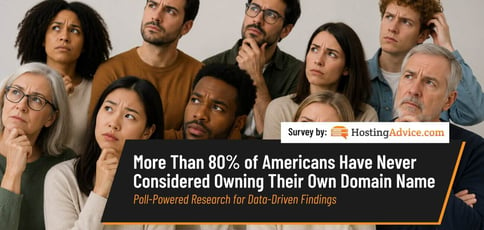
A recent HostingAdvice.com survey reveals that just 2% of Americans currently own a personal-name domain, while more than 80% have never even considered owning one. These findings suggest that fewer people are aware of domain names and their value in the age of social media.
While personal websites haven’t disappeared, it’s clear that social media’s expansion has weakened their appeal. Yet the personal domain name’s value still remains intact, as the need for identity ownership rises amid concerns about AI-generated content and impersonation.
Social Media Has Replaced the Personal Website for Many
While most people wouldn’t think twice about creating a social media account these days, the idea of setting up a website and owning a legal-name domain isn’t exactly at the top of mind for most people.
Most people have shifted their online “personal diaries” to vlogs, short-form video updates (stories), and community posts. It’s not difficult to understand why. Social media offers a level of visibility, ease of use, and accessibility that personal websites can’t provide.
For the everyday person, signing up for a social media account may feel easier and more accessible compared to building and sharing a website with others.
But where websites still have social media beat is in absolute control and ownership. With social media, you’re at the mercy of the platform. There’s the risk of shadowbanning or even sudden algorithmic penalties. Not to mention account hacks and the inability to recover your account.
As AI-generated search and online reputation continue to shape society, independently owned digital assets may become more important than consumers currently realize.
Millennials Are Most Likely to Care About Personal Domains
We found key generational variances among those who are aware of personal domains. Interestingly, millennials, specifically ages 35 to 44, showed the highest awareness among those surveyed.
Have you ever owned a domain name that uses your legal name?
- Never thought about it
- Own + active site
- Own + parked
- No, plan to
- No, squatter has it
Millennials were not only the most aware but also the most eager to buy a personal domain. When asked whether they had ever owned a legal-name domain, older millennials were the most likely to say they had considered it (27%) and reported the highest parked-domain ownership rate (3.8%) among the age groups.
Nearly 1 in 5 (19%) older millennials also said their preferred personal-name domain had already been taken by someone else, reinforcing their higher awareness.
Older Gen Xers follow millennials in awareness, with 21% reporting they had considered owning their legal-name domain, compared to 14% of boomers.
These findings may reflect the unique internet experience of these two generations. Older millennials and Gen X were probably the most eager to buy their own domains during the early open web era. Most millennials came of age during the rise of blogs, forums, and personal websites, which likely influenced their awareness of personal domain names.
Seniors Show the Least Interest in Owning Their Name Online
Baby boomers showed the least interest in owning their personal-name domain, reporting the lowest levels of ownership, future intent, and overall awareness.
Nearly 86% said they have never considered owning a personal-name domain, while only a small minority (2.4%) expressed interest in purchasing one in the future.
Baby boomers came of age well before the internet became a fixture of daily life, which may explain their lower engagement with concepts like domain ownership. For those who built their online presence later in life, if at all, the idea of staking out a personal domain may simply feel less relevant than it does for generations who grew up navigating the web.
Most People Think About Personal Domains Only After They’re Taken
One of the strongest findings in our survey was the number of people who knew a squatter had taken their domain name. About 1 in 7 (14%) respondents said a squatter had already taken their personal domain.
This trend was also consistent across age groups. A sizable share of respondents said a squatter had already taken their personal domain name in each generation. Here are the numbers:
- Ages 18-24: 14.3%
- Ages 25-34: 11.4%
- Ages 35-44: 19%
- Agess 45-54: 13.9%
- Ages 55-64: 14.2%
- Ages 65+: 11.8%
These results reveal not only the level of awareness each group has about their domain but also the timeline in which they become aware. Many respondents appear to become aware of personal-name domains only after discovering their preferred domain is unavailable.
Americans are finding out too late about their personal domain names. This suggests that consumers aren’t proactively searching for their domain names through long-term planning but may be acting reactively.
As Americans’ lives become increasingly digital, many aren’t taking the initiative to track or own the digital infrastructure connected to their names.
Legal-name domains aren’t only essential for professional use; they offer complete control over your digital identity. As AI-generated content, impersonation concerns, and digital reputation systems continue to evolve, independently owned identity assets may become increasingly important.
Methodology
This survey was conducted in May 2026 among 500 U.S.-based respondents. Respondents were selected from a third-party research panel.
To ensure the integrity of data collection, the researcher developed a proprietary machine-learning algorithm that can detect fraudulent responses early and remove inauthentic respondents immediately. The overall margin of error is ±3.1 percentage points at the 95% confidence level. Margins of error increase for subgroups such as age or gender.
For media inquiries, please reach out to dennis@hostingadvice.com.