



Writer: Joe Warnimont


Editor: Lillian Castro


Reviewer: Christina Lewis

Key Takeaways
- 7 out of 10 experienced developers say industry hype, not proof, drove their migration decisions.
- 76% of developers surveyed say they ran into hidden integration issues and complexities, despite migrating for reasons like performance gains and improved productivity.
- 86.6% of developers in the survey now rely on AI tools during migrations, with 81.8% saying it made the process easier.
Methodology: This survey was conducted in July 2025 among 500 U.S.-based software developers with at least five years of experience. These respondents have been on at least one team that migrated a production system to a different programming language within the past five years. Respondents were selected from a third-party research panel.
To ensure the integrity of data collection, the researcher developed a proprietary machine-learning algorithm that can detect fraudulent responses early and remove inauthentic respondents immediately. The overall margin of error is ±3.1 percentage points at the 95% confidence level. Margins of error increase for subgroups such as age or gender.
Only Half of Respondents Felt Their Programming Language Migrations Were Worthwhile
It sounds like a recipe for disaster: 71% of experienced developers admit their migration decisions were influenced more by industry hype than proven outcomes. A CTO goes to a conference, or reads a blog post, or gets “influenced” by industry experts on social media. Then before you know it, their entire development team is working to migrate an online store from PHP to Node.js, or a mobile app from Java to Kotlin.
I think following that type of hype is like going to a restaurant because a bunch of Instagram influencers told you the place was good. I’ve done it before, and it usually takes me to a place that’s made for taking good pictures, with a side of subpar food.
But here’s the plot twist. Our survey showed that 50% of those developers who committed to migrations said they actually felt it was worthwhile. Perhaps even more revealing: AI has become a trusty wingman for those migrations, with 86.6% of developers surveyed using AI during the process. Only 18% of those devs did not find that AI tooling made the process easier.
Our survey of 500 U.S. developers unveiled quite a bit about the state of programming language migrations, and below I’ll explore whether the hype behind it all is really worth it.
7 Out Of 10 Developers Were Inspired to Change Programming Language Through Industry Buzz
It doesn’t surprise me that 71% of developers say their consumption of hype led to a migration decision. You see this hype everywhere. Blog posts claim you need to chase the latest framework. Conference speakers present case studies of near-impossible performance improvements. Social media posts make it look like migrations will eventually lead to easy street for hiring the best talent.
Marketing is convincing. The more dramatic and narrative-oriented the better. The question, however, is whether the product being sold actually has value. In this case, surprisingly, yes it does. At least sometimes.
Half of all respondents who committed to those migrations claimed it added value. I appreciate this result for a few reasons. We often see the opposite of value from “impulse purchases.” I’ve bought far too many candy bars at grocery store counters, and all they gave me was a muffin top and a slightly smaller bank account.
Here, however, it’s possible the impulse migrations fueled by buzzwords and over-enthusiastic conference speakers may have been the push teams needed to modernize their infrastructures and clean house.
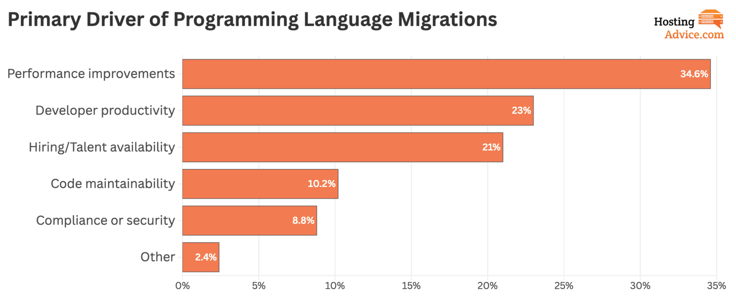
What Drove Teams to Migrate After Falling for the Hype?
- Performance boosts: 34.6%
- Developer productivity: 23%
- Talent availability for hiring: 21%
- Code maintainability: 10.2%
- Security or compliance: 8.8%
I want to clarify: These are percentages of what development teams hoped to achieve from migrations, not the results. So, you’ll be interested in examining their reported migration pitfalls to see the irony in their expectations. In short, performance boosts sometimes come from migrations, but 36.6% of developers also say performance regressions stand as one of the top migration pitfalls.
37% of Development Teams Had Performance Regressions
Although roughly half of all respondents claimed they were satisfied with their migrations, and many had high hopes of results such as performance boosts and developer productivity, our survey discovered some hidden costs of programming migrations that many people don’t talk about.
In my eyes, these results paint a picture of underestimation. And perhaps that’s a result of buying into cheaply available hype. It’s easy to jump into something exciting and forget about potential pitfalls. Well, developers told us the issues they encountered.
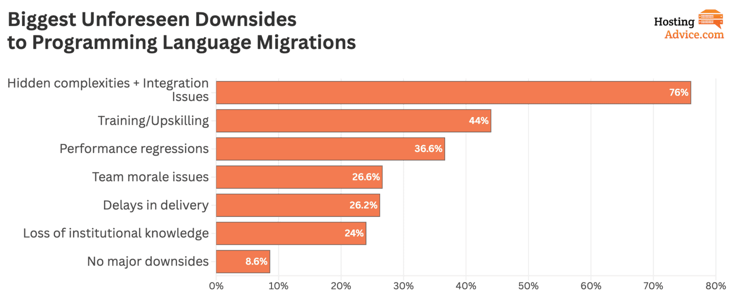
Reported Pitfalls from Migrations:
- Integration problems and hidden complexities: 76%
- Upskilling and training costs: 44%
- Performance regressions: 36.6%
- Low/decreased team morale: 26.6%
- Delayed delivery: 26.2%
- Erosion of institutional knowledge: 24%
Tying into my earlier discussion about the desire of developers to gain performance boosts with migrations, I assume it’s rather irritating when they see performance regressions as a result. In fact, all these pitfalls are concerning — especially the 76% figure for integration problems and hidden complexities.
Again, this may have something to do with starting migrations after the hype of it all. I could see lots of development teams walking into a migration with rose-colored glasses only to be met with issues like date/time handling differences or broken authentication flows.
71% of Developers Have Executed Two Migrations Within The Past 5 years
My biggest fear from the survey is that we’re creating a culture of “serial migrators.” One where constant technical churn is normal, when it’s probably just leading to more confusion and budget busting.
Here are the numbers:
- 71% of respondents have completed more than two migrations in the last five years
- 55% of development teams with over 1,001 employees said they have gone through more than three migrations in that same time period
- 38% of developers consider their teams “serial migrators,” completing three or more migrations in five years time
I truly hope this trend reverses because it’s clear that larger companies are simply turning the idea of migration into a sport. They need the best tech all the time. Otherwise, they won’t get the best talent, and their profits will slip, and the world will end. It’s a recipe for burnout, inefficient money management, and an environment where everyone is chasing the next technological high.
87% of Dev Teams Leveraged AI to Aid Migration Efforts
Love it or hate it, AI has wedged its way into the development world, particularly as a migration assistant. Our survey suggests that a whopping 86.6% of development teams used AI in some way to complete a programming language migration.
Here’s how our survey respondents said AI affected their migrations:
- Made the migration significantly easier: 40.8%
- Made the migration somewhat easier: 41%
- Saw no significant improvement with AI: 13.4%
That’s 81.8% of respondents who find AI at least somewhat helpful for a migration. I would call that a fundamental shift. With AI, people execute migrations drastically differently than they did five or 10 years ago — automating syntax conversion, showing developers how to learn new languages, automating with tools like GitHub Copilot for streamlined transfers from Python to Go.
A Paradox in How Migration Decisions Get Made
Are migration decisions made from the top down (by management) or from the bottom up (coming from developers and end-users)? Our results show a stark divide. In fact, management appears to make the call less than half the time.
The Origins of Migration Decisions:
- Top-down (by management): 47.2%
- Bottom-up (by developers and end-users): 27.2%
- Consensus-driven (by everyone throughout the organization): 25.6%
There’s obvious tension between management and developers with programming language migrations. It’s clear from our survey that not everyone agrees about where the actual decisions come from — or perhaps this is a true reflection of their origins. But that leaves me wondering why management sometimes decides and other times it’s a developer’s approval.
It’s an issue because decisions made by upper management often have different motivations than those made by developers. Migration decisions made by management often focus on talent acquisition and long-term cost savings. Developers, alternatively, like migrations to avoid technical debt and improve productivity.
What It All Means When Moving Forward with a Migration and How to Complete One
If I’m able to communicate any lessons from our study about programming language migrations, it’s that we shouldn’t immediately dismiss decisions just because they arise from unsolicited hype. The 50% success rate shows there’s promise, and it could simply be the push a development team needs to move past legacy systems.
Other lessons:
- Prepare for integration issues and hidden complexities: You can’t run from the fact that 76% of respondents said they actually encountered these issues after a migration. And it was unexpected.
- Embrace AI, at least for assistance: More than 80% of respondents saw value in AI during a migration, and it didn’t appear to eliminate jobs but expedite the work of current developers.
- Do your best to avoid serial migration: Even large corporations shouldn’t have to migrate more than once every five years.
And above all, you should know that perceived expectations may not align with your actual results: Due to hype-driven communications, you’ll plan for performance improvements or boosts in talent availability because of your migration. You may, however, find that something like the talent pool stays the same, yet you discover unexpected benefits like new language ecosystems or faster feature development.
For media inquiries, please reach out to press@hostingadvice.com.