




Writer: Ryan Frankel


Editor: Jordan Sprogis


Reviewer: Cristian Lopez

Key Takeaways
- Vercel’s newly public v0 API lets any hosting provider rent a full AI app-building agent instead of spending quarters building one.
- The API slots into surfaces hosts already own — control panels, onboarding flows, and support queues — with no model training or GPUs required.
- The catch: the friction-free deploy path lands customer workloads on Vercel’s own platform, not the host’s.
Site builders and hosting providers have faced the same awkward arithmetic for the past 24 months: Spend a few quarters of engineering work to build one or let your customers migrate to platforms that already have one.
DreamHost implemented Remixer, and versions were subsequently shipped by Wix and Squarespace, leaving all other providers waiting.
On August 5, Vercel offered waiting providers a third option: Rent one. The company delivered a completely programmable, headless interface to the same agent used for v0.app, over a production implementation of its v2 API. The first-party SDK is available as a standard npm package.
The result isn’t a “generate a code snippet” API, but rather complete access to the entire agent loop, including a stateful worker that parses, edits, and executes files in an isolated environment and returns results directly to the caller.
What was once just a conference demo can become a feature that hosting providers build directly into their own control panels, and all it takes is a single API call.
The Builder Is Now a Line Item
The chats.create API works synchronously: A provider sends a prompt and receives a URL for the running development server once a site has been built. That can be integrated directly into the interface provided to the caller.
For longer builds, the chats.createAsync API lets providers run the process in the background and retrieve the result through polling or webhooks, rather than leaving customers staring at a control panel. Meanwhile, chats.createStream provides a real-time record of activity performed by the agent, including its text outputs, file modifications, searches, and shell commands.
Three weeks in the hosting-platform AI-builder race
The major benefit to hosting providers is the ability of the chats.createFromRepo API, which can accept an existing GitHub repository or a collection of files in a ZIP archive. That means providers aren’t limited to offering AI as a new “build me a site” tool, but can also let customers use AI to modify and work on existing customer projects.
Vercel also built security considerations into the API: Preview tokens are short-lived, while the recommended implementation keeps API keys on the server with uses an intermediate proxy to control the browser’s operations. For hosting providers considering an AI-powered customer portal, those safeguards can protect sensitive API credentials and give providers greater control over how the AI interacts with the browser.
So What Does a Host Actually Build With This?
Think about the integration opportunities in the infrastructure that is already owned by the hosting company: the control panel, the onboarding workflow, and the support queue, all of which represent opportunities for integration of this API.
The control panel is an obvious choice to put the technology: Hosting providers could place an AI inference and a live preview alongside a file manager, allowing customers to make requests in plain language. For example, a small business owner could ask the AI to add a newsletter signup confirmation with an email and receive a preview URL within the same interface without ever opening a source code editor.
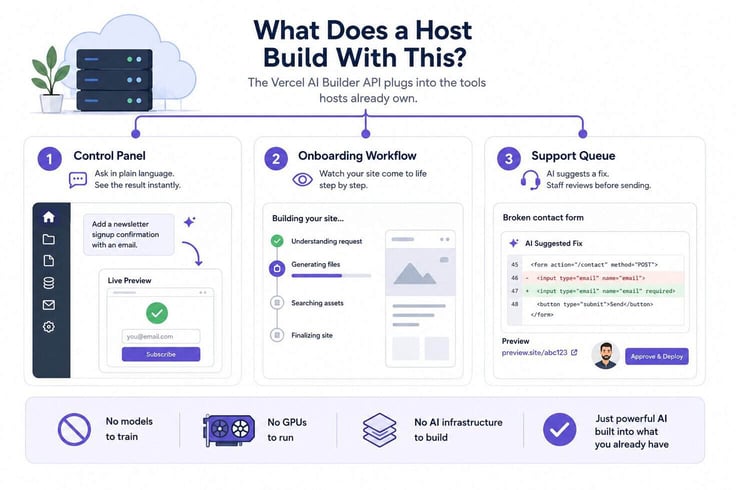
The onboarding workflow is a more subtle opportunity. The API’s synchronous, asynchronous and streaming options is virtually identical with the process of building a starter site. Users can watch as the AI’s work happens, including file changes and searches, while waiting for their site to be ready. That’s a much more informative experience than staring at a loading spinner.
The support queue may offer the greatest potential for added value. If a customer reports a broken contact form, for example, the API could retrieve the site from its repository and have the AI generate a proposed fix. The support technician can then review the changes through a preview URL before they’re delivered to the customer. Complete involvement of the support staff eliminates the 40-min delay associated with initial analysis of the problem.
None of these capabilities require a hosting provider to train its own model, operate high-speed GPUs, or build an infrastructure stack for AI applications from scratch.
House Style in a URL
Vercel provided team-scale access to its system within two days of API availability. On Aug. 7, the company launched Skill Packs at skills.sh containing agent skills obtained from the community, local directories, or public or private GitHub repositories. These Skill Packs can be shared as a single, unlisted URL and installed with a single npx command.
“Share that link with a single person, or your whole team to standardize the skills across your projects,” said the release notes.
For agencies or providers delivering white-label sites, the same approach can standardize how AI-generated sites are built. A single private URL can contain the agency’s component library, implementation conventions, and testing requirements, giving the AI a set of rules to follow. The resulting output is significantly more appropriate for the provider’s own standards rather than the generic v0 output. Vercel is essentially doing exactly what it sells to all of its customers.
In a case study published on the Next.js blog on Aug. 6, members of the v0 team used an agent based on a skill to eliminate slow transitions between pages. The agent wrote failing test cases, applied corrective actions, and repeated the process until all routes passed, producing 16 test conditions for purposes of regression testing.
The philosophy behind the approach was summed up by Jude Gao, the case study’s author: “An agent can write any code it wants to, but a framework’s job is to constrain it so it produces better UIs than it would on its own.” Vercel is applying exactly the same philosophy that it has sold to all other users.
The Catch: Whose Cloud Does It Ship To?
If a hosting provider uses chats.deploy, the resulting site gets deployed to Vercel’s infrastructure. For a hosting provider that integrates the API into its own control panel, that could ultimately mean sending customer workloads to a competing platform.
Providers can obtain the resulting files and implement them on their own technology base, but the course of least resistance results in use of Vercel — and that’s by design. This reflects the major difference between this release and all other activities of an extremely busy 2-week period. Cloudflare launched its open-source Cloudflare OS on the same day to provide a staff-based workspace rather than a headless interface for application builders.
In contrast, DreamHost took the opposite approach in July, and added capabilities for AI-based video creation to Remixer, its fully-controlled application builder.
“Most website builders hand you a blank page and wish you luck. Remixer would rather do the staring-at-a-blank-canvas part for you,” said Ralph Castro, DreamHost’s vice president of product, in the announcement.
DreamHost is betting that owning its application builder will keep customers on its platform. Vercel is betting that owning the API — and the infrastructure behind it — will keep deployments flowing through Vercel. For hosting providers, that creates a strategic choice: own the AI experience, or build on someone else’s.
Should it develop its own application builder, obtain access to an application builder from another provider, or remain completely inactive? Access to an application builder is now easier to obtain, but also represents a customer relationship that is managed by agents and by infrastructure controlled by other providers.
It will soon be known which provider is most comfortable with these conditions. A large managed WordPress provider could introduce its own customer-facing application based on v0 technology, while Cloudflare could respond with an agent-based development API of its own. If that happens, hosting providers that way too long may find themselves competing not only on infrastructure, but on who controls the AI layer sitting between customers and their websites.
