


Writer: Jordan Sprogis


Editor: Lillian Castro


Reviewer: Cristian Lopez

Gamers are no longer just teenagers glued to a console anymore: They’re parents, grandparents, mobile players, social players, and pretty much everyone in between. And recent data suggests a much more interesting picture of who plays video games, how often they play, what they’re playing on, and why they keep coming back.
There are hundreds of millions of players in the U.S. alone, billions more worldwide, and an industry generating enough revenue to make “it’s just a hobby” officially sound a little dated. So, instead of rehashing the same old “gaming is a $X billion industry” statistics (OK — there’s one), we dug into recent research to find some of the more surprising numbers hiding underneath the most common headlines.
Here are 21 gaming statistics that might make you rethink what a “gamer” actually looks like.
1. 62% of the U.S. Population Plays Video Games Every Week
A whopping 212.3 million Americans play video games every week1, which is about 62% of the entire American population. It looks like the audience is still growing, with weekly gaming participation increasing by 7.2 million people (3%) between 2025 and 20261.
2. The Average U.S. Gamer Is 37 Years Old
The average U.S. gamer is 37 years old, with 71% of Millennials and 56% of Gen X playing every week1, meaning a huge share of today’s players have carried gaming with them from childhood or picked it up later in life.
3. Nearly a Third of Americans Ages 81 to 90 Play Video Games Every Week
Depending on how many grandparents you have, this one might not surprise you: 32% of Americans ages 81 to 90 play video games every week1. Video games have somehow become a multigenerational pastime in a way that few other forms of entertainment have.
4. 75% of American Parents Play Video Games Every Week
Parents aren’t just buying their kids’ consoles — they’re playing them too! More than 70% of American parents play video games every week1. Most (81%) also play with their children, while 52% play with their children as frequently as at least once a week.
As for the why, it’s probably because nearly half (49%) of parents whose children play games agree gaming teaches important skills, like problem-solving and creative thinking1. Yup, sounds like a perfectly defensible response to late-night gaming.
5. 80% of Video Game Players Play on Mobile Devices
No longer do you need a gaming PC or a $500 console you nearly trampled someone for on Black Friday: 80% of video game players play on mobile devices, making mobile gaming the most widely used platform across age groups1.
6. 78% of Gen Z Gamers Have Purchased In-Game Content
Most Gen Z gamers (78%) say they’ve purchased in-game content, compared to 69% of Gen Alpha gamers and 67% of Millennial gamers1. Among these players, the median monthly spending is $20. Whether that’s a battle pass, DLCs, or something else, in-game purchases are alive and well, even in free-to-play games.
7. 45% of Teens Play Video Games but Don’t Consider Themselves Gamers
Nearly half of teens who play video games (45%) don’t consider themselves “gamers”2.
Only about 4 in 10 teens actually use that label for themselves, suggesting that playing games is less of an identifier and more of a normal form of entertainment.
8. Discord Reaches 44% of Teen Gamers
Many teen gamers use platforms built around connecting with other players, with 44% saying they use Discord, compared with 28% of teens overall (including gamers and non-gamers)2. Twitch is also more common among teen gamers, with 30% using the platform compared to 17% of teens overall.
9. 72% of Teen Gamers Play to Spend Time With Other People
Gaming is, unsurprisingly, a very social activity for many teens. More than 70% of teen players say spending time with other people is one reason they play, while 89% say they play with other people either online or in person2.
10. 41% of Teen Gamers Say Gaming Has Hurt Their Sleep
This one probably doesn’t come as much of a surprise: 41% of teen players say that gaming has hurt their sleep quality and schedule2.
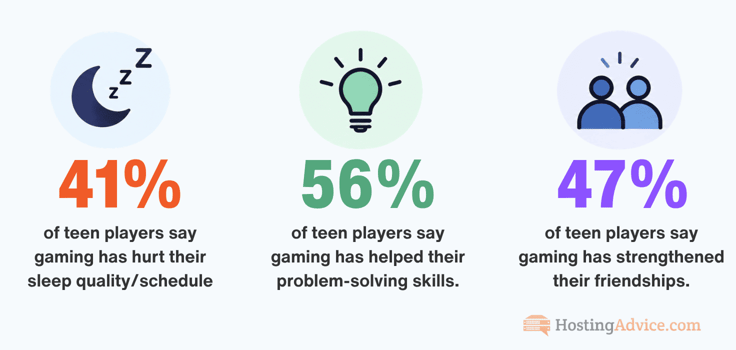
But gaming isn’t all late nights and lost sleep. More than half of teen players (56%) say gaming has helped their problem-solving skills, while 47% say it’s strengthened their friendships2.
11. Gaming Harassment Is a Problem for 80% of Teens
The social side of gaming does have a dark side: 80% of teens say harassment over video games is a problem for people their age, with 41% of teen gamers saying they’ve been personally called an offensive name while playing2.
12. 27% of Teen Gamers Play Across 4 or More Device Types
The modern gamer isn’t loyal to one screen: Nearly one-third (27%) of teen gamers play across at least four types of devices, while another 49% use two or three devices2.
How Many Devices Do Teen Gamers Use?
Most teen gamers play across multiple types of devices.
Just 8% play on one type of device. Consoles remain popular, but smartphones are right behind them.
13. The Global Games Market Is Projected to Reach $213.9 Billion in 2026
The global video games market is projected to generate $213.9 billion in revenue in 2026, up 6.1% from 2025. Mobile gaming accounts for the biggest slice at $121.1 billion (or 57% of the market), followed by consoles at $46.9 billion and PCs at $45.9 billion3.
14. Console Gaming Is Projected to Grow 5.1% in 2026
Console gaming is projected to grow 5.1% year over year in 2026, reaching $46.9 billion in revenue3. That’s slightly behind mobile, which is projected to grow 6.8% and PC at 5.3%. The forecast suggests that the launch of “Grand Theft Auto VI” in November 2026 helped play a role in these purchases.
15. China and the U.S. Account for 52% of Global Game Spending
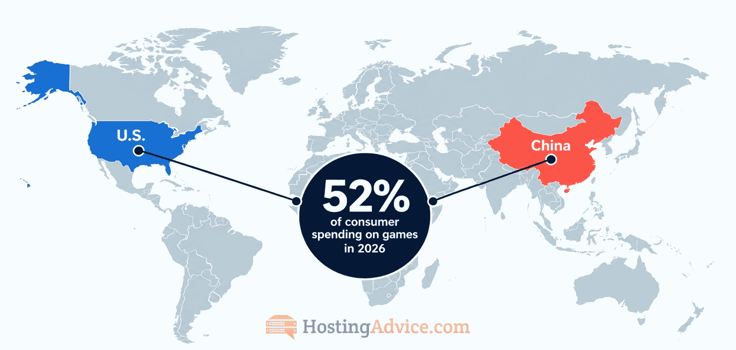
Gaming is global, but the biggest markets still account for a huge share of the money. China and the U.S. are expected to account for 52% of consumer spending on games in 20263.
16. 78% of American Adults Say Video Games Provide Stress Relief
Video games can be stressful, sure, but 78% of American adults say video games actually provide stress relief4. Another 85% say that gaming is fun, 81% say it brings them joy, and 79% say it provides mental stimulation. So yes, sometimes a video game makes you want to yell at your screen. Other times, it’s exactly what helps you unwind after a long day.
17. Counter-Strike 2 Is The Most Popular Steam Game
Counter-Strike 2 is the most-played game on Steam, with 1,140,697 active users5. Steam's all-time peak was from March 2026 when Crimson Desert and Slay the Spire 2 games came out, with 42.68 million players in one month.
18. Roblox Has 123 Million Daily Active Users
Roblox is more than a game. It’s a platform where people can play, create, and socialize — and it has an average of 123 million daily active users, as of Q2 20265.
Roblox’s Audience Is Getting Older
About 64% of Roblox users were 13 or older in Q2 2025.
- 13 or older
- Under 13
Despite its reputation as a kids’ platform, its audience is getting older: In Q2 2025, about 71 million Roblox users were 13 or older, compared with about 40 million younger users6.
19. 67% of Players Say Video Games Help Them Meet New People
Nearly 70% of global players (ages 16-35) say they’ve met a good friend, spouse, or significant other through video games.7 And it’s not just about casual online connections: 73% say video games have helped them feel less isolated and lonely.
20. Gaming Genres Vary by Generation
The genres that video game players gravitate toward vary greatly by generation. Arcade games ranked first among Gen Alpha players at 64%, while action games followed at 60%, and puzzle games at 56%8.
Puzzle Games Get More Popular With Age
Preference rises steadily across generations, from 56% of Gen Alpha to 72% of Boomers and Silent Generation players.
Gen Z shows a similar preference for arcade and action games, while shooters round out their top three.
Among older generations, however, puzzle games take the lead. Puzzle games are the top genre for 61% of millennials, 66% of Gen X, and 72% of boomers and Silent Generation players. Skill and chance games also gain ground with age, played by 39% of Gen X and 53% of boomers and Silent Generation players.
21. 73% of Parents Would Rather Their Kids Play Games Than Use Social Media
Parents aren’t exactly known for encouraging more screen time, but video games appear to get a pass from a surprising number of them: 73% of parents say they would prefer their children spend time playing video games rather than on social media9.
Data Sources
- https://www.theesa.com/two-thirds-of-americans-play-video-games-every-week-according-tonew-report-from-the-entertainment-software-association/
- https://www.pewresearch.org/internet/2024/05/09/teens-and-video-games-today/
- https://newzoo.com/articles/2026-global-games-market-key-numbers
- https://www.theesa.com/resources/essential-facts-about-the-us-video-game-industry/2026-data/
- https://www.demandsage.com/most-played-games-right-now/
- https://www.statista.com/statistics/1192573/daily-active-users-global-roblox/
- https://www.theesa.com/global-report-video-games-transcend-entertainment-affect-positive-change-in-players-lives/
- https://www.theesa.com/wp-content/uploads/2024/05/Essential-Facts-2024-FINAL.pdf
- https://respawn.outlookindia.com/gaming/gaming-news/esa-why-parents-prefer-video-games-over-social-media-for-kids