



Writer: Jordan Sprogis


Editor: Lillian Castro


Reviewer: Cristian Lopez

Key Takeaways
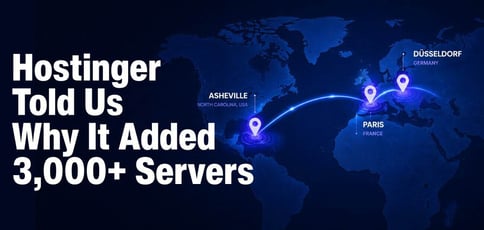
Hostinger recently secured more than 3,000 servers across Düsseldorf, Germany; Paris, France; and Asheville, North Carolina. That’s a lot of servers, so we went straight to the source to find out why the hosting provider wants so much more capacity and why it chose these three particular locations.
When I spoke Aivaras Šimkus, who’s the chief operating officer at Hostinger, he explained that the longer-term effort is to keep up with customer growth. The 3,000-plus servers will give the company the capacity to eventually go beyond 7 million customers, up from the more than 5 million in August 2026.
The 3,000-plus servers are also Hostinger’s largest server order to date, according to the official press release. Hostinger says the batch gives it enough capacity to cover its needs for the full year.
Server orders by year
Hostinger server orders from 2022 through 2026
"We chose these locations to strengthen our presence in key markets and bring our infrastructure closer to customers," Šimkus explained. "Paris expands our existing footprint in France, Düsseldorf establishes a new location in Germany, and Asheville increases capacity while upgrading the facility to our latest infrastructure standard."
Hostinger didn't just choose these places out of thin air, of course. They're strategically located where there's the most demand. "Our main focus is continuing to expand our global infrastructure so we're as close as possible to our customers," Šimkus said.
But adding thousands of servers isn't exactly easy and it's definitely not getting any cheaper.
Hostinger noted server costs have risen 5-6x over the past year, depending on the configuration, while some infrastructure components are 6-8x more expensive than they were in 2025. Lead times have also stretched from a few weeks to around 30 weeks since last year, with some manufacturers already sold out for the year.
"We face the biggest challenges around RAM, NVMe SSD storage, and CPUs. Those components have seen the longest lead times and the strongest pricing pressure as demand for server hardware has increased across the industry," Šimkus explained.
Industry research by TrendForce shows that server DRAM contract prices will rise sharply in Q3 2026 and continue into 2027 thanks to AI infrastructure demand. CPUs are feeling it as well, with Reuters reporting that Intel and AMD have signed longer-term server CPU supply agreements as demand and prices climbed, with some CPU prices in China rising more than 40% since the beginning of 2026.
"Higher infrastructure costs naturally put pressure on the entire industry," the COO said. "Every company will make its own decisions, so we can't speculate on how others will respond, but the market is certainly operating in a much more expensive environment than it was a year ago."
