




Writer: Jordan Sprogis


Editor: Lillian Castro


Reviewer: Cristian Lopez

Key Takeaways
- A small host formalized a “fair pricing charter,” promising no surprise hosting or domain increases on its platform.
- In an industry where promo pricing rarely reflects long-term costs, there’s a growing frustration among hosting clients.
- Most people don’t expect prices to stay flat, but they do expect to know what they’re signing up for before checkout.
Unpredictable renewals and steep post-promo price hikes have become a familiar frustration for web hosting customers.
WebDaddy Pro, a hosting provider out of Texas, announced a “Fair Pricing Charter,” promising no hidden fees, no renewal markups, and identical pricing for new and existing customers.
“At WebDaddy Pro, we believe in keeping things simple and honest. Your plan stays at the same rate year after year — only changing if our core costs significantly increase,” according to the company.

On its own, the announcement is admittedly modest. But it does stand directly in front of the bigger picture that’s happening across the hosting market: Pricing distrust has become such a common pain point that some providers now feel the need to formalize their promises in writing.
For a long time, hosting clients learned to read hosting prices with a caveat. They understand that the low introductory rate was never the real price and that renewal hikes were expected. Many “optional” features turn out to be required, leaving customers to pay extra for the basics.
This is a model that worked for years when web hosting was usually cheap and simple. But as the industry enters a new era — one where security and automation are now central to hosting, and trust harder to earn — price hikes aren’t something that many hosts can hide behind for much longer.
When Trust Reaches a Breaking Point
Introductory pricing has been a standard industry practice for decades. But the gap between promotional, introductory pricing and the actual long-term costs has widened, and everyone’s starting to notice.
Part of it is the economy. Part of it is that small businesses are now expected to pay for security, backups, performance plugins, SaaS software, and AI features in addition to hosting.
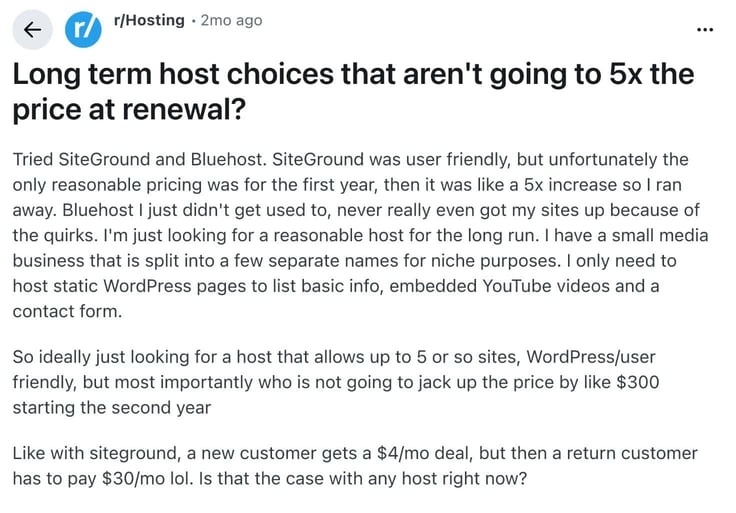
Take a look at the past couple of years and complaints about renewal hikes are common across hosting forums and Reddit threads. It’s not unusual for users to regularly warn newcomers to “check the second-year price” before signing up.
Frankly, it’s really not a great time for the hosting industry to push clearer pricing. The market itself is very crowded, and with thousands of hosting providers all over the world, aggressive introductory pricing is how they stood out from the rest. It’s a customer acquisition method as old as time.
But lately, the economy has been less than steady. Energy prices have shot up, data centers housing AI workloads are sprouting out of the ground, GPUs cost an arm and a leg, and security, licensing, and LLM training are just adding pressure.
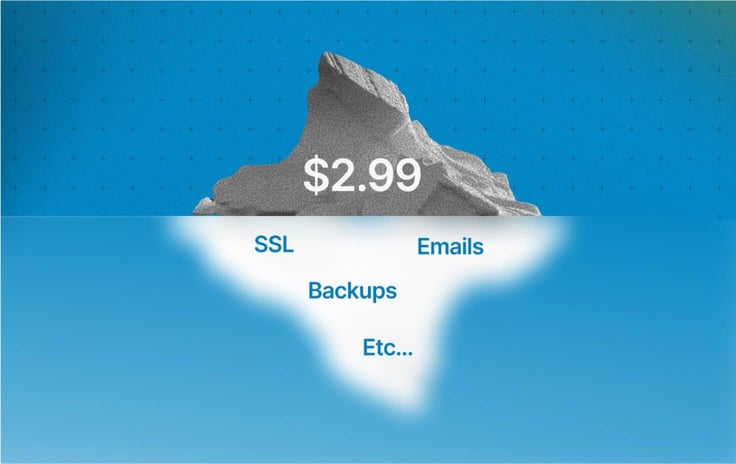
A host can’t possibly charge $2.99 a month for SSL, domain, hosting, security, automated backups, caching, and the whole shebang.
But today’s hosting customer is a lot more informed than they were a decade ago. They’re more likely to research renewal pricing before committing. They share negative experiences publicly.
And in turn, they’re far less tolerant of surprises.
What “Transparent Pricing” Actually Means
None of this means that hosts should try to keep their prices flat forever. Customers just expect honesty about when, why, and how prices change.
For some, that’s a perfect opening. For example, Cloudways openly markets itself as the best alternative to GoDaddy, arguing that GoDaddy’s pricing changes after signup and pushes extra fees for features Cloudways already bundles into its core price.
But transparency means different things depending on the provider.
For some, it simply means displaying renewal rates up front instead of burying them in the fine print. A lot of hosts are doing that these days — where you’ll see smaller or perhaps less opaque text next to the introductory pricing showing how much you can expect to pay post-intro price.
Others emphasize the flat or all-inclusive pricing. Platforms like WordPress have leaned into that. In fact, its parent company, Automattic implores hosts to show the real cost up front and avoid selling add-ons as optional when they’re functionally required.
Clarity — not policy jargon — seems to be one of the biggest blocks.
Let’s look at HostGator. It clearly flags that its introductory pricing isn’t the actual long-term price: There’s a small asterisk next to the promotional rate that shows what the plan is expected to cost after the first term. Click it and you’ll see a short explanation noting that the price only applies to the first invoice.

But the same disclosure also points out that VAT isn’t included in the advertised price and may be charged separately depending on where the customer is located. This means that even though HostGator’s regular pricing is $10.99/month, customers will see extra fees (and won’t know what they are until they’ve arrived).
It’s a good example of how renewal pricing can be disclosed without being especially easy to find or understand, depending on how closely a customer looks. Perfectly legal, just something customers can miss.
Very few hosts actually formalize pricing commitments. That’s why WebDaddy Pro’s announcement draws attention at all; now, this won’t stop price hikes across the board and it may not even inspire the masses to follow suit.
But it does make it clear that providers are becoming more aware of the fact that customers no longer take pricing at face value.
