



Writer: Jordan Sprogis


Editor: Lillian Castro


Reviewer: Cristian Lopez

Key Takeaways
Every year, more video games disappear: A study from a few years ago found that 87% of classic video games released in the U.S. are no longer commercially available. So if you didn’t buy them years ago, you’re left digging through used game shops and eBay listings.
This is one of those things that nobody seems to talk about until it actually happens. When you buy a game online, a digital library is intangible; it’s held in the hands of whoever published it. So when you pay $70 (soon $80, thanks to GTA 6) for a new game, you’re basically paying for the right to play it, not to own it.
Game publishers are within their legal rights to pull that access whenever they decide to. No refund, no credit, no server alternative.
It's happened dozens of times already, including for Ubisoft's "The Crew." When the publisher shut down its servers in March 2024, the game went fully unplayable, even for the people who'd already paid for it. The backlash is what birthed Stop Killing Games (SKG), the campaign YouTuber Ross Scott launched, which argues publishers shouldn't be able to render a purchased game permanently unplayable by shutting down its servers.
Two years since its inception, it's capturing the attention of American and European lawmakers. HostingAdvice spoke with indie game developer James Zinn and BerryByte founder Imad Qadri about where the movement could go, if anywhere at all.
SKG Takes Its Case to Brussels
SKG's biggest milestone came through a European Citizens' Initiative (ECI), which requires the European Commission to respond once a petition reaches 1 million verified signatures. In January, SKG crossed that threshold with nearly 1.3 million signatures.
Where SKG's 1.29M Signatures Came From
- Germany
- France
- Poland
- Spain
- Netherlands
- Italy
- Rest of EU (21 countries)
"Licensing is the tough one and it's mostly out of our hands. Even the European Commission basically said IP rights were the reason they wouldn't force publishers to keep games playable," Qadri points out.
He's referring to the European Commission…which unfortunately ended up denying SKG's ask to make games playable even after it reaches end-of-life.
The EC explained it couldn't just propose this legislation because already under existing EU law, rights holders have exclusive control over their creations, including the servers and data. The Commission said it would develop a voluntary industry code of conduct for game end-of-life by the end of this year.
Scott's response, more or less, was a shrug. Within hours, SKG pivoted to its backup plan: EU's Digital Fairness Act (DFA), which is designed to improve consumer protection laws around digital products and services.
The good news about this is that the DFA will be a live bill so it can be amended as it moves through Parliament. SKG says 45 members of the European Parliament (MEPs) have already expressed support.
Meanwhile, similar bills unfold in California. The state's Protect Our Games Act (AB 1921) would require publishers of certain server-connected games to offer alternatives if support ends, like an independently playable version or a refund. The bill passed the California Assembly in a 43-16 vote but recently stalled in a Senate committee following opposition from the ESA. It was granted reconsideration, though -- so we'll see where we are soon enough.
Publishers Still Own Everything
Publishers have shared that they're concerned about losing ownership because of liability: Video Games Europe and the Entertainment Software Association (ESA) have argued that preservation mandates could create new piracy, security, intellectual property, and liability concerns.
A private server could be modified to bypass protections, leak proprietary technology, or host content the original publisher has no control over, all while continuing to operate under its game and brand.
Ubisoft has also argued that requiring companies to provide private-server tools could mean additional development and maintenance costs while forcing them to relinquish control over technology and copyrighted assets they would otherwise have retired alongside the game.
Stop Killing Games isn't necessarily asking companies to operate unprofitable servers forever, but making a game playable without them can require work of its own. Depending on how a game was built, publishers may need to develop an offline mode, separate proprietary backend systems from the parts that can safely be released, or package server software for players and hosting providers.
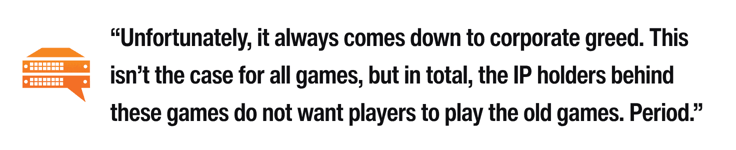
"Unfortunately, it always comes down to corporate greed," Zinn says. "This isn't the case for all games, but in total, the IP holders behind these games do not want players to play the old games. Period."
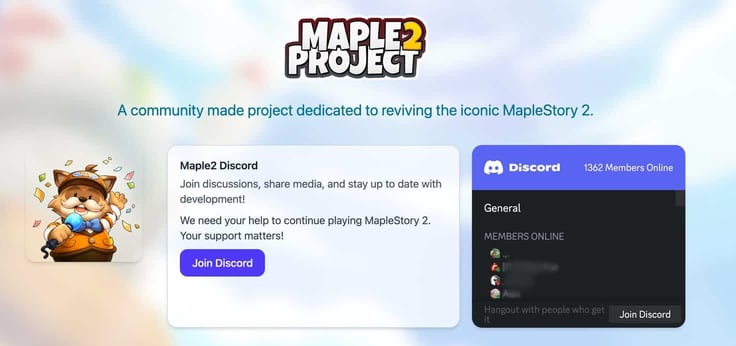
When Nexon shut down "MapleStory 2," fans launched Maple2.net, an open-source, fan-run private server. It's mostly legal — but only because the publishers of this fan server follow the legal line very closely; the game still involves a lot of MapleStory 2 elements and environment.
So no, not every game can be saved. But Zinn believes many more could survive than people realize. Online games like "Minecraft," "Hytale," and "Palworld" let players host their own servers.
And if more publishers went the route of offering dedicated servers to continue playing even after it's discontinued, companies like Qadri's is exactly where hosting providers come in.
"Every game that becomes self-hostable after a publisher walks away is another game we can keep alive and another community looking for somewhere to run it. Games that would otherwise just die suddenly get a long tail," Qadri says.
Long Live the Disc...?
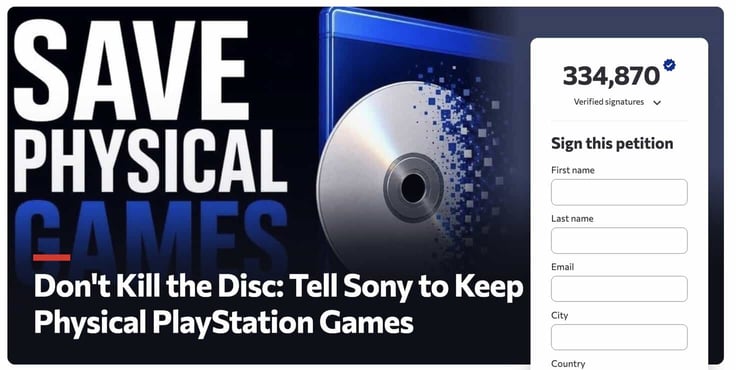
When Sony announced it would stop producing physical discs for its first-party PlayStation games beginning in January 2028, it didn't take long for another preservation campaign to emerge.
"Don't Kill the Disc," a petition that has collected more than 334,000 signatures at the time of publication, is calling on Sony to continue releasing physical versions of its games rather than moving entirely toward digital distribution.
It's not just about being able to own something physical: Discs can also act as a decentralized form of digital rights management (DRM), giving publishers a way to protect their intellectual property without making a player's access entirely dependent on an online authentication server. As long as the hardware can read the disc and the game itself doesn't require an outside connection, that copy can theoretically remain playable, even if the publisher stops supporting it.
SKG is more or less asking the same thing: If players lose physical copies and publishers retain control over digital access, what exactly do consumers own when they buy a game?
"Due to the fact that many old games were preserved because we had them on CDs, our literal rights to these games are taken from us everyday when we only own them digitally — making preserving online games so much more important," says Zinn.
The Sims franchise is a perfect case study. EA re-released "The Sims" and "The Sims 2" digitally last year for the series' 25th anniversary. TS2's original disc release, meanwhile, is functionally unplayable on modern Windows without workarounds, because the copy protection it launched with doesn't run on anything built after Windows 7. Today, there's no version of TS1 or TS2 that just works.
Which is too bad, because as Qadri said: "Once you hand players the keys the game just keeps going way past whatever the publisher had planned. Modders, people running events, small communities — they all keep it going."
The Infrastructure Is Ready
If publishers do decide to release that control, they wouldn't have to build the next step from scratch. And that's where Qadri believes hosting providers can step in.
"If more publishers put out server binaries, hosts can have those games back up and one-click playable the same day," Qadri says. "The demand's there, the infrastructure's there, the only missing piece is upstream with the publishers."
From a developer's perspective, it's completely plausible. Zinn shared he's already designing future Blue Scarf Games titles — including his upcoming game — around peer-to-peer networking or community-hosted servers so players can continue playing even if official support ends.
"As a developer myself, and someone who has worked very closely with developer teams, it would not take me more than a few days to a week to pivot most multiplayer projects to some other form of suitable multiplayer connection, or even singleplayer," says Zinn.
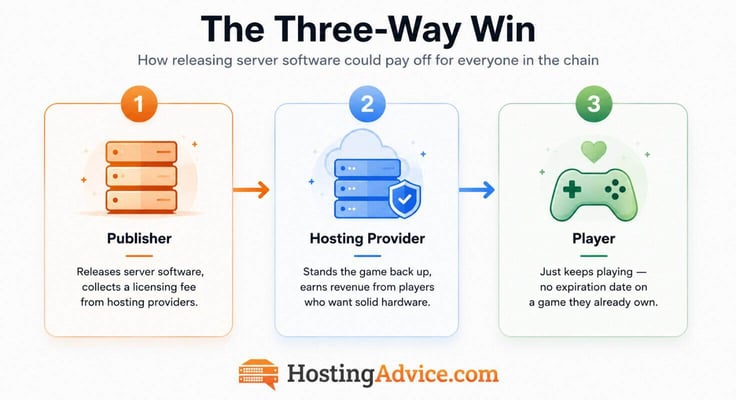
He sees it as a rare three-way win: the publisher collects a licensing fee from hosting providers, hosts profit from players who want to run their game on solid hardware, and players just keep playing.
"It all depends on whether the industry actually decides to release server software," Qadri says. "If they do, I reckon preservation could end up being one of the more interesting long term parts of hosting."
