



Writer: Jordan Sprogis


Editor: Lillian Castro


Reviewer: Cristian Lopez

Key Takeaways
When seven of the world’s biggest tech companies gathered at the White House to sign the Ratepayer Protection Pledge, they committed to covering the costs of all new power generation needed for their data centers, promising that ratepaying Americans wouldn’t see their electricity bills go up because of AI.
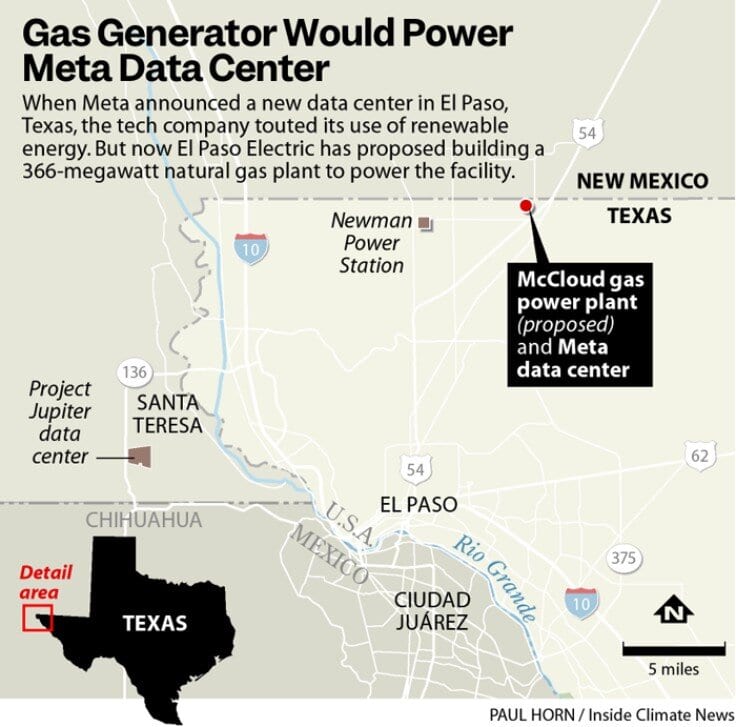
For Meta, this actually turned out to be a heck of a lot more complicated. The company recently expanded its planned data center investment in El Paso from $1.5 billion to $10 billion, so the local power company is now working to build a power plant to service it.
That plant is estimated to cost $473 million to build. Under the pledge, that’s something Meta will cover. But because El Paso Electric is a regulated monopoly, it’s allowed to recover infrastructure costs from all customers once those assets are approved and added to the grid.
Starting in 2027, Meta will cover the plant costs upfront during a one- to five-year “bridge period.” After that, the costs are passed on to ratepayers through electricity bills.
The plant in question is the McCloud Generation facility, a 366-megawatt complex running 813 modular gas generators on a 31-acre site. El Paso Electric expects McCloud to produce electricity at an average cost of $41.70 per megawatt-hour.
Regulated Markets Don’t Care About Pledges
The energy industry has been skeptical of the Ratepayer Protection Pledge since it was announced. It’s a decent set of principles, but it’s also unlikely to substantially change anything.
Part of the issue is state franchise utility laws: In El Paso, one regulated provider controls the entire power grid; it’s just how the city works.
So, the bridge period model is probably the most creative solution possible within these parameters.
But El Paso Electric argues that since Meta’s scale will help cover a larger share of the grid’s fixed costs, it will lower what other customers pay by $40 million a year collectively.
That $40 million figure is optimistic; the pessimistic one, which the El Paso City Council is worried about, is that ratepayers end up paying for the $473 million gas plant built for one company.
The El Paso situation will likely resolve without harm to residential ratepayers, but it’s the first fully documented instance of what happens when companies say they’ll avoid higher power costs, but in reality, they can’t guarantee that. Surely, more stories are coming.
Maybe adopting the bridge period model is the most workable solution in a regulated market. But it is, by design, temporary.
