













9 Tips for Choosing the Best Dedicated Server Hosting

Laura Bernheim
Contributing Expert
Dedicated hosting gives you an entire physical server dedicated to your website or application. That means maximum performance, security, and customization — but also greater responsibility for choosing the right hardware, operating system, and management level.
If you’re considering a dedicated server, the tips below will help you evaluate hosting providers, understand key features, and choose a solution that fits your traffic, performance, and budget requirements.
1. Understand the Basics — What Is a Dedicated Server?
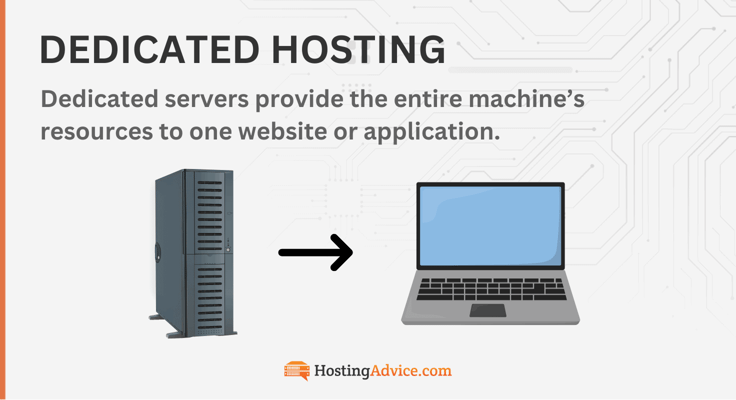
A dedicated server is just like any other kind of server, but only one individual or company is hosting websites or applications on it.
Rather than sharing bandwidth, storage, RAM, and other resources as you would in a shared hosting scenario, you get all of the computing power when you sign up for dedicated hosting.
For the sake of total clarity, virtual private server (VPS) hosting is when a single server is partitioned to act as several mini dedicated servers. You’re still essentially sharing with neighbors, but if any of them misuses the hosting environment, you’re not in danger.
2. Know the Benefits of Dedicated Servers: Do You Really Need One?
If you have a larger-than-life hosting budget, you may be tempted to splurge on the best hardware your money can buy. But first, you should understand the benefits of a dedicated server that are not available with shared hosting.
- Complete control: A dedicated server offers more control over the infrastructure than a VPS or shared server. You can control the operating system, security, and backups any way you see fit.
- Isolated resources: Unlike a shared server or a VPS, a dedicated server gives you all the available computing power. This may be worth it if you have hundreds of thousands of monthly visitors.
- Dedicated IP address: A dedicated IP address is helpful in large organizations that send out mass email communications. A dedicated IP gives you faster and more secure file transfer and makes it less likely your IP will get blocked because of the behavior of other sites on the server.
If your site doesn’t yet require the power of a dedicated server, a VPS hosting plan can provide similar control at a lower cost.
3. Do Your Operating System Homework — Linux vs. Windows?
The first decision to make is whether you want to run a Linux or Windows operating system on your dedicated server. Most hosts give you a choice, while some specialize in one or the other.
Which one is right for you depends on what kind of languages or databases you plan on using. For most websites and applications, Linux is the preferred choice because of its flexibility, performance, and compatibility with popular web technologies.
Best Linux Dedicated Server
Flexible and favored among many hosting customers, Linux is powerful and performance-oriented. The best hosts for Linux will include the operating system as well as support for Linux-friendly applications like Apache, MySQL, PHP, and various other programming languages.
I recommend InMotion Hosting for Linux dedicated servers. The company offers AMD EPYC and Intel Xeon hardware, rebootless kernel updates, IPMI access, and a 99.99% uptime SLA.
Best Windows Dedicated Server
Liquid Web offers your choice of operating system, and the company is one of my favorite Windows hosts. If you choose Windows hosting, you should have a specific reason for doing so — for example, you know you need to run software that is solely compatible with Windows. The Liquid Web Heroic Support team offers incredible reliability for both you and your server.
4. Dedicated Server vs. VPS Hosting: What’s the Difference?
Dedicated hosting and VPS hosting both offer more power and control than shared hosting, but they differ in how server resources are allocated.
With VPS hosting, a single physical server is divided into several virtual machines. Each user receives a portion of the server’s CPU, RAM, and storage while still sharing the underlying hardware with other customers.
Dedicated hosting, on the other hand, gives you an entire physical server reserved exclusively for your website or application. This eliminates resource sharing and delivers maximum performance, customization, and security.
| Feature | VPS Hosting | Dedicated Hosting |
|---|---|---|
| Server Type | Virtual server | Physical server |
| Resource Allocation | Shared hardware | Entire server |
| Performance | High | Maximum |
| Customization | Root access | Full hardware control |
| Cost | Lower | Higher |
For many growing websites, VPS hosting provides enough power and flexibility at a lower cost. Dedicated servers are typically best for high-traffic websites, enterprise applications, and resource-intensive workloads.
5. Cheap Dedicated Server Hosting May Not Be Best
It’s human instinct to hone in on the cheap deals during any shopping trip, but heed my advice: Hosting is not something you want to skimp on.
The good news is you can get high-quality but affordable services in the dedicated hosting market. Just know that you’ll get what you pay for if you aim for the cheapest in existence.
Don’t Buy Into “Free” Dedicated Servers
Repeat after me: There is no such thing as a free dedicated server — not one that can handle all the things that dedicated customers typically need their server to process, anyway.
If you fall into one of the free dedicated hosting traps, you’re going to wind up so frustrated by the resource limitations and downtime issues, or your credit card is going to be charged out the you-know-what when the free trial expires in a week. Turn your attention to low-cost, high-quality options instead.
Do Choose a Quality, Affordable Web Host
You’re not wrong to want a reasonable cost for hosting your resource-intensive project. Lots of the best web hosts offer affordable dedicated servers that aren’t cheap quality!
Most hosts pack plenty of RAM, CPU power, storage, and allocated IP addresses into each dedicated server plan, and package pricing typically starts around $40 to $80 a month.
No, this is not the lowest price tag you’ll find in the hosting market, but remember, dedicated hosting is the expensive hosting niche. You’re not sharing any of your server’s compute power, storage, or bandwidth with anyone else, so you’re the only one paying for it all.
To give you some perspective, I’ve seen some of the dedicated servers from the best hosts in the industry go for $2,000 a month or more. Basically, if you’re happy with the support, hardware reliability, and processing power, and your monthly costs are still in the double digits, you should be a happy camper.
6. Go For Quantity and Quality — Features To Look For
Whoever said “quality over quantity” was right most of the time, but not necessarily in hosting. My experience tells me you can get a laundry list of features and resources for a low price point.
Storage, Power, and Traffic
The main perk of a dedicated server is not having to share with any hosting neighbors. If you’re shopping for a dedicated host, you probably need more disk space and processing power than, say, a shared host can offer.
You’ll want to look for a dedicated hosting plan with the following basic essentials:
- Hefty amount of RAM and multiple storage options
- Bandwidth to match your expected traffic
- Seamless scaling from VPS or cloud
- NVMe or SSD storage for faster disk performance
If you’re currently hosted on a VPS or cloud server, that last point is crucial. Ideally, you’d be able to scale up to a dedicated server with your current hosting provider, but if, for whatever reason, that’s not a worthwhile option, your new host should make it easy for you to make the move to their services — or handle the transition for you.
Hardware, Security, and Monitoring
Dedicated hosting customers have resource-intensive projects to host. High-traffic sites tend to also power important business missions, so if the site goes down, the site owner loses thousands of dollars or more.
Dedicated servers must accommodate the following points, at the very minimum:
- Modern hardware with an expert team supporting it
- Choice of operating system (or the one you’re looking for)
- Advanced monitoring and security solutions
Since you’re probably expecting upward of 100,000 monthly visitors, your hardware needs to be able to deal with that. Don’t skimp on CPUs or RAM!
Uptime, Support, and Reliability
Lastly, and I can’t stress this enough, think long and hard about the reliability and support you’ll get from a potential dedicated host. You want an always-online network backed by an always-there-for-you support team.
Whenever you hear that the support technicians are all Tier II SysAdmins or Red Hat certified or anything along those lines, that’s a good thing! It means they know what they’re doing.
Keep these features in mind when evaluating a host on its reliability:
- Uptime! (Typically 99.99% or better)
- Support you would trust with your life (or at least your business’s life)
- Trustworthy network and your choice of data center location
One last note on this: True 100% uptime is impossible. At the very least, you have to schedule downtime for maintenance. The most reliable hosts ensure that any downtime is minimal and has as tiny or nonexistent an effect on their customers.
7. Invest Wisely — Dedicated Server Pricing
I touched on this earlier, but dedicated server pricing can range anywhere from $50 to $140+ per month and can exceed $500 depending on hardware and management services. Where your project should fall in that huge cost spectrum depends on your expected traffic, in-house IT expertise, and storage needs.
If you want top-of-the-line servers running a Linux operating system and plan on managing the network yourself, InMotion Hosting is a good option in the less-than-$100 ballpark. The company offers excellent support and exceptional server power. If you prefer to have your web host manage your servers for you, InMotion Hosting offers managed services, as well.
For a mid-range price, IONOS offers some of the best value in the industry. The company is not the most expensive and not the cheapest, but the performance of its dedicated hardware is only matched by the huge range of options it has.
Finally, if you want premium hosting with white-glove service and your choice of self- or fully managed servers, Liquid Web delivers enterprise-grade dedicated hosting backed by a 99.99% uptime SLA and PCI-ready environments.
If limitless resources and guaranteed uptime are necessities for your business, and you’re willing to pay what it takes to get that peace of mind, Liquid Web is your winner.
8. Consider Managed Dedicated Servers — More Costly, But Worth It
Managed hosting services will cost you a bit more, but it’s probably worth it. If you don’t realize that now, you may experience the painful epiphany when your system goes down over the weekend and you don’t know why (or worse: how to fix it).
Managed hosting minimizes the amount of hands-on IT work you have to do. The level of management can vary from provider to provider. Some hosts offer your choice of semi- or fully managed services — and one host’s fully managed plan may be entirely different than another provider’s.
All in all, management services may include hardware monitoring, software updates, security patches, and bug fixes.
The main idea is that your host worries about your hardware while you worry about your business, website, and customer relationship. Liquid Web, Bluehost, and InMotion Hosting offer some of the best managed hosting services you’ll find in the industry.
9. Read Our Dedicated Server Hosting Reviews
The best advice I can give on the subject of selecting a dedicated server is to consult someone who knows more than you do on the matter. Ask colleagues, friends, and long-time hosting customers about their experiences with various hosts. Scope out what services other companies in your niche are using.
Instead of relying solely on recommendations, review detailed hosting comparisons and expert testing. Scroll to the top of this page to compare the best dedicated hosting providers and find the right server for your needs.