



Writer: Lynn Cadet


Editor: Lillian Castro


Reviewer: Cristian Lopez

Key Takeaways
- 44% of Adults in the U.S. said they’ve streamed World Cup matches, compared with the 32% who said they watch on cable or broadcast TV.
- Women are more likely to stream than men, 47% vs 40%, while free streaming (27%) beats paid (17%) among viewers.
- More than 4 in 10 (42%) World Cup viewers have used a VPN or other workaround to access a blocked match in their area.
It’s no secret that the World Cup is one of the biggest sporting events in the world. After all, the evidence is in its name. Every four years, the entire globe comes together to watch this mega sporting event, cheering on their teams and basking in national pride.
But while the love and passion for the sport remain unchanged, how fans tune in for the World Cup is changing. A new HostingAdvice.com survey found that streaming has become the preferred way for fans to watch the sporting event in 2026, overtaking traditional media outlets, including cable and broadcast television.
For decades, viewers crowded around television sets to watch matches via broadcast or cable. Today, people can stream a match from anywhere — their phones, TVs, and laptops — and fans are using this portability to their advantage.
But for some fans, the question isn’t just how they watch — it’s whether they can watch the match they want at all. The findings illustrate how live sports viewing continues to evolve as fans navigate an increasingly fragmented streaming landscape.
Cable Holds 32% of Viewers, But Streamers Split Between Free and Paid Services
The 2026 World Cup has become a streaming sensation, breaking all-time records for U.S. viewership. NPR reports that an average of 25 million people tuned in across FOX, Telemundo, and their streaming platforms, more than doubling viewership of the 2022 World Cup in Qatar.
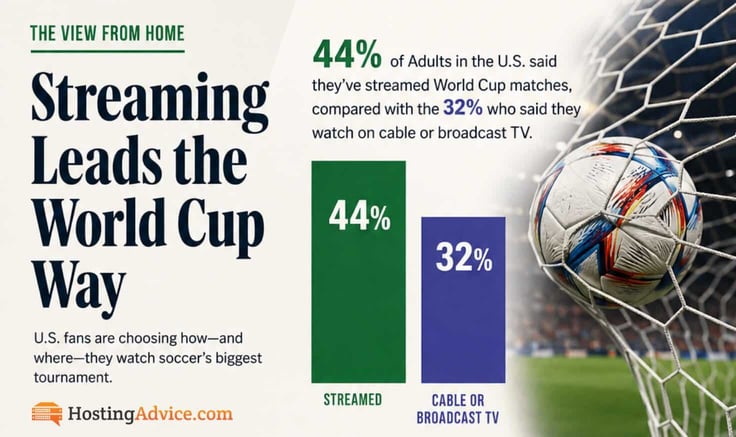
It’s clear people are tuned in. But how are they watching the tournament? We asked our respondents this question, and these were their responses:
- Cable or broadcast TV: 32%
- Free or ad-supported streaming: 27%
- Paid streaming service or app: 17%
- Bars, restaurants, or watch parties: 11%
- Not really watching: 10%
- In person at the stadium: 4%
Cable or broadcast TV topped the list. Yet, when you combine the two streaming options (free and paid) on the list, streaming becomes the clear preference among soccer fans, dethroning traditional TV.
These results show how streaming is changing the live sports viewing landscape, giving people more options to watch games beyond traditional TV.
Women Are More Likely to Stream — 47% vs. 40% for Men
We found key gender variations in how men and women choose to watch the World Cup.
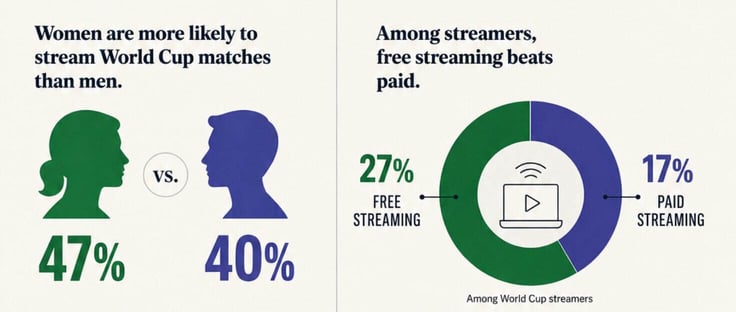
Interestingly, nearly half of women (47%) surveyed said they primarily watch matches through free or paid streaming services, compared with 40% of men. Men were more likely to rely on cable or broadcast TV, with 36% choosing traditional television, compared with 28% among women.
Free Streaming Beats Paid, 27% to 17%
Unsurprisingly, free beat out paid streaming services among respondents. Nearly 3 in 10 viewers said they used free streaming services to watch games, while only 17% said they used paid streaming, revealing a 10-point gap.
Fans across the U.S. are facing high costs this summer. While the data can’t prove it, this gap suggests that free streaming may be the more popular option for fans as they try to save on expenses this year.
42% of Fans Have Used a VPN or Workaround to Watch a Blocked Match
Between streaming rights, local availability, subscription costs, and regional broadcast restrictions, not all games are available to watch everywhere, and fans are taking matters into their own hands to avoid missing their favorite teams.
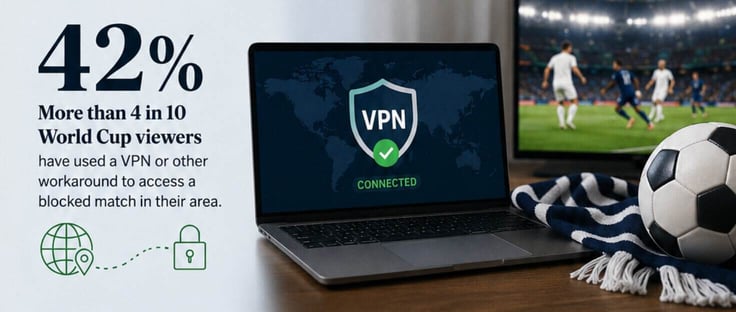
According to our survey, 42% of fans say they have used a VPN or workaround to stream matches that are not available in their area.
While a slim majority of viewers haven’t used a VPN at all, another 8% said they didn’t know a workaround such as a VPN existed.
Gen X Leads VPN Use at 46%, But Every Generation Is Close Behind
Our study also found generational differences among those who used a VPN or workaround.
While VPN usage was fairly consistent across age groups, Gen X was the most likely group to use one:
- Gen X: 46%
- Boomers: 42%
- Gen Z: 41%
- Millennials: 40%
This tight 6-point gap points to the prevalence of VPN use and awareness among the American people. This suggests that VPNs have become a normal part of how fans watch sports, highlighting how live sports viewing continues to evolve.
Miami Tops Major Markets at 52% VPN Use
As for where VPN use is the highest, Miami leads among the host cities. 52% of fans in Miami said they used a VPN to watch a game, followed by residents in Los Angeles (47%) and Philadelphia (46%). These results show the market for VPNs is varied and nationwide.
World Cup Viewership is Evolving
From streaming services to VPNs and workarounds, Americans are finding their own way to watch the 2026 World Cup, and viewership has been booming. Thanks to technology, fans have more options to watch the tournament.
The rise in streaming use shows how the service continues to reshape live sports events and how people watch. VPNs have also allowed people to bypass barriers and access games restricted in their area.
Whether it’s through a VPN or a streaming service, Americans are leveraging technology to tune into the world’s greatest soccer event and aren’t letting barriers keep them from missing out.
Methodology
This survey was conducted in June 2026 among 1,000 U.S. residents living in FIFA World Cup host cities. Respondents were selected from a third-party research panel.
To ensure the integrity of data collection, the researcher developed a proprietary machine-learning algorithm that can detect fraudulent responses early and remove inauthentic respondents immediately. The overall margin of error is ±3.1 percentage points at the 95% confidence level. Margins of error increase for subgroups such as age or gender.
For media inquiries, please reach out to dennis@hostingadvice.com.