


Writer: Lynn Cadet


Editor: Lillian Castro


Reviewer: Cristian Lopez

Key Takeaways
- 8 in 10 surveyed parents say they are concerned about their child’s safety while gaming online, including 46% who say they are very concerned.
- The most commonly reported gaming risks included bullying or harassment (23%), requests for personal information (22%), and contact from an adult or stranger (21%).
- Nearly all (97%) parents reported taking at least one precaution to protect their kids online, with parental controls (44%) ranking as the most common.
- Despite concerns, 83.5% of parents believe their children would tell them if someone made them uncomfortable while gaming online.
Gaming has become one of the most dominant pastimes among children, with over 90% of children aged 2 and over playing video games. Online gaming is more than a hobby; it’s also an outlet for kids to socialize and connect with each other in today’s society.
Yet behind this world of creativity and connection can often lurk dangers and risks that many parents aren’t always aware of in real time. A new HostingAdvice.com survey reveals 81% of parents surveyed have concerns about their children’s safety while online gaming.
These findings suggest parents aren’t simply worried about screen time — they’re increasingly focused on what can happen inside today’s multiplayer games and how it may be affecting their children.
From Roblox to Fortnite, Parents Are On High Alert
Video games, such as Roblox and Fortnite, are popular online spaces for children to spend their time and engage with others. But while these virtual worlds can bring enjoyment, they have also prompted caution among parents.
When asked what their level of concern was for the children’s safety while online gaming, here is how respondents answered:
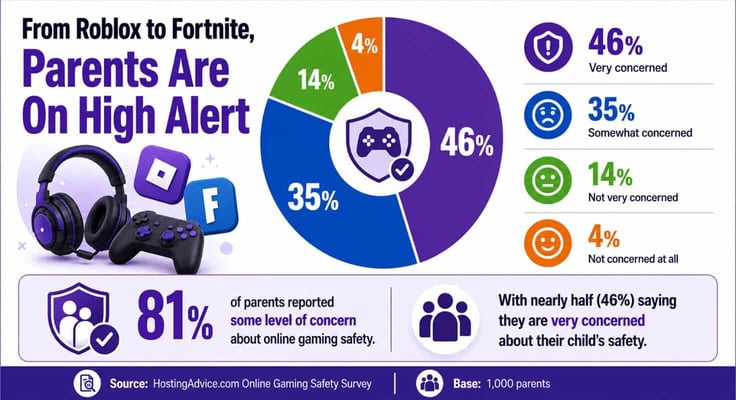
Overall, 81% of parents reported some level of concern about online gaming safety, with nearly half (46%) saying they are very concerned about their child’s safety. Concern was widespread across age, gender, and region, underscoring that online gaming safety has become a mainstream parenting issue rather than a niche concern.
Bullying, Stranger Contact, and Scams Are Common Experiences
But why are parents so concerned about online gaming safety? Perhaps it’s due to their children’s real-life experiences.
We asked parents, to their knowledge, what specific harmful situation their children encountered while gaming, and these were their top reported answers:
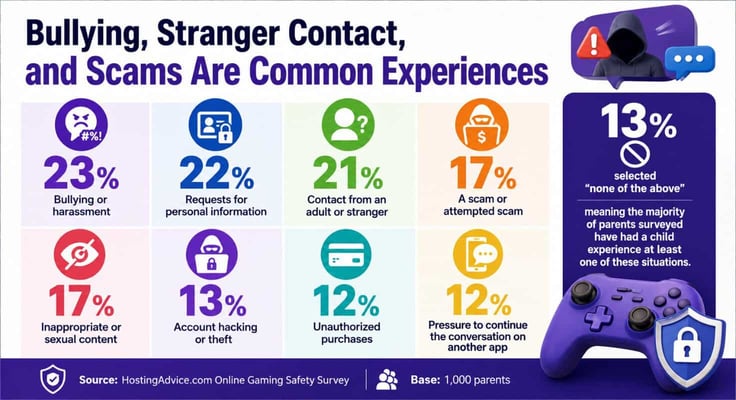
Only 13% selected “none of the above,” meaning the majority of parents surveyed have had a child experience at least one of these situations.
Bullying, scams, and stranger contact made the top three, pointing to the diversity of risks that can stem from online gaming. These findings also suggest that online safety concerns are more than hypothetical.
Parents Are Fighting Back With Safety Tools
While parents don’t want to stop their kids from playing games altogether, they are finding other ways to combat safety risks. How? By enlisting the help of some tools.
An overwhelming majority (97%) of parents selected at least one safety measure they have used to protect their child while gaming online.
The most common measures were:
- Enabling parental controls (44%)
- Restricting chat, messaging, or friend requests (38%)
- Reviewing privacy settings (31%)
- Restricting in-game purchases (27%)
- Enabling two-factor authentication (26%)
- Reviewing their child’s online friends or contacts (24%)
- Discussing what personal information their child should not share (22%)
- Monitoring or playing the game with their child (15%)
Parental controls were the most widely used safeguard, followed by restrictions on chat, messaging, and friend requests. Overall, the findings suggest that parents favor targeted protections — often combining technical controls with conversations and supervision — over banning online games altogether.
Most Parents Believe Their Children Would Speak Up
Despite their concerns, most parents still believe their child would tell them if something was wrong while online gaming.
More than 8 in 10 (83.5%) parents say they are confident that their children would communicate their discomfort or worries about online gaming to them.
These findings suggest that parents are having open conversations with their kids about online gaming and trust their kids to speak up.
However, parents have also reported negative experiences involving their children, including bullying and scams. This contrast suggests that communication may be strong within families, but other methods beyond conversations remain essential to helping children navigate online communities safely.
A Closer Look at the Demographics
Our study also found notable demographic differences among parents with concerns about online gaming safety.
Older Parents Express the Greatest Concern
Parents aged 46 to 61 were the most likely to express intense concern about gaming safety compared with other age groups, with a high share (48.6%) describing themselves as “very concerned.”
Western Families Report the Highest Online Gaming Participation
Parents in the Western United States were more likely to say their children played online games than parents in other regions, suggesting heightened gaming activity in the area.
Concern Crosses Gender Lines
Both mothers and fathers showed similar levels of concern about online gaming safety, indicating that it is a shared parental concern or responsibility within households.
Summary
Online gaming has become a staple in American culture, especially among children and young adults. But what often goes understated are the risks involved with navigating these communities as a young child, including bullying and stranger contact.
Our survey shows parents have concerns and are actively seeking safeguards to protect their children online, while also relying on open communication to bolster safety.
While having conversations is important, families who combine communication and proactive safety measures, such as parental controls, may be better positioned to protect their children when gaming online.
Methodology
This survey was conducted in August 2026 among more than 1,000 U.S.-based parents. Respondents were selected from a third-party research panel. To ensure data quality, responses were screened using a proprietary machine-learning system designed to identify and remove potentially fraudulent or inauthentic survey responses.
The overall margin of error is ±3.1 percentage points at the 95% confidence level. Margins of error increase for demographic subgroups such as age, gender, and region.
Questions regarding online gaming risks and parental safety measures were answered by 783 respondents and allowed participants to select multiple responses. As a result, percentages for those questions do not total 100%.
For media inquiries, please reach out to dennis@hostingadvice.com.