



Writer: Lynn Cadet


Editor: Lillian Castro


Reviewer: Cristian Lopez

Key Takeaways
-
New Hampshire takes the top spot for launching an online business due to its strong economic outlook and business-friendly environment.
-
While digital infrastructure plays a unique role in supporting online businesses, it was less of a deciding factor due to consistent, nationwide accessibility.
-
Top performers faced challenges in quality of life, but lower-ranked states had slightly higher scores, giving them the edge in that category.
Launching a business can be an intimidating task for anyone, whether you’re a seasoned pro like Mark Cuban or a first-timer like one of those Shark Tank contestants.
But if there’s one philosophy any entrepreneur can live by to ease the stress or workload, it’s this: Take it one step at a time.
And one of those first steps typically involves deciding where you want to launch your business.
For many business owners, hosting a shop or service online is an obvious choice, which takes the pressure of searching for an affordable brick-and-mortar off your plate. But still, where you live can impact how well you do online for a variety of reasons.
Is there reliable digital infrastructure to host your site in your state? Is the cost of living there affordable enough to keep you afloat in the early stages of entrepreneurship?
These are important questions. So we set out to help you answer them.
To identify the best states to jumpstart a business online, HostingAdvice.com examined state-level differences in key metrics, including economic viability, workforce readiness, digital infrastructure, and quality of life, across all 50 states and the District of Columbia.
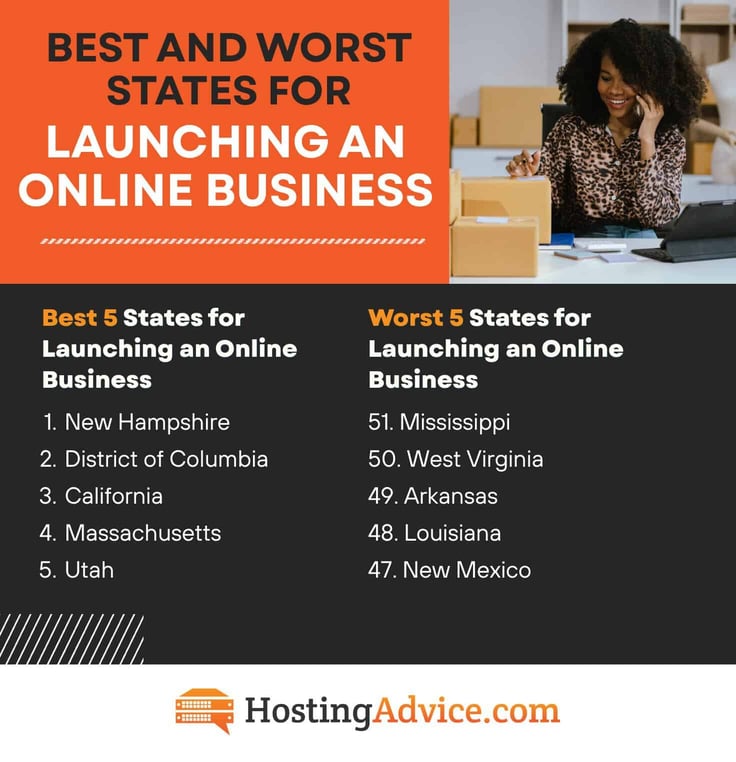
Based on a weighted 100-point scoring system, here are the best and worst states for launching an online business in 2026.
Main Findings
The table below ranks each state across four key dimensions: Economic Viability, Workforce Readiness, Digital Infrastructure, and Quality of Life.
| Rank | State | Total Score | Digital Infrastructure | Economic Viability | Workforce Readiness | Quality of Life |
|---|---|---|---|---|---|---|
| 1 | New Hampshire | 61.29 | 58.87 | 70.8 | 58.88 | 47.26 |
| 2 | District of Columbia | 58.06 | 58.22 | 78.4 | 38.21 | 36.13 |
| 3 | California | 57.86 | 60.63 | 61.78 | 52.38 | 45.96 |
| 4 | Massachusetts | 57.49 | 57.74 | 70.92 | 48.47 | 34.25 |
| 5 | Utah | 57.27 | 59.39 | 57.62 | 67.61 | 27.02 |
| 6 | South Dakota | 56.86 | 59.71 | 52.66 | 64.53 | 42.7 |
| 7 | North Dakota | 56.27 | 58.4 | 50.21 | 69.26 | 40 |
| 8 | Minnesota | 56.25 | 59.7 | 53.58 | 62.45 | 38.05 |
| 9 | Colorado | 55.06 | 57.37 | 56.23 | 58.53 | 35.41 |
| 10 | Connecticut | 53.95 | 61.4 | 61.59 | 38.1 | 32.99 |
| 11 | Wyoming | 53.63 | 61.88 | 44.43 | 54.35 | 46.8 |
| 12 | Maryland | 52.57 | 54.93 | 53.98 | 50.08 | 43.86 |
| 13 | Washington | 52.46 | 57.34 | 55.14 | 47.49 | 34.81 |
| 14 | Hawaii | 51.99 | 59.18 | 50.71 | 43.99 | 43.07 |
| 15 | New Jersey | 51.82 | 57.86 | 57.48 | 38.76 | 36.74 |
| 16 | Virginia | 50.86 | 56.28 | 46.4 | 55.26 | 33.74 |
| 17 | Nebraska | 50.68 | 59.38 | 34.29 | 67.73 | 30.92 |
| 18 | Wisconsin | 49.81 | 57.4 | 35.21 | 60.86 | 41.17 |
| 19 | Vermont | 48.71 | 58.54 | 37.6 | 52.51 | 35.08 |
| 20 | Rhode Island | 48.35 | 59.1 | 47.9 | 34.56 | 34.33 |
| 21 | Illinois | 48.01 | 56.26 | 41.9 | 41.18 | 47.04 |
| 22 | Maine | 46.74 | 58.14 | 35.12 | 45.76 | 38 |
| 23 | Idaho | 46.47 | 57.95 | 34.49 | 49.76 | 29.87 |
| 24 | New York | 46.37 | 50.63 | 46.2 | 37.63 | 47.3 |
| 25 | Iowa | 46.24 | 57.29 | 28.67 | 57.07 | 33.06 |
| 26 | Montana | 46.19 | 58.14 | 29.75 | 48.51 | 43.09 |
| 27 | Florida | 46.07 | 53.93 | 32.42 | 42.41 | 62.9 |
| 28 | Kansas | 45.71 | 58.69 | 26.16 | 54.98 | 33.91 |
| 29 | Oregon | 44.82 | 58.87 | 34.9 | 35.01 | 38.03 |
| 30 | Texas | 44.42 | 48.83 | 29.58 | 55.6 | 48.9 |
| 31 | Delaware | 43.6 | 58.69 | 31.75 | 33.34 | 39.38 |
| 32 | Indiana | 43.21 | 55.32 | 25.07 | 46.85 | 41.92 |
| 33 | Missouri | 42.67 | 55.97 | 23.62 | 47.01 | 37.95 |
| 34 | Georgia | 42.61 | 53.46 | 25.94 | 43.34 | 47.7 |
| 35 | Alaska | 42.12 | 36.38 | 48.32 | 36.36 | 57.98 |
| 36 | Pennsylvania | 41.91 | 50.63 | 29.59 | 41.62 | 44.53 |
| 37 | Ohio | 41.16 | 53.56 | 22.83 | 43.66 | 41.59 |
| 38 | Arizona | 41.16 | 53.87 | 29.08 | 34.5 | 39.92 |
| 39 | Nevada | 40.83 | 54.83 | 35.17 | 21.93 | 39.54 |
| 40 | Michigan | 40.36 | 55.21 | 24.77 | 30.2 | 48.08 |
| 41 | North Carolina | 40.01 | 52.62 | 20.93 | 43.23 | 40.4 |
| 42 | Tennessee | 39.52 | 53.84 | 18.43 | 38.52 | 47.55 |
| 43 | Oklahoma | 37.43 | 52.21 | 16.64 | 37.18 | 41.14 |
| 44 | South Carolina | 37.09 | 53.91 | 15.63 | 33.75 | 40.89 |
| 45 | Kentucky | 35.69 | 55.89 | 11.25 | 31.89 | 35.8 |
| 46 | Alabama | 35.27 | 55.38 | 12.43 | 28.04 | 37.82 |
| 47 | New Mexico | 34.26 | 55.86 | 13.06 | 17.49 | 45.02 |
| 48 | Louisiana | 33.74 | 54.28 | 11.13 | 17.81 | 51.24 |
| 49 | Arkansas | 33.68 | 56.05 | 8.24 | 27.8 | 32.31 |
| 50 | West Virginia | 31.9 | 61.61 | 3.8 | 9.33 | 42.48 |
| 51 | Mississippi | 28.78 | 54.23 | 0.19 | 14.49 | 41.31 |
A Closer Look at the Top 5 States
According to our results, the top five states for launching an online business deliver a consistent combination of strong economic performance, workforce readiness, and digital infrastructure.
1. New Hampshire
New Hampshire ranks first for digital business, thanks to its exceptional economic viability score. The state offers a financially viable location for entrepreneurs to live and work, supported by its high SBA loan approval rate, lack of personal income tax, and high median household income.
The state also boasts an unemployment rate of 3.56%, one of the lowest in the top five. While it has a lower quality of life score, New Hampshire still offers a favorable destination for entrepreneurs, thanks to its strong overall performance across the board.
Offering both suburban and rural backdrops, New Hampshire gives online business owners their choice of lifestyle while providing a robust economic environment for businesses of all sizes.
2. District of Columbia
The District of Columbia takes second place primarily for its strong economic performance. Like New Hampshire, the federal district scores well in economic viability, highlighted by its high per capita personal income of $111,185. This points to strong earning — and spending — potential among residents.
The district also fares well in digital infrastructure, equipping residents with reliable internet connectivity for their online activity. Where it slightly stumbles, however, is in workforce readiness and quality of life, posting a high unemployment rate of 7.05%. Despite these challenges, its strong overall economic health is able to offload some of these pressures.
3. California
Coming in third is California. The Golden State performs well in economic metrics, particularly earning power. Boasting a median household income of $91,905 and a per capita personal income of $86,232, California offers a strong earnings foundation for residents, allowing for financial stability despite its affordability pressures.
While the state faces challenges in quality of life, including significant air quality concerns and a notable number of households lacking internet access, its strong network of businesses and massive economy outweigh these burdens and provide entrepreneurs with the resources and clients to launch a business successfully.
4. Massachusetts
Massachusetts ranks fourth overall for online businesses primarily due to its strong economic viability score — the second-highest on the list. Its median household income of $96,505 and a per capita personal income of $93,607 suggest strong earning and purchasing power among residents, creating a viable financial base for entrepreneurs.
Like others on the list, Massachusetts has its struggles in the quality of life category, mostly due to a low State Business Tax Climate Index score. But the state is able to overcome this challenge by scoring well across economic, digital, and workforce indicators.
5. Utah
Utah completes our top five with a particularly strong score in workforce readiness. The state stands out for its impressively low 3.34% unemployment rate and solid labor force participation rate of 69.35%.
Utah’s diverse economy also adds to its strength as a contender. It offers a robust business ecosystem and talent pool, even boasting a competitive, low-tax environment ideal for small business growth. Like its peers, Utah faces some challenges in quality of life scores, primarily due to its air quality.
In Summary
As our results show, the top five states performed exceptionally well in economic viability, providing a financially stable landscape for entrepreneurs. Not only do these states have strong earnings and purchasing power, but they also offer a business-friendly environment, with high SBA loan approval rates and solid labor participation.
While digital infrastructure remains a prominent factor for online businesses, it is a less significant differentiator for entrepreneurs, thanks to consistent internet access scores across the rankings.
What’s telling: The top five states scored more than 9x higher in economic viability than the bottom five. This highlights a stark gap in income levels, access to capital, and overall business activity among top and bottom performers.
Overall, our findings point to a clear reality: While internet access is widely available across the U.S., economic strength and workforce quality are what truly separate the best and worst states for launching an online business.
For media inquiries, please reach out to dennis@hostingadvice.com.
Methodology
The methodology below explains the data inputs, scoring approach, and weighted metric framework used for this ranking. This ranking was generated in April 2026, using a weighted composite scoring model.
Overview
The Best and Worst States for Launching an Online Business study evaluates 50 states and the District of Columbia based on their suitability for launching online businesses, considering factors like digital infrastructure, economic viability, workforce readiness, and quality of life. Each section is weighted differently to reflect its importance in supporting online entrepreneurship.
Data & Sources
Data is sourced from reputable organizations including the U.S. Census Bureau, Bureau of Economic Analysis, Numbeo, and SBA Open Data. Metrics were selected to provide a comprehensive view of the environment for online businesses across all 50 states and the District of Columbia.
Scoring Approach
States are scored based on a weighted sum of metrics within each section. Higher scores indicate better conditions for launching online businesses, with specific metrics adjusted for directionality to reflect positive or negative impacts. 4 metrics used state fallback filling (national median) for missing state values.
Caveats
Some metrics utilized national medians as fallbacks for states with missing data, which may affect the accuracy of rankings. Metrics impacted by fallbacks include average broadband price, quality of life index, crime index, and air quality score. Metrics using fallback are annotated in section-level explanations.
Digital Infrastructure — Total Points: 40
This section contributes 40 points to the total score and captures one dimension of state performance. Its 3 metrics are combined using metric-level weights, then rolled into the composite score according to the section point allocation.
1. Broadband Internet Access — Quadruple Weight
The Broadband Internet Access metric measures the percentage of households with a broadband internet subscription. This metric is crucial for the study as it reflects the digital readiness of a state, which is essential for launching online businesses. A higher percentage indicates better connectivity, facilitating e-commerce and remote work opportunities. The raw transformation means that the interpretation is straightforward; states with higher values are more favorable for online business ventures.
2. Households without Internet — Quadruple Weight
The Households without Internet metric quantifies the percentage of households lacking internet access. This metric is particularly relevant to the study as it highlights barriers to entry for online businesses in a state. A lower percentage is desirable, indicating that more residents have the necessary tools to engage in digital commerce. The raw transformation allows for a clear interpretation, where lower values signify a more conducive environment for online business operations.
3. Broadband Internet (Unlimited Data, 60 Mbps or Higher) — Triple Weight
The average price of broadband services affects affordability for businesses. Lower prices can enhance the viability of online operations, making this metric essential for assessing digital infrastructure. State fallback fill was applied for 6 states using the national median for this metric.
Economic Viability — Total Points: 30
This section contributes 30 points to the total score and captures one dimension of state performance. Its 3 metrics are combined using metric-level weights, then rolled into the composite score according to the section point allocation.
1. Per Capita Personal Income — Triple Weight
Per Capita Personal Income measures the average income earned per person in a state, providing insight into the economic health and purchasing power of its residents. This metric is vital for the study as it affects consumer spending and the potential market size for online businesses. The raw transformation means that higher values directly correlate with a more favorable economic environment for launching online ventures, indicating greater financial capacity among the population.
2. Median Household Income — Triple Weight
Median Household Income reflects the middle income level of households in a state, adjusted for inflation. This metric is significant for the study as it indicates the economic stability and disposable income available for online purchases. A higher median income suggests a more affluent consumer base, which is advantageous for online businesses. The raw transformation allows for straightforward interpretation, where higher values indicate a more promising market for e-commerce.
3. SBA Loan Approvals per 100k Residents — Double Weight
SBA Loan Approvals per 100k Residents measures the number of approved Small Business Administration loans normalized by population. This metric is important for the study as it indicates the accessibility of funding for new online businesses, reflecting the entrepreneurial climate of a state. A higher rate suggests greater support for startups, which is essential for fostering online business growth. The raw transformation means that higher values are interpreted as more favorable conditions for business development.
Workforce Readiness — Total Points: 20
This section contributes 20 points to the total score and captures one dimension of state performance. Its 3 metrics are combined using metric-level weights, then rolled into the composite score according to the section point allocation.
1. Labor Force Participation Rate — Triple Weight
The Labor Force Participation Rate measures the percentage of the population aged 16 and over that is actively participating in the labor force. This metric is crucial for the study as it indicates the availability of a workforce for online businesses. A higher participation rate suggests a more engaged and potentially skilled labor pool, which is beneficial for business operations. The raw transformation allows for a direct interpretation, where higher values are indicative of a robust labor market.
2. Unemployment Rate — Triple Weight
The Unemployment Rate measures the percentage of the labor force that is unemployed and actively seeking work. This metric is relevant to the study as it reflects the economic health of a state and the availability of potential employees for online businesses. A lower unemployment rate is preferable, indicating a more stable job market. The raw transformation means that lower values are interpreted positively, suggesting a favorable environment for business growth and workforce availability.
3. Work from Home — Double Weight
The Work from Home metric indicates the flexibility of the workforce, which is increasingly important for online businesses. Higher rates suggest adaptability and a readiness for remote work environments.
Quality of Life — Total Points: 10
This section contributes 10 points to the total score and captures one dimension of state performance. Its 5 metrics are combined using metric-level weights, then rolled into the composite score according to the section point allocation.
1. Quality of Life Index — Triple Weight
The Quality of Life Index provides insights into living conditions, impacting employee retention and satisfaction. A higher index indicates a more attractive environment for potential employees. State fallback fill was applied for 11 states using the national median for this metric.
2. Crime Index — Double Weight
The Crime Index is a composite measure of crime rates in a given area. This metric is significant for the study as it impacts the overall quality of life and can influence business decisions regarding location. A higher crime index may deter potential entrepreneurs and consumers alike, making it less favorable for online business operations. The raw transformation allows for straightforward interpretation, where higher values indicate greater concerns about safety, potentially affecting business viability. State fallback fill was applied for 6 states using the national median for this metric.
3. Air Quality Score — Double Weight
Air Quality Score is essential for assessing environmental conditions that can impact health and productivity. Better air quality contributes to a higher quality of life, making states more attractive for businesses. State fallback fill was applied for 6 states using the national median for this metric.
4. Business Applications — Double Weight
The Business Applications metric reflects the total number of business applications filed, serving as an indicator of entrepreneurial activity in a state. This metric is crucial for the study, as higher numbers of applications suggest a thriving business ecosystem, which is essential for the success of online ventures. The interpretation is that increased business applications correlate with a more favorable environment for entrepreneurship, indicating potential growth in the online business sector.
5. State Business Tax Climate Index Score (2026) — Double Weight
The State Business Tax Climate Index Score evaluates the overall tax environment for businesses in a state. This metric is particularly relevant to the study, as a higher score indicates a more favorable tax climate, which can attract online businesses and stimulate economic growth. The interpretation suggests that states with better tax climates may encourage more entrepreneurs to establish online operations, thereby enhancing the overall business landscape.