


Writer: Surajdeep Singh


Editor: Britain Simons


Reviewer: Cristian Lopez

Could you imagine if you had to type something like https://23.253.70.72 to visit this website? Do me a favor: please read this article’s domain name. You may recognize hostingadvice.com — But the part that comes after is called the URL path, or, well, just path.
The https://23.253.70.72 is the IP Address. Tedious, right? If I had to type that in every time, I’d walk away.
That’s where the Domain Name System (DNS) comes in — without it, you’d have to remember the IP addresses for every site. I’ll explain how it works for you.
Whenever you type, let’s say, hostingadvice.com in your browser, your device asks a DNS server, “Hey, what is its IP address?” It puts on its reading glasses and replies with the requested numerical ID. Next? Your browser connects to that string of numbers to your website host and specified domain. Then, it loads the website.
Can you imagine the chaos if there’s a DNS outage? Your browser will be left on read. Ouch.
The thing is, even if the website or app you want to visit is online, if DNS servers are down, you won’t be able to access it. It’s like being stuck in a foreign country without a translator or a city map. You’re left high and dry.
Interesting, right? Well, you’ll be amazed when you read the DNS outage stats I’ve prepared for you.
-
Navigate This Article:
Global DNS Outage Statistics
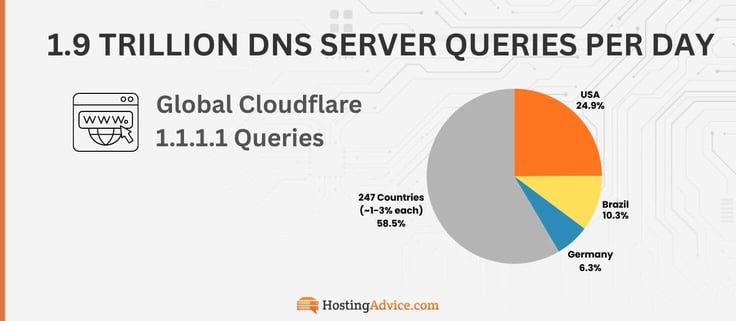
DNS servers handle millions of queries every second. Billions as the hours go on, and Trillions daily. Cloudflare 1.1.1.1, a major global provider, handles 1.9 trillion on average per day.1 That’s from around 250 countries/regions, with the United States making up 24.9% of queries.
That number is followed by Brazil at 10.3%, Germany with 6.3%, and a dozen more countries making up 1-3% each. It’s the global internet infrastructure, so it needs to be fault-tolerant and respond in milliseconds.
That’s the kind of pressure F1 pit crew members face — only on a global scale. If DNS fails for even a minute, the internet will appear down.
1. An AWS DNS Outage on October 20, 2025, Affected 3,500+ Companies
I can think of 19 other places to start, but there’s only one that would do my DNS outage stats guide justice — the largest global DNS outage of 2025: the AWS (Amazon Web Services, Inc.) domain management issue on October 20. It affected more than 3,500 companies, but do you know how long it lasted?
15 gruesome hours.
It must have been a sleepless night for those poor AWS engineers! Around 17 million users across 60 countries submitted reports saying they couldn’t access apps like Amazon, Snapchat, and Netflix.2,3 I can only imagine the billions in lost revenue.
2. Businesses Face 7.5 DNS Attacks Annually
We were originally digging into DNS outage statistics to determine the percentage of organizations affected. I’ll do one better: organizations face about 7.5 DNS attacks on average per year. The problem is, around 82% of these attacks result in application outages, and approximately 29% lead to data theft.4
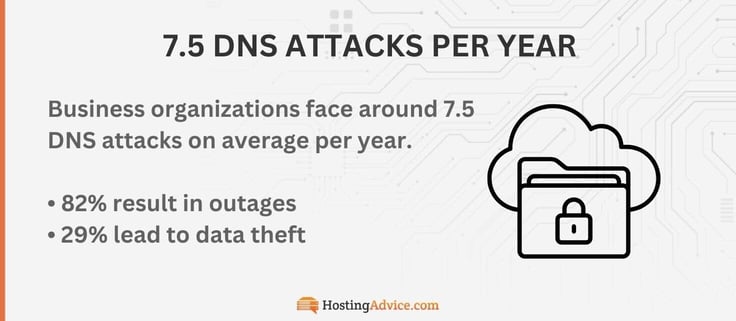
If you’re a business owner, I suggest investing appropriately in DNS protection. Why? These numbers tell us DNS attacks are frequently attempted and are highly effective. A nearly 30% data theft rate is a wake-up call, so read on.
3. Average Duration of a DNS Outage Is One Hour and 15 Minutes
Not every DNS outage is “Amazonian.” The average duration of a DNS outage is far less than the 15 hours it took AWS to recover in October 2025 — it’s about 30 minutes to two hours.5 According to current stats, the average is one hour and 15 minutes. You might be wondering why DNS outages last so long.
You’ve heard the phrase “broken record,” right? When a DNS outage happens, your browser caches the broken record when you request a site. In fact, most outages are reported first by users when they can’t access services. Unfortunately, even if the problem is fixed ASAP, your browser can’t access the website until the cache expires. And this can take hours.
4. There Were 32.6M DDoS Attacks in 2025
Honestly, it’s impossible for me (or anyone) to pinpoint exactly how many DNS attacks took place in any year, let alone 2025. You won’t find a single industry report that covers this, but Cloudflare can give us some insight.
Note: Since many DNS attacks are DNS-based Distributed Denial of Services (DDoS) attacks, the best “official” stat I can give you is that there were around 32.6 million DDoS attacks in 2025 — which is a 170% increase compared to 2024.6 That’s an attack almost every second of the year.
And here’s the deal: even this figure is missing the full scope of data — why would any company publicly disclose all records? I strongly estimate the number is closer to 300 million (the math checks out).
5. 1,552 DNS Outages Will Likely Occur in 2026
I’ll try to give you a reasonable idea of how many global DNS outages could occur in 2026. According to current research, 199 significant global network outages took place between December 29, 2025, and January 4, 2026.
Aligned with trending data, DNS outages fluctuate around an average 10% to 25% of such events. Let’s take a conservative 15% for these future estimations. We could expect about 1,552 DNS outages in 2026.7 That’s 30 every week. If you have a website, it may be a good time to update your security measures.
DNS Outage Statistics in the United States
It shouldn’t be any surprise which country is most affected by DNS outages. If the United States came to mind, you know a thing or two. The problem isn’t with our security measures; it’s the regional infrastructure. Many global platforms rely on USA-headquartered DNS providers like Cloudflare, AWS, Google Cloud, and Microsoft Azure.
USA-headquartered DNS providers make up the majority, so even if a website outage happens elsewhere, the record books may call it a USA-based incident. I’ll let the numbers speak for themselves.
6. 554 DNS Outages Will Happen in the USA in 2026
Here are the most recent numbers: 71 major network outages took place in the time frame I covered in Stat 5. Using the same data projections, the USA could face around 554 major DNS-related outage events in 2026.
My fellow US web security teams, buckle up — that’s almost 11 events per week!7 Treat yourself to a cool, crisp beer every time you thwart an attack. Drunk on success, eh? I’d take that win!
7. In the United States, ~35.7% of Global DNS Outages Will Take Place in 2026
According to Stats 5 and 6, the research also points to the United States accounting for approximately 553 DNS outages, or 35.7% of the total global DNS outage share in 2026.7 May our entrepreneurial spirit live strong.
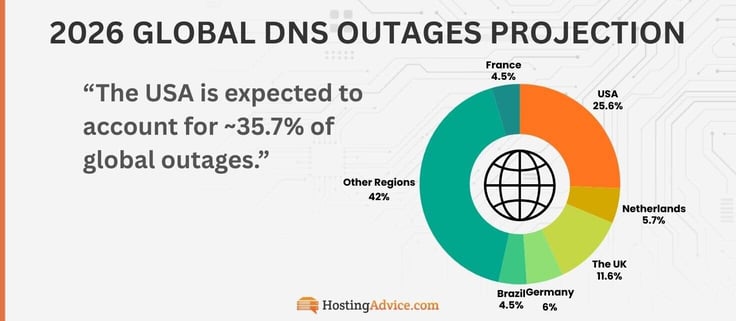
This DNS incident report chart gives us a better idea of what 2026 might look like for other countries:
- USA: 553 DNS outages (35.7%).
- The UK: 251 DNS outages (16.2%).
- Germany: 129 DNS outages (8.3%).
- Netherlands: 123 DNS outages (7.9%).
- Brazil: 98 DNS outages (6.3%).
- France: 98 DNS outages (6.3%).8
I expected China to be on this list, and they may be, but I suspect they’re not sharing all their data with the West.
DNS Outages by Industry
Do you like your bread white or whole wheat? I order whole-grain bread online from my local bakery’s website. I like it fresh. Now, let’s imagine their website is down for an hour or so, due to a DNS failure. Is it the end of the world? No.
I can just call them and place an order. Or, pull out my car, drop by the bakery, and grab my bread. Maybe I’ll even give the owner a tip or two about handling the DNS situation. The point is, DNS dependency varies by industry, locality, and risk tolerance.
According to this report by Etheric Networks, the average cost across all businesses for a DNS outage ranges from $5,600-$9,000 per minute. Enterprise business, which relies heavily on eCommerce? $16,000 per minute.9
Here’s another example: the “Stranger Things” series finale was released on Netflix on December 31, 2025 (no spoilers). Even a few seconds of DNS delay would have sparked instant outrage online! The conclusion? Netflix’s DNS dependency > my local bakery.
8. India’s A Jio and Airtel DNS Downtime Incident in 2024 Affected 53,000 Users for 7 Hours
Remember the AWS DNS failure I talked about earlier? Of the thousands of companies affected, many were telecom-dependent services. I’m sure your Facebook, Instagram, or WhatsApp has been down at some point in the past 12 months. Communication apps rely on servers!
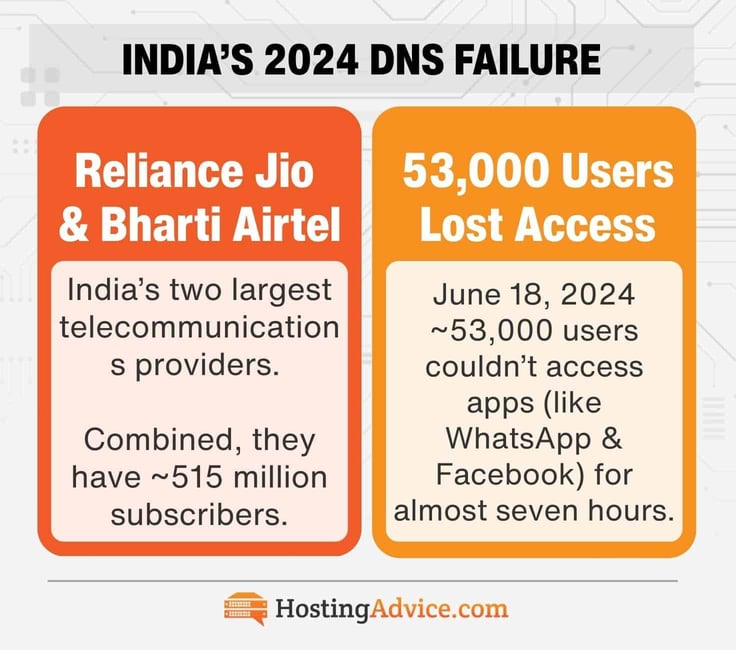
Telecom providers have their own DNS servers, often in partnership with companies like AWS. IIf you’re using their network to access these apps, a DNS failure is possibly why they might not have worked, for those seconds you were frantically refreshing!
India’s two largest telecommunications providers are Reliance Jio and Bharti Airtel. They have 515 million subscribers – more than the population of the United States.
The largest recent incident happened on June 18, 2024, when more than 53,000 Reliance Jio and Bharti Airtel users couldn’t access apps like WhatsApp and Facebook for almost seven hours due to DNS server downtime.10
A similar outage affected AT&T’s DNS in February 2026, but the data is a bit more anecdotal. It’s based on some user complaints on Reddit. You can check it out from the sources below — the thread is pretty interesting.11
9. A November 2025 Cloudflare DNS Outage Blocked SaaS Apps for 5 Hours
We’ve picked on Amazon (AWS) enough, so I’ll talk about Cloudflare instead. This is how Cloudflare works — It has cloud-based servers spread out regionally and it’s one of the world’s largest public DNS services. I’ll let you connect the dots (does 1.1.1.1 ring a bell?)
Anyway, Cloudflare had two major DNS outages in 2025: a five-hour incident on November 18 and a 25-minute one on December 5 that affected SaaS apps like X, ChatGPT, Canva, Zoom, and Slack.12,13 They were affected because Cloudflare’s DNS servers couldn’t resolve their domains.
10. November Cloudflare DNS Incident Cost eCommerce $1.5-$2 Billion
November 18, 2025. 5 hours and 25 minutes of pure loss for eCommerce and transaction platforms.12 I’m not talking about millions. Think billions. Cloudflare’s DNS incident triggered around $1.5 to $2 billion in losses for Shopify-powered stores, PayPal-linked services, Visa payment pages, IKEA, bet365, and Coinbase.14
Phew! When payment systems and financial technology go down, everyone takes a hit. That’s like the production budget of six Marvel movies! I’m guessing the December incident caused a few hundred million in losses, too.
Common Causes of DNS Outages
My front door is made of oak, and, of course, it isn’t termite-proof. While I wouldn’t be able to see the bug infestation, I would be able to hear them gnawing away at night — if they were to “bug” me. Now, in complex distributed systems like Cloudflare DNS, there are hidden bugs.
In the November Cloudflare incident, a “harmless” internal database configuration change exposed one.
The result? Well, catastrophic — We covered the $2B Cloudflare incident. Even the big guys can suffer from software bugs. What I’m trying to say is, perfection at scale is a myth — even the best engineers make mistakes.
11. 50% of DNS Outages Are Due to Misconfigurations
Speaking of mistakes, 50% of DNS outages are caused by configuration and change management errors.15 Yes, you read that right.
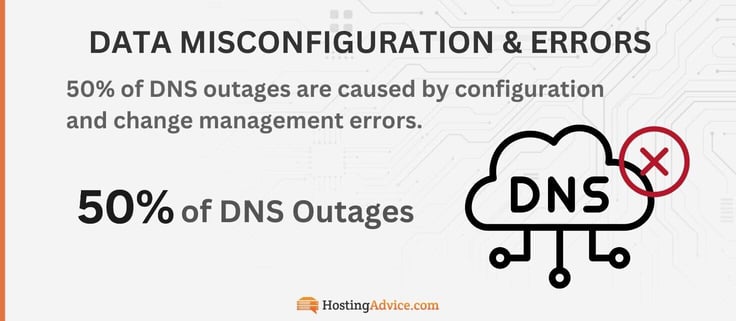
The thing is, engineers make thousands of changes every day. And even a teeny-tiny misconfiguration can spark an avalanche of disaster — billions of dollars worth of it. Time is money. I do have a solution for business owners: don’t rely on a single DNS provider — designate one provider as primary (for updates) and the second as a backup. I’ll talk about additional DNS security options below.
12. Hardware Failures Cause 31% of DNS Outages
Even if the engineers get everything right, if a server or router fails, all they can say is, “Oops, the machine broke.” I know, I know: they plan for such events with redundancy.
Sometimes, you just can’t control the domino effect, but you can mitigate the damage. In the case of DNS outages, almost one-third are caused by hardware failures.13 If you ever wondered why data engineers are paid so much, there you go. Just think of the cost of downtime.
13. 17% of DNS Outages Are a Result of DDoS Attacks
It’s difficult to estimate the percentage of DNS outages due to DDoS attacks, but I can confidently say that around 17% are the result of cyberattacks. This includes IT, ransomware injections, DDoS, and zero-day attacks.15 Let’s focus on DDoS attacks.
DNS is like a golden goose for cybercriminals — if you knock servers down, you could impact millions of users almost instantly.
But what is DDoS? Alright, picture this: you’re at Disneyland and want to ride a roller coaster. You have to get in line and wait your turn, right? We’ll ignore the fast pass — Dad’s on a budget.
If the line rope disappears and everyone rushes to the counter at once, the whole system breaks down. Imagine hundreds of people trying to force their way in and overload the train cars. You know what’ll happen next? Chaos and closed rides.
That’s exactly what a DDoS attack does. DNS providers like Cloudflare have a huge army prepared to defend their servers (think of “digital soldiers”), so it’s not easy for DDoS attacks to overwhelm them. But hey, never say never (joking)!
Business Impact of DNS Outages
The November Cloudflare DNS outage can help us visualize the true business impact — the global economic loss estimate is approximately $4.5 billion. That’s 13 Marvel movies. Wow!
Since Cloudflare DNS supports nearly five million websites, how much did each company lose in that 5 or so hour spell?14,16 The law of averages says $900, but in reality, it’s millions in targeted losses.
14. November Cloudflare DNS Incident Cost Enterprises $5M Per Hour
The November 18, 2025, incident, resulting from a large “Feature File”, cost enterprises around $5 million per hour in unplanned downtime.17 That’s approximately $27 million in losses because of one hidden bug.
According to this Cloudflare report, “It was triggered by a change to one of our database systems’ permissions, which caused the database to output multiple entries into a ‘feature file’ used by our Bot Management system. That feature file, in turn, doubled in size.” It caused a system-wide failure.18
I thought termites were pesky!
Small sites probably lost less than $500 per hour. I’m talking individual Shopify stores, local businesses, and niche SaaS tools. A $5 million cost to enterprises, a huge overall impact.
15. Businesses Should Aim For At least 99.99% Uptime
I used Uptimia to check the loading speed of our website, and I was pleased with the results! We have an average load speed of just one second and are faster than 84% of websites. We also target an uptime of 99.99% and meet it most months. Let’s keep this between us: we use Cloudflare DNS.
As the leading authority in hosting advice, it’s important to practice what we preach.
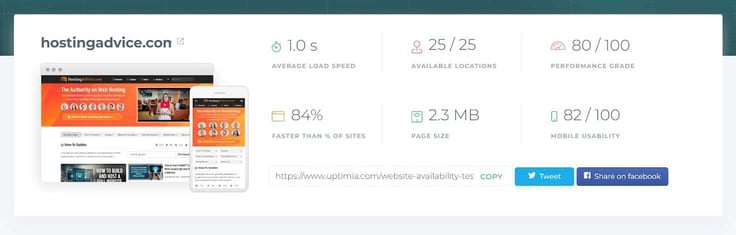
Do you know how the November outage affected our uptime goal for the month? 5 hours and 25 minutes of downtime pushed our monthly uptime down to around 99.24% (including all downtime metrics).
That might not sound like much, and thankfully, we weren’t heavily hit, but for enterprises? It’s disastrous.
16. 50% of Customers Will Walk Away After a DNS Outage
I’m going all in on the assumption that you own a business website for this stat. All it takes is one poor experience for half of your customers to switch to another brand.20 Just one. So, if they’re unable to access your website or complete a transaction because of a DNS outage, you should probably bid them farewell.
The only silver lining I can think of here is that your competitors might be in the same mess, too! A gentle reminder: you could avoid such situations by using multiple DNS vendors.
Retain your customers and make them super happy!
DNS Provider Reliability and Uptime Statistics
When I said “we target an uptime of 99.99%” at HostingAdvice, what I meant is we want our website to experience less than an hour of overall downtime in a year. A DNS outage isn’t the only thing that can affect our website’s availability — it’s just one of many possibilities.
So, what’s the industry-standard DNS uptime? Let’s find out.
17. AWS and Cloudflare Promise 100% DNS Uptime
AWS DNS (Amazon Route 53) and Cloudflare DNS promise an uptime of up to 100% — the more you pay, the higher the commitment.18 That is only possible through massive, redundant global networks. One server goes out, and there are a dozen more to take its place.

One good thing to come out of the infamous AWS and Cloudflare outages? Their customers probably got credits or refunds for the periods DNS was down!
If I were in your shoes, I’d more realistically expect a 99.99% DNS uptime for your money.22 For DNS, if you follow my advice and go the multi-vendor way, the system will only fail if both (or more) vendors fail at the same time. Using two DNS vendors would take your effective availability closer to 99.999% aka “five nines.”
Now that’s what I’m talking about! For optimal performance and cost, I’d go with Amazon Route 53 as your primary vendor and Cloudflare DNS as your secondary.
DNS Security Tips: You need to enable registry lock (the most overlooked risk) to prevent unauthorized domain transfers. Then, turn on DNSSEC in your provider’s dashboard (it’s a security feature), generate security keys, and submit the DS record to your domain registrar to prevent DNS spoofing attacks. Use DriftSensor to track DNS records with real-time security alerts.
18. 15.9% of Websites Use Cloudflare DNS
Do the largest DNS providers have lower outage frequencies? Of course, they have more servers, redundancy, hardware, software engineers, and security. Here’s an interesting DNS outage stat: around 15.9% of all websites use Cloudflare DNS. AWS? Just 3.5%.23
So, if Cloudflare is completely down, about 16% of the internet will go into darkness. Talk about impact. That leads me to a conclusion: the higher the market share of a DNS provider, the higher the outage impact. I hope Cloudflare has no major DNS outages in 2026!
19. Cloudflare DNS Will Handle 71 Trillion Queries in 2026
You might be wondering why I suggested Amazon Route 53 as your primary DNS vendor when all the data says Cloudflare is the leader in uptime. I mean, a market share of approximately 16%, average uptime figures of around 99.98% in real-world tests, and about 71 trillion projected DNS queries in 2026 is an impressive feat!23,24,25
That’s like every American “calling” a DNS roughly 600 times a day! So, why Amazon Route 53, one service within the greater AWS platform?
The answer isn’t as complex as you might think:
- Pay-per-query modeling: Save money and scale by only paying for what you need.
- Access to the AWS ecosystem: storage, computing, security, disaster recovery, scalability, and machine learning.
- You can still use Cloudflare as a secondary option for its extra DDoS protection and global edge caching. The best of both worlds, truly.
The Future of The Global DNS Services Market
One thing’s for sure: we can’t continue to have hours-long DNS outages, like we did in 2025. For a technology so simple, yet so complex, we need to find ways to minimize downtime, especially considering how frequent DNS-based DDoS attacks are. With the advent of AI, attacks will only become more sophisticated.
Have you heard of the Anycast DNS routing technique (built into Cloudflare and Amazon Route 53)? It “casts” your IP address to the nearest healthy DNS node.
It’s getting even smarter with the help of control-plane separation. The brain, or control plane, that manages the DNS is separated from the data plane, which sends information packets. It improves resiliency, along with AI monitoring and automated checks.
With these improvements, a bug like AWS’s 2025 outage could have been contained (never say never).
20. The Global DNS Services Market Will Reach $1.2B by 2030
The global DNS services market was $659.2 million in 2024. According to Market Research, it is expected to grow at an astonishing rate of about 10.5%, and could reach $1.2 billion by 2030.26
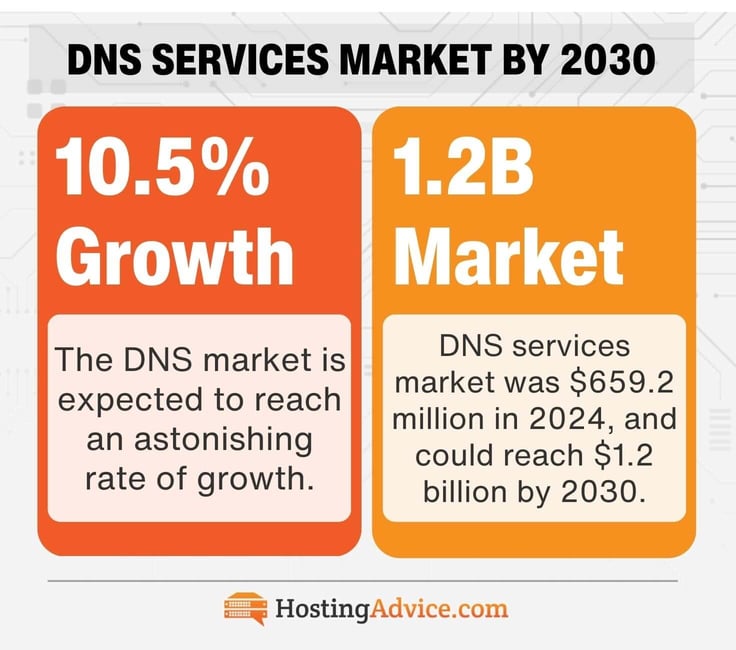
Wait. Billion? But didn’t the November Cloudflare outage cost billions in itself? Comparing the cost of DNS outages to global corporations with the market value of DNS services offered to those corporations creates an interesting contrast.
What does this tell you? While DNS infrastructure is relatively affordable to set up, the financial loss of failure is huge.
We need DNS providers to step up their game and avoid the long outages that are costing our economy. Of course, I don’t expect there to be zero DNS outages in 2026 — that’s crazy talk. But hours-long ones? That’s unacceptable. You do your part to build redundancy, security, and backups. Let your DNS providers (yes, plural) do the rest.
Billion-Dollar DNS Outages: My Final Thoughts
My 20 DNS outage stats tell a clear story: while the global DNS services market may reach around $1.2 billion by 2030, the cost of a single hour-long Cloudflare outage in 2026 could match this number in global losses. This shows how critical DNS reliability is and how the providers we revere are falling short.
Now, while they’re investing in the modern technologies I talked about in the previous section, it’s your job to invest in a multi-vendor DNS setup and demand stronger regulatory penalties for breaches, like the CCPA (Consumer Privacy Act) in California, so they’re financially motivated to step up.
We should also ask local and federal government agencies for more transparency and public reporting. I want to know how many times AWS and Cloudflare’s DNS failed in 2025. Why don’t they publish the numbers? I want to know everything, and so should you.
Thank you for reading this article! There’s plenty more, and don’t forget to follow us on social media!
Sources and Methodology
1. https://blog.cloudflare.com/new-dns-section-on-cloudflare-radar/
2. https://bloggervoice.com/internet-outage-statistics
3. https://timesofindia.indiatimes.com/technology/tech-news/biggest-outages-of-2025-aws-playstation-cloudflare-and-other-disruptions-that-shut-down-major-services-online/articleshow/126034038.cms
4. https://www.indusface.com/blog/key-cybersecurity-statistics
5. https://www.ioriver.io/questions/how-long-do-network-outages-typically-last
6. https://www.pcgamer.com/software/security/cloudflare-says-ddos-attacks-have-multiplied-to-1-7x-last-years-count-and-at-points-theres-been-about-one-attempt-every-second
7. https://www.networkworld.com/article/3630303/2025-global-network-outage-report-and-internet-health-check.html
8. https://www.demandsage.com/internet-outage-statistics
9. https://ethericnetworks.com/blog/high-speed-business-internet/
10. https://economictimes.indiatimes.com/industry/telecom/telecom-news/what-happens-when-telcos-dns-server-is-down/articleshow/111212529.cms
11. https://www.reddit.com/r/ATT/comments/1qwayiw/att_dns_outage_2426
12. https://www.cloudflarestatus.com/ (https://www.reddit.com/r/sysadmin/comments/1p0a1jq/cloudflare_global_network_experiencing_issues)
https://www.windowscentral.com/software-apps/cloudflare-is-down-causing-outages-at-x-openai-and-even-taking-some-multiplayer-games-offline
13. https://www.varindia.com/news/cloudflare-outage-freezes-global-internet-losses-likely-in-billions
14. https://uptimeinstitute.com/resources/research-and-reports/annual-outage-analysis-2025
15. https://webtechsurvey.com/technology/cloudflare-dns
16. https://www.entrepreneur.com/en-in/news-and-trends/cloudflare-outage-why-businesses-needs-a-solid-fallback/499889
17. https://www.entrepreneur.com/en-in/news-and-trends/cloudflare-outage-why-businesses-needs-a-solid-fallback/499889
18. http://uptimia.com
19. https://www.businesswire.com/news/home/20250514046271/en/91-of-Consumers-Impacted-by-Poor-Digital-Experiences-Leading-to-Significant-Revenue-Losses-for-Businesses
20. https://en.wikipedia.org/wiki/List_of_managed_DNS_providers
21. https://dn.org/evaluating-sla-considerations-for-dns-providers-ensuring-reliability-and-performance
22. https://w3techs.com/technologies/overview/dns_server
23. https://hokstadconsulting.com/blog/dns-providers-resolution-speed
24. https://zipdo.co/dns-statistics
25. https://www.marketresearch.com/Global-Industry-Analysts-v1039/DNS-Services-42593267