



Writer: Andrew Wandola


Editor: Jon McDonald


Reviewer: Christina Lewis

Cloud hosting has been around since the 1990s, but only big companies and enterprises used it in the early days. It really started gaining popularity among other demographics in 2009.
Then, the COVID-19 pandemic supercharged cloud adoption as businesses and schools sent everyone home for lockdown.
Since then, cloud hosting has become a top hosting solution for smaller companies and organizations. Here, I dive into the numbers to show how much cloud hosting has grown over the years and what the future holds.
1. Amazon Claims the Largest Cloud Service Market Share at 30%
Chances are, you’ve probably ordered something from Amazon in the last month. Maybe even in the last week. Its popularity is nothing short of amazing.
Well, its cloud sector is just as popular. In 2025, Amazon commanded 30% of the cloud hosting market.
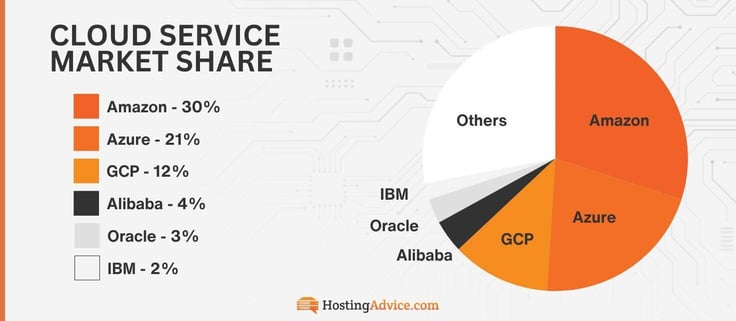
Its closest competitor, Microsoft Azure, is well behind with a 21% cloud market share. Google Cloud Platform is in a distant third with approximately 12% of the market. Additional players include Alibaba Cloud (4%), Oracle (3%), IBM Cloud (2%), Salesforce (2%), and Tencent Cloud (2%).1
2. Cloud Hosting Is the Fastest-Growing Web Hosting Segment, Growing at 18.3% Each Year
Everything is growing in the web hosting world. The entire market expands by 15% per year, while shared hosting usage increases by 10.3% yearly, and dedicated hosting usage grows by 5.6% yearly.
And although shared hosting dominates with a 31.7% share of the market, cloud hosting is by far the fastest growing at a rate of 18.3% yearly.2
3. Cloud Hosting Will Grow 20% By the Year 2030
A Fortune Business Insights study recently painted a clear picture of how fast the cloud hosting industry has grown (and will grow).
The report suggests that by 2030, the global cloud computing market will be worth more than $2.4 trillion.3 To identify what is sparking this astronomic cloud growth, simply look around.

The internet is our second home for dating, shopping, entertainment, and education. Cloud hosting provides businesses and organizations with a scalable hosting solution for both performance and storage. That paves the way for exponential cloud growth.
4. The Cloud Industry Grew 534.9% From 2010 to 2020
It’s also important that we look at the past. This helps to tell us if growth is becoming a trend.The cloud computing industry has grown significantly over the last decade. In 2010, the industry was worth nearly $25 billion.
By 2020, it had grown by about 535% and was worth at least $156 billion.4 That’s when the COVID-19 pandemic peaked and most businesses shifted to remote work. More entrepreneurs discovered the power of eCommerce businesses, and gamers spent more time in front of their consoles than ever.
5. Public Cloud Hosting Will Bring in At Least $980.3 Billion in Annual Revenue
Public cloud hosting will contribute more than $980.3 billion in annual revenue to the global tech economy in 2025.5

As for countries with the most cloud revenue, the U.S. takes the cake with roughly $457 billion in revenue in 2025. For scale, that’s more than the entire mining industry brought to the U.S. economy in 2024 ($393.7 billion).6
6. Hybrid Cloud Environments (70%) are the Most Popular
Around 70% of organizations use hybrid cloud environments, primarily for their flexibility.7 Enterprises and small businesses gain access to the cost-effectiveness of public clouds but also the security and customization of private clouds, hence why so many turn to hybrid solutions.
7. About 81% of Enterprises Use Two or More Clouds
More and more enterprises are relying on a combination of cloud services for a variety of reasons. In fact, 81% of companies state they’re using two or more cloud providers.
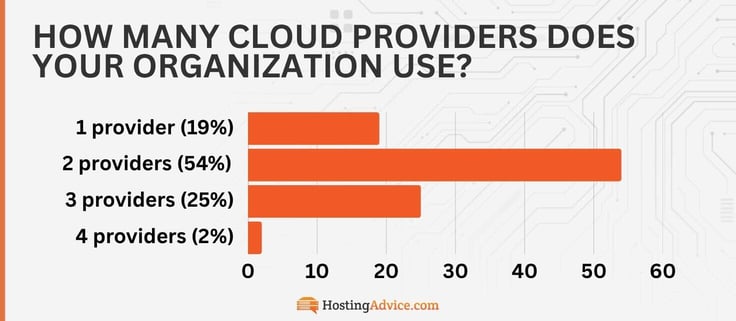
About 19% of enterprises use one cloud provider, 54% use two, 25% use three, and 2% use four. This is often to avoid vendor lock-in, receive more features, and build a more customized cloud solution. 8
8. The Public Cloud Industry Is Actually Slowing Down and Consolidating, With Annual Growth Dropping to 15.3%
Enterprise cloud providers have seen annual growth rates drop from 47% in 2021 to 15.3% in 2024. New cloud IPOs have decreased, too, showing that the market is maturing. In 2021, we saw 46 cloud IPOs. In 2024, there were three.9
9. SaaS Accounts for 45% of Cloud Hosting Revenue
Out of the $669.2 billion generated by the cloud hosting industry, Software-as-a-Service applications account for at least 45% of that, followed by Infrastructure-as-a-Service at 19.9%.
Platform-as-a-Service solutions are third, contributing 18.4% of global cloud hosting revenue. System Infrastructure Software (SaaS SIS) contributed 17% of all revenues to the cloud industry.10
| Application Type | Share |
|---|---|
| SaaS | 45% |
| IaaS | 19.9% |
| PaaS | 18.4% |
| SaaS SIS | 17% |
10. Three-Quarters (75%) of Business Owners Plan to Use Cloud Services By 2026
A popular IT consulting firm, Gartner, predicts 75% of business owners will invest in cloud hosting by 2026.11
The study notes that the future of business will evolve around customer experience, digital and business outcomes, and the virtual-first world. That indicates companies are now prioritizing internet-based solutions over the traditional brick-and-mortar approach.
11. The World Values Cloud Skills at $6.3 Billion
It’s not just cloud infrastructure and software raking in the dough — skilled workers are, too. Gallup estimates the annual global value of cloud-based skills and other advanced digital skills at $6.3 billion.
If you have advanced digital skills, expect to get paid a premium of 65% over non-digital workers.
This is also something for businesses to keep in mind, both that they may have to pay more for cloud-oriented workers, but also that they could make more money doing so.12
Final Thoughts on the Future of Cloud Hosting
Based on the data and trends, cloud hosting is on course to become the new face of web hosting.
Gone are the days when cloud hosting catered to enterprises and Wall Street. Gamers, startups, nonprofits, website developers, and eCommerce entrepreneurs have all adopted the cloud as the new hosting touchstone.
Pay-as-you-go models coupled with hybrid options have made cloud computing services more affordable and accessible for individuals and organizations. As prices fall and more users realize the benefits of cloud hosting, it is just a matter of time before it becomes a basic need in the digital space.
Sources and Further Reading:
- https://www.statista.com/chart/18819/worldwide-market-share-of-leading-cloud-infrastructure-service-providers/
- https://websitesetup.org/news/web-hosting-statistics/
- https://www.globenewswire.com/en/news-release/2023/05/16/2669731/0/en/Cloud-Computing-Market-Size-to-Surpass-USD-2-432-87-Billion-by-2030-exhibiting-a-CAGR-of-20.html
- https://www.statista.com/statistics/500541/worldwide-hosting-and-cloud-computing-market/
- https://www.statista.com/outlook/tmo/public-cloud/worldwide
- https://www.statista.com/statistics/247991/value-added-to-the-us-gdp-by-industry/
- https://info.flexera.com/CM-REPORT-State-of-the-Cloud?lead_source=Website%20Visitor&id=Flexera.com-PR
- https://cpl.thalesgroup.com/sites/default/files/content/campaigns/data-threat-report/2025-thales-data-threat-report.pdf
- https://cdn.prod.website-files.com/6643a08d305ab77f8c7566b6/670f22a19ea69a94f9710c1a_16%20October%20-%20Accel%202024%20Euroscape.pdf
- https://my.idc.com/getdoc.jsp?containerId=prUS52343224
- https://www.gartner.com/en/newsroom/press-releases/2023-04-19-gartner-forecasts-worldwide-public-cloud-end-user-spending-to-reach-nearly-600-billion-in-2023
- https://www.gallup.com/analytics/402284/aws-digital-skills-study.aspx