




Writer: Jordan Sprogis


Editor: Lillian Castro


Reviewer: Cristian Lopez

Key Takeaways
When the Department of Justice announced on April 20 that it was extending its ADA Title II web accessibility deadline, there was a sigh of relief across the web industry. One less technical mandate to worry about, right?
But that sigh may have come a bit too early for those in the private healthcare sector: While the DOJ’s extension gave public sector organizations more time under ADA Title II, it did not move the HHS Section 504 deadline.
For healthcare and social service organizations that receive federal financial assistance from HHS, the May 11, 2026 date is still the deadline for those with more than 15 employees. Smaller organizations have until May 10, 2027.
What These Rules Actually Are
The Americans with Disabilities Act (ADA) has required physical accessibility since 1990, but the web was a legal gray area for a long time. Until 2024, that is, when two separate federal agencies issued two separate rules requiring websites and mobile apps to meet a specific technical standard: Web Content Accessibility Guidelines (WCAG).
The first came from the DOJ under ADA Title II, which covers state and local governments: public schools, county courts, transit authorities, universities.
The second came from the HHS under Section 504 of the Rehabilitation Act, which covers private organizations receiving federal healthcare funding (hospitals, clinics, insurers, including many Medicare and Medicaid-funded entities).
WCAG 2.1 Level AA requires:
- All images have descriptive alt text
- Videos include synchronized captions
- Color contrast ratios meet a minimum threshold
- All functionality is operable via keyboard alone
- Form fields have visible labels
- Error messages identify what went wrong and how to fix it
The rule applies to all web content a covered entity provides or makes available, including third-party tools like appointment schedulers, patient registration platforms, bill pay portals, and telehealth platforms.
The 96.3% Problem
When 96.3% of the top 1 million websites have detectable WCAG 2 issues, it’s hard to believe that’s the baseline for most websites a week before a compliance deadline is set to go into effect.
And that’s not good math. Financially speaking, that is — website accessibility lawsuits have exceeded 4,000 federal filings annually. Out-of-court settlements typically run $25,000 to $75,000 per claim.
Now, hosting providers already understand that clients will treat ADA compliance as a website design concern. They’re assuming their themes are already accessibility-compliant — maybe just have to add some alt text and ARIA labels here and there.
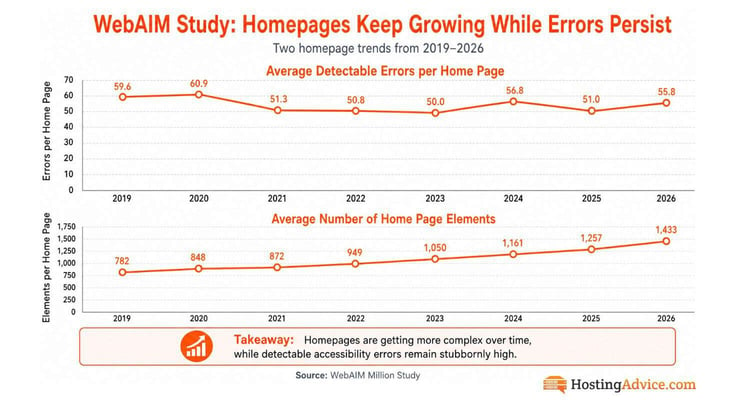
However, covered healthcare organizations cannot outsource its compliance to its host or CMS vendor. This accountability falls 100% to the organization. Obviously, history will tell you that this doesn’t mean the host is not relevant: They’re pulled into the loop whether they like it or not.
But managed providers may actually have a shortcut here. Many managed WordPress platforms, for example, already have built-in WCAG auditing and compliance-ready setups.
Call it Accessibility as a Service (AaaS, perhaps?) or the base standard for running a health services organization, but adding things like automated auditing can be a very high-value add-on or even dedicated tiers.
In the meantime, these deadlines are here. And for hosts with clients in these industries, it may be a welcome reminder. A healthcare organization that gets hit with an audit failure on a managed WordPress plan is going to ask their host what’s going on.
And it’ll be wise to be able to answer it. The hosts who can’t answer it may just see what mass turnover looks like from a compliance failure.
