




Writer: Ryan Frankel


Editor: Jordan Sprogis


Reviewer: Cristian Lopez

Key Takeaways
- Cloudflare’s new AEO Visibility Dashboard shows site owners whether Claude and ChatGPT cite, mention, or ignore them — and which competitors get recommended instead.
- Cloudflare engineers say fewer than half of all HTML page requests now come from a human.
- A companion Agent Readiness Diagnostic grades any site from “Not Ready” to “Agent-Native” across four effort tiers.
- The dashboard capped four launches in three days, positioning Cloudflare as a full agentic-web stack and pressuring stand-alone AEO vendors.
Ask any site owner about what happened to organic traffic this year, and you’ll hear variations on the same story: It dropped, rankings barely moved, and no one could say where the visitors went. The worst news? More visitors are skipping search altogether. Instead, they’re asking for Claude or ChatGPT to recommend something and then they go with whatever the model returns.
On Aug. 6, Cloudflare released a tool that measures what’s happening inside that black box. The resulting Answer Engine Optimization (AEO) Visibility Dashboard is available in early access within the Cloudflare dashboard. It reports on how AI assistants respond to buying questions for a site’s category and indicates whether the site is cited, mentioned, or ignored. Perhaps most importantly, it identifies which competitors receive the recommendation instead.
Four Numbers for a Question Nobody Could Answer
The AI tool breaks visibility down into four metrics, according to the engineering blog of Cloudflare.
The rate of citation reflects the proportion of responses that cite the site as a source. The rate of mention captures the more subtle situation in which the assistant refers to the name of the brand but provides no link to the site. The measure of prominence reflects the degree to which responses are based on content provided by the site and identifies the position of the site within each response. Finally, the share of voice provides a competitive perspective: It compares how often a site gets cited by AI models with how often its competitors are cited when answering the same question.
How Cloudflare Measures AI Visibility
| Metric | What it measures | What it tells you |
|---|---|---|
| Citation rate | How often AI responses cite your site as a source | Are AI assistants linking to you? |
| Mention rate | How often AI responses name your brand without linking to your site | Are AI assistants talking about you, even without a citation? |
| Prominence | How much a response relies on your content and where your site appears in the response | How important is your site to the answer? |
| Share of voice | How often AI cites your site compared with competitors answering the same question | How are you performing against competitors? |
The sampling runs against the two major AI vendors: Anthropic’s Claude and OpenAI’s GPT models. When a potential customer asks, “Which is the best managed WordPress hosting service for a small store?” and responses from both models cite only a site owner’s competitors and not their site, this is the tool that reports it.
“We see actual signals: real crawl activity, real referrals, what AI systems are genuinely doing across millions of sites,” Stephanie Cohen, Cloudflare’s chief strategy officer, said in the launch announcement. “Brands can finally get a real answer to the question they’ve been asking: how am I showing up, and where?”
The Stat Doing the Heavy Lifting
Cloudflare engineers put the reason for the timing in one line of the launch post: “By our count, fewer than half of all HTML page requests now come from a human.” That’s a huge amount of internet activity disconnected from human interaction.
Most page visits are now done by crawlers, scrapers, and agents — and they represent an increasingly important component of the experience of your users. The agents making recommendations to your customers include software that determines what to tell a human.
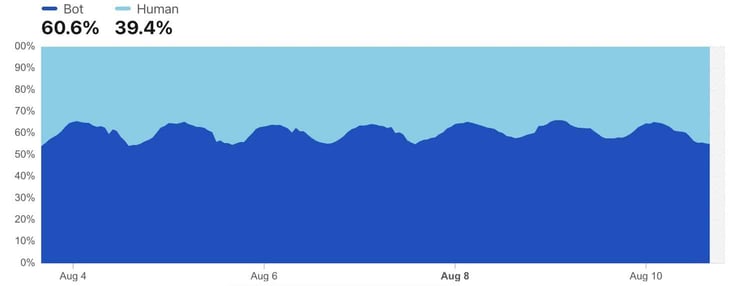
Discoverability means more than ranking on a search results page. It now includes detection, retrieval, and confident recommendation by agents controlling the experience of your users.
This represents a major change for hosts and for businesses operating on their behalf. Search engine optimization is a mature discipline with well established tools and charges. Answer engine optimization is barely in its infancy, and until last week, measuring it usually required paying a stand-alone vendor. The visibility dashboard provides information on whether agents recommend your site at all. The second tool in the bundle, the Agent Readiness Diagnostic, then checks whether agents can find, read, and use your site at all.
The diagnostic runs a series of technical checks, including examining robots.txt, XML sitemaps, response headers, availability of a clean machine-readable version of the site, rules for AI crawlers, use of Content Signals metadata, publication of MCP (Model Context Protocol) and A2A (Agent2Agent) agent cards, detection of access to OAuth identity services, and evaluation of agent compatibility with Web Bot Auth and with WebMCP.
From “Not Ready” to “Agent-Native”
The diagnostic reports results for four levels of effort: Quick Wins, Technical Groundwork, Advanced Integration, and Commerce. Each hostname receives a grade between “Not Ready” and “Agent-Native,” with an evidence trail behind every check.
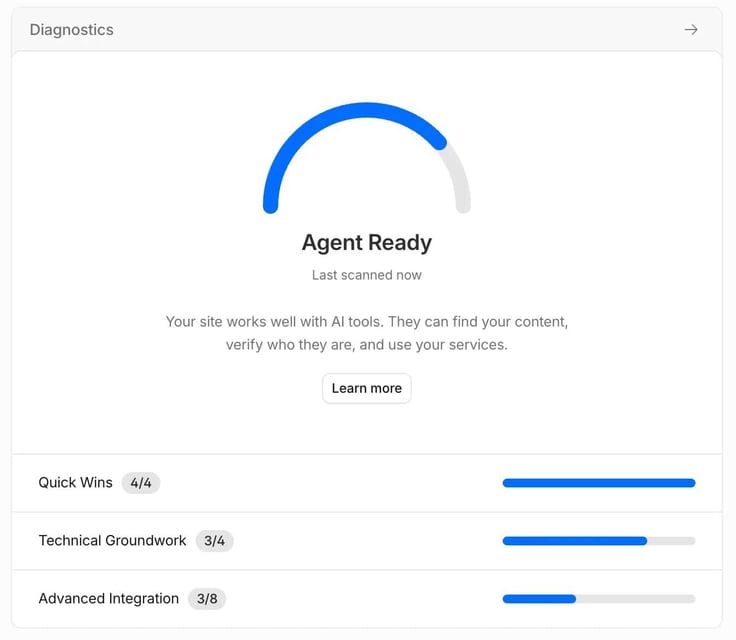
“Quick Wins” and implementing basic technical requirements is a relatively inexpensive first step toward making a site more agent-friendly, but fully integrating with agent-controlled systems and providing complete support for agent-controlled commerce is a major time and resource commitment. It also points to Cloudflare’s grand vision of where this is headed: agents that make purchase decisions on behalf of humans.
Four Launches in Three Days
The AEO dashboard didn’t arrive alone: It rounded out a week of work by Cloudflare to deliver a complete agentic web stack.
Cloudflare Agents, a hosted agent platform with integrated tracing and observability, launched on Aug. 4, the same day as Cloudflare Wallets, which provides agents with an identity and a balance of stablecoins to spend on behalf of their owner. Cloudflare OS, an open-source AI workspace, followed on Aug. 5, and the AEO dashboard brought the week to a close on the 6th. This is a full stack upgrade. And in the process, according to Adweek’s coverage, it directly competes with standalone AEO tools such as Profound and Athena, as well as with the AI-enabled visibility capabilities added by Ahrefs and Semrush to their product suites this year.
Cloudflare's Agents Week: Four Launches in Three Days
The result is equivalent to providing an entire dashboard tab to every Cloudflare account. The economics of stand-alone AEO services probably got more difficult on Aug. 6.
But who will make the next move remains to be seen. Both Google and Microsoft maintain their own answer surfaces, and neither provides site owners with a native view of how their sites appear in the AI answers. And an obvious opportunity for integration now exists for small-business web hosts like Bluehost, SiteGround, Hostinger, and DreamHost, because “why isn’t my site in Claude’s answer?” is quickly becoming a support call, not a hypothetical.
For 20 years, these web hosts have sold visibility as a problem for Google. Their next attempt to do so will be accompanied by a report card for each site, with every site receiving a grade between “Not Ready” and “Agent-Native.”
