



Writer: Jordan Sprogis


Editor: Lillian Castro


Reviewer: Cristian Lopez

Key Takeaways
In 2023, a Netlify user opened their dashboard to find a $104,500 bill thanks to a sudden bandwidth spike caused by a DDoS attack. It’s hard to imagine seeing a bill like that, let alone for something out of your control. And stories like this one pop up more often than most people even realize.
Hostinger wants to take problems like that, crumple them up, and toss them into the kindling. The company — which is one of the top three hosting brands in the world — just released a managed Node.js application hosting tier across its cloud platform.
It’s designed for the same JavaScript Git-based deploys and auto-scaling that drew developers to the likes of Vercel and Netlify, but with one major difference: There are zero usage-based fees.
The Rise of Developer-First Hosting Platforms
Developer-first platforms have been putting traditional hosts in a chokehold as devs migrated to their platforms in droves, promising them easier workflows with things like automatic deployments, and of course, serverless computing.
Traditional PaaS is also more backend-centric. It forces devs to manage environments, runtimes, ports, firewalls, daemons, the whole nine. But more modern platforms — the “dev-first” ones — are frontend-first, removing almost everything that looked like infrastructure management.
“A major driver for this growth is Node.js, which lets developers use the same language for both the frontend and backend,” said Saulius Lazaravičius, Hostinger’s VP of Product. “This cuts development time, reduces costs, and keeps projects simpler. It also makes scaling easier because Node.js handles many simultaneous connections without blocking or waiting for slow tasks to finish.”

But there are trade-offs. Serverless platforms are great when it comes to ease-of-use. But every request, compute cycle, or gigabyte is considered a metered charge, so costs that start small can snowball in a second.
Even a fairly small Next.js app can look affordable for months and then jump from $40 to $200+ after a traffic surge. AKA, cloud unpredictability — a song and dance we’ve all heard before.
That’s why so many hosts are now scrambling to compete in the developer lane. They’re hoping to win back a demographic they lost (or never even had).
And by promising that no matter how much traffic you get, Hostinger is making one of the most appealing cases of a lifetime.
What Hostinger Is Actually Offering
Hostinger’s new Node.js hosting is available now, but it does raise an obvious question: Why start with Next.js instead of the dozens of other JavaScript frameworks developers rely on?
Hostinger acknowledged that while JavaScript is smaller compared to other server-side languages, its usage has increased by 1.5% in the past year. PHP declined about 2.6%.

“Hostinger also sees a much higher adoption among newly created projects, where modern stacks often start with JavaScript by default,” the press release added.
But what you get and how much you’ll pay for it depends on the plan you choose. Node.js hosting is available via:
- Cloud Hosting: Managed environment, easy-to-deploy Node.js apps, automatic backups, free SSL, and a free domain for 12+ month plans
- Agency Hosting: Includes all Cloud features plus advanced collaboration and client management
- VPS Hosting: Full root access, total control, and the ability to install any stack or software (Note that Netlify and Vercel don’t offer full root access.)
Just one caveat, according to Hostinger’s Kodee agent: “For VPS plans, if you exceed your monthly bandwidth, your connection speed is temporarily reduced until the next month, but you won’t be charged extra.”
Its core features include:
- Fully managed infrastructure
- Automatic scaling
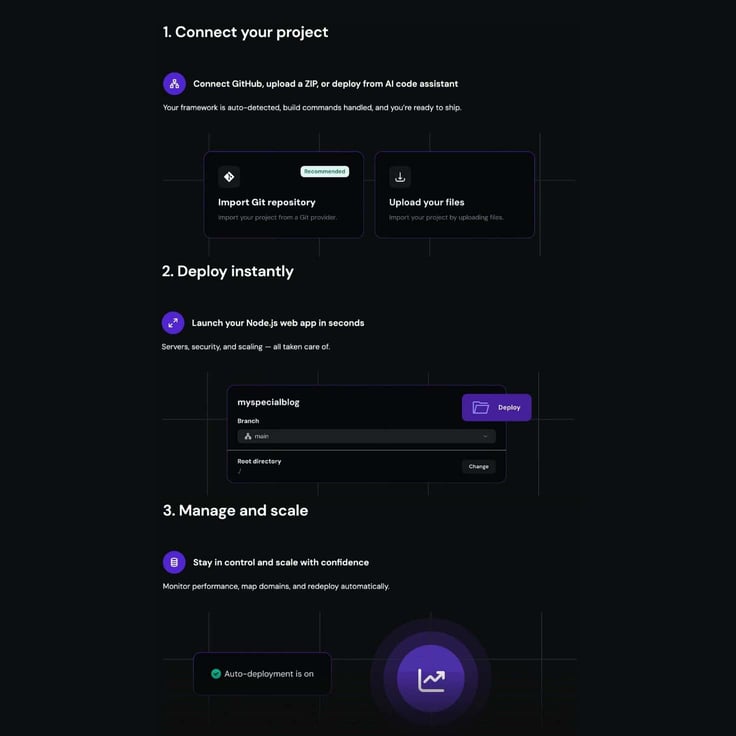
- Deploy from GitHub, every commit redeployed automatically
- Option to upload via ZIP or IDE
- Production-ready runtime with no server configuration
- One flat monthly price
This is something worth remembering when considering the fact that developers are not loyal to specific hosts as much as they are to the platforms those hosts offer; if a host wants to help host the next gen of projects — which are all going to be AI-adjacent — they need to support those workflows.
Let’s look at some real numbers. Say you’re building a small web app with:
- 100,000 serverless/edge function requests per month
- 50ms average execution time per request
- 10 GB bandwidth outbound
- No premium add-ons
| Platform | Base Price | Invocation Cost (100k) | Bandwidth Cost (10GB) | Total for Scenario |
| Vercel (Pro) | $20/user/month + usage-based overages | $0.02 (per-unit pricing) | $1.50 | $21.52 |
| Netlify (Pro) | $19/team member/month (includes 3M function calls; overages billed per unit) | $0.05 | $2.00 | $21.05 |
| Cloudflare Workers (Paid tier pricing) | $0 base + $0.30 per million requests + $0.02 per million CPU-ms | $0.05 | $0 | $0.05 |
| Hostinger (Managed Node.js) | $27.99–$69.99/month (flat cloud-hosting plan pricing) | $0 (no metering) | $0 | Flat monthly price — usage does not change cost |
The table is really just here to demonstrate how Hostinger’s flat pricing looks in action. It’s truly $0 meterage.
And Hostinger knows exactly what it’s doing; it’s spent the past couple of years stacking on more developer-friendly and client-friendly tools, including:
- Hostinger Mail (with AI features)
- Hostinger Reach (AI email marketing)
- Hostinger Horizons (AI builder for sites and apps)
- AI support tools in its Website Builder and WordPress ecosystem
Clearly, Hostinger wants to move from the shared hosting provider reputation it’s had for years to developer-first application platform. Just, you know, without abandoning the predictable pricing that actually built that reputation.
