



Writer: Jordan Sprogis


Editor: Lillian Castro


Reviewer: Cristian Lopez

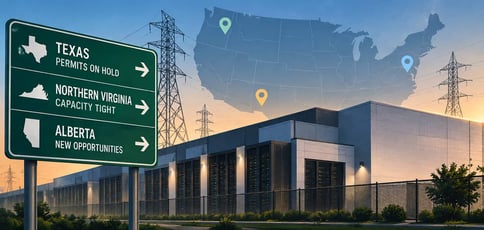
Data centers are popping up everywhere, but finding enough power to run them is becoming a bit of a headache. Texas is putting new permits on hold, Northern Virginia is running low on available capacity, and operators are looking to places like Alberta for their next big projects.
Here’s a quick roundup of what’s happening in the data center world.
1. Texas Puts Data Center Expansion Under the Microscope
Texas has spent years selling itself as an attractive destination for data center development, but a recent decision says that cost and power demands are harder to ignore when choosing where to build.
On Monday, September 21, Texas Gov. Greg Abbott ordered a halt to new state-issued data center permits while officials conduct an audit of the facilities’ impact on the state’s electrical grid.
“Simply put, Texans must come first,” said Gov. Abbott. “Data centers must pay their own way, protect our grid and water, and complete the ERCOT and TWDB audits. Until they do, TCEQ will issue no permits sought by data center projects.”
According to Reuters, more than 470 GW of data center projects are requesting grid connections in Texas — and that’s far beyond the state’s peak demand. The audit will examine electricity consumption, tax incentives, and water usage.
2. Data Center Capacity Is Growing, But Available Space Remains Tight
Building more facilities should, in theory, make it easier for businesses to find space for their workloads…and yet, the latest figures from CBRE say it’s not that easy.
In its North American Data Center Trends report, released September 8, CBRE found that Northern Virginia added more than 1 GW of data center capacity over the past year. But somehow, Northern Virginia’s vacancy rate fell to 0.2%, leaving just 10.8 MW of capacity available. Companies are apparently leasing data center space faster than operators can build it.
"Power is the deciding factor in Northern Virginia right now," said Stu Dyer, Executive Vice President with CBRE's Data Center Solutions Group. "Occupiers and capital sources that secure power early are the ones closing deals."
| Market | Total Inventory (MW) | Available Capacity (MW) |
|---|---|---|
| Northern Virginia | 4496.5 | 10.8 |
| Atlanta | 1803.2 | 29.5 |
| Dallas-Fort Worth | 1432.8 | 39.6 |
| Phoenix | 1069.2 | 12.1 |
| Chicago | 910.6 | 20.0 |
| Silicon Valley | 509.2 | 21.2 |
| Hillsboro | 491.4 | 1.1 |
| New York Tri-State | 190.0 | 13.7 |
The same thing is happening across eight major North American markets — Northern Virginia, Dallas-Fort Worth, Silicon Valley, Chicago, Phoenix, New York Tri-State, Atlanta, and Hillsboro — where more than 80% of the data center capacity under construction has already been leased, leaving less than 1,500 MW available for companies looking to reserve space.
Apparently, even AI data centers aren’t immune to the laws of supply and demand.
3. New Regions and Existing Power Infrastructure Are Becoming Part of the Strategy
Up in Alberta, Meta's planned C$13 billion data center (~$9.4 billion USD) is drawing attention to the region's land and energy resources. Reuters reported that Capital Power is discussing electricity supply for other projects, while BCE plans to expand its Saskatchewan data center into a 1.2 GW hub.
To top it off, Capital Power's CEO Avik Dey says it could help attract even more big names to Alberta.
"Meta is the first to cross the line, but I think multiple hyperscalers have been evaluating Alberta for, I would say, the last 18 months," Dey said. "I do feel strongly that we've got the potential to be a multi-gigawatt market."
Most Data Center Capacity Under Construction Is Already Preleased
More than 80% of capacity across eight major North American markets has already been leased.
- Preleased
- Available for preleasing
Meanwhile, Google is helping Georgia Power increase electricity generation at its Vogtle and Hatch nuclear plants. The upgrades are expected to add approximately 96 MW to Georgia's grid, and Georgia Power estimates the agreement could deliver $900 million in customer benefits over the plants' operating lives. The deal still needs regulatory approval, though.
OK, So What?
Because they’re gonna build anyway, right? Even so, it doesn’t mean hosting providers can assume new capacity will be available when they need it.
Power shortages, permitting delays, and limited space can push back expansion plans or increase infrastructure costs. Just look at Texas, where officials paused new data center permits until they can fully audit its impact on the power grid. (Though Alberta's looking pretty good.)
So, if you’re a hosting provider planning to expand, you may want to check how much power and data center capacity a region has before settling on your next location.
