




Writer: Jordan Sprogis


Editor: Lillian Castro


Reviewer: Cristian Lopez

Key Takeaways
- AI is making everyone's lives easier, but David Linthicum warns the industry is drifting toward the same mistakes it made with early cloud adoption.
- But the problem isn’t AI itself. It’s how quickly companies are deploying it without fully considering infrastructure impact or whether there’s a real ROI.
When something is presented as both revolutionary and inevitable, there’s an odd sense of familiarity. Dot-com and the cloud pitched the same things, didn’t they?
As soon as AI became the next big thing, hyperscalers began dumping billions into expansion projects. And there are already immediate consequences: Just look at Vietnam or the Netherlands, which are experiencing outages and power rationing just to keep up with electricity demand.

Just like so many did with the cloud, organizations are investing billions of dollars into AI without fully understanding the cost, security, and infrastructure necessary to do so.
Sometimes, that rush toward AI isn’t even driven by demand. After a wave of negative feedback, Mozilla Firefox recently announced it’s adding a kill switch option for its new suite of embedded AI tools.
“Just save the money and don’t add any AI. No one asked for it. Does any executive ever interact with a normal human being?” commented one Redditor on a news thread in r/technews. Another user responded, “It’s clear that the higher-ups at Mozilla are being paid money for pushing AI into Firefox.”
When HostingAdvice spoke with longtime cloud and AI strategist David Linthicum at CloudFest Miami, his warning about AI wasn’t rooted in fear. He’s a vocal advocate for it and even teaches one of LinkedIn Learning’s most popular courses on the subject. But he’s also seen what can happen.
“We’re looking at making the same mistakes we made 15 years ago when we first started to move to the cloud,” Linthicum told us. “Only now, AI systems cost ten times as much as traditional systems doing the same thing.”
Is AI Hype Following a Familiar Pattern?
The biggest mistake that enterprises made during the cloud boom wasn’t choosing between AWS and Azure. It was hopping on the bandwagon, convinced that if everyone else was doing it, they should get a foot in the door as early as possible.
Linthicum saw this happen firsthand during his decades at Deloitte when clients would ask to switch to AWS.
“They’re following technology and not their own requirements,” Linthicum explained. “They know what they think they want because they’ve been deluged with marketing messages, demos, and videos. That’s exactly what they end up doing — even when it’s the wrong choice for their situation.”
Most of the time, there wasn’t a real answer. A client can deploy on AWS and the systems will work, but they’ll be wildly inefficient.
“They end up with something that’s wholly under-optimized,” he added. “For every dollar they’re spending on cloud computing, they’re losing two. I see that over and over again.”
This is partly because the risks with AI are massive. AI is far from cheap to build or train. Overspending, lack of security, or ever seeing real ROI should be expected.
“Agentic AI is very expensive. It’s very problematic to operationalize. It’s very problematic to secure,” Linthicum said. “It’s being pushed as the definitive architecture, but it has a limited number of valuable use cases. I think it’s going to have a reckoning.”
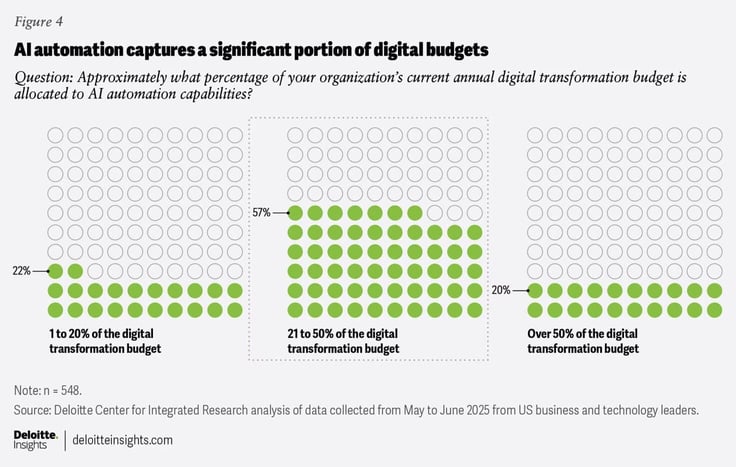
Surveyed organizations say their AI investments outpace almost every other digital initiative, with more than half allocating 21-50% of their digital budgets to AI.
For a big company, that can mean hundreds of millions of dollars. And yet, another report says that 49% of those surveyed can’t confidently say whether their AI spending is delivering any real ROI.
And Then There’s the Cost-Security Bottleneck
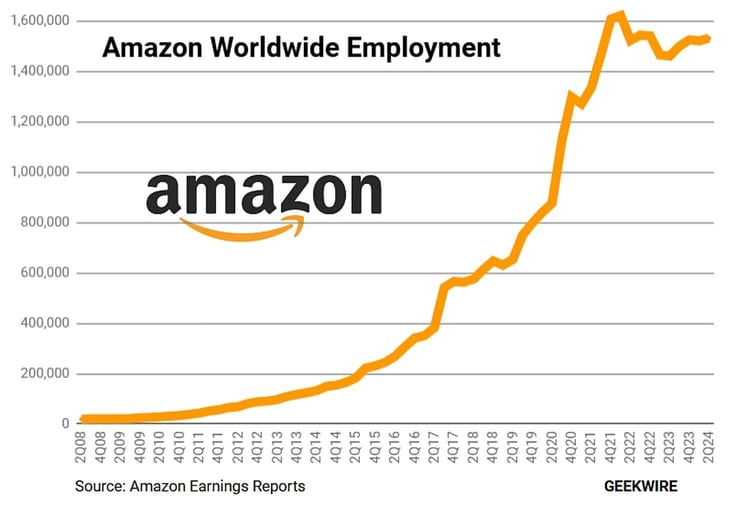
And yet, nobody is immune to falling for the AI hype. One of biggest news this year was the fact that Amazon recently laid off 14,000 people, making it one of the largest rounds of layoffs in its history.
The timing, of course, coincided with a renewed push toward efficiency and heavier investment in AI infrastructure. Andy Jassy, Amazon’s CEO, said in June:
“As we roll out more Generative AI and agents, it should change the way our work is done. We will need fewer people doing some of the jobs that are being done today, and more people doing other types of jobs.”
Ask Linthicum and he doesn’t believe AWS has AI systems in place yet that would justify laying off thousands of employees.
“[AWS is] making excuses for overhiring [during the pandemic] and having more competition out there than they thought they would have,” he theorized.
And soon, the AI hype will subside for many other organizations, too.
The technology will remain useful for replacing specific tasks, but most enterprises will eventually settle on monolithic generative AI systems — large, centralized models designed to handle many tasks at once, often with broad access to data, tools, and internal systems.
And that will have major security implications.
“We’re going to end up with monolithic generative AI systems for about 95% of problems,” Linthicum said. “And many of them will run in OPCs — other people’s clouds, other people’s AI systems. We’re not going to build everything internally.”
The way data moves in the cloud is not unlike the hive mind in “Pluribus.” Information is passed within seconds, almost effortlessly. But when one node stalls, it’s like a domino effect.
And yet, companies are trusting AI systems with unlimited visibility and control into their data, customers, pricing, and internal operations.

“AI becomes the mother of all single points of failure for the security system,” Linthicum warned. “AI systems are trained with a lot of enterprise data. They’re going to know everything about everything. And therefore, it’s a single point of theft.”
Even a basic chatbot can act as a single point of failure, given the level of access it often needs to internal databases and knowledge bases to answer customer questions.
It’s part of why Linthicum thinks 2026 is going to be a big year for AI breaches.
“People moved their data into proof-of-concept prototypes, under-protected, and it’s going to get stolen,” he said. “We don’t understand the impact of AI becoming another place where all your data resides.”
His advice? Stop treating AI like an inevitability and start treating it like infrastructure. Pick architecture deliberately. Understand the tradeoffs. Decide what you actually need before committing to what everyone else is using.
This is a companion piece to: “Why This Cloud Strategist Says It’s Time to Rethink Everything Most People Believe About the Cloud.”
