



Writer: Jordan Sprogis


Editor: Lillian Castro


Reviewer: Cristian Lopez

Key Takeaways
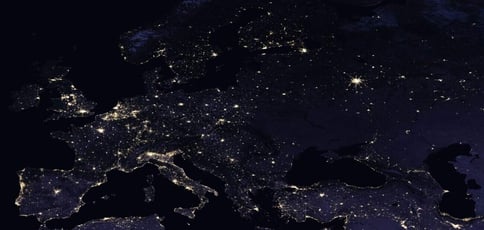
AI data centers are truly taking their toll in Europe: Nearly 12,000 Dutch businesses are rationing electricity because the country’s power grid just isn’t keeping up with demand. Even homeowners are asked to lessen the strain with a campaign called “Flip the Switch,” which encourages using less electricity between 4 and 9 p.m.

Officials estimate it could take around 200 billion euros to modernize the grid by 2040 — at the earliest, but that’s a long time for a problem that’s already draining 10 to 40 billion euros from the economy each year.
Some companies look at this landscape and expand anyway. Expansion equals new markets equals more revenue. And yet, Snel.com — a hosting provider out of the Netherlands — says it’s purposely going in a different direction.
When we asked if it plans to expand beyond the Dutch market, founder and CEO Mustafa Aslan told HostingAdvice: “We’re not planning geographic expansion right now; we prefer to stay focused and keep service quality high.”
Europe’s Energy Problem Is More Than “Expensive”
An energy shortage almost sounds like an old wives’ tale until you realize it’s a regular Tuesday in Europe. After weaning off Russian gas in 2022, the EU began moving to importing LNG (liquified natural gas) from the U.S., Norway, and Qatar.
The problem is that those imports are slower and much more expensive. And, when energy is bought in dollars, and revenue is earned in euros, that means every dollar of imported power now costs about eight extra euro-cents.
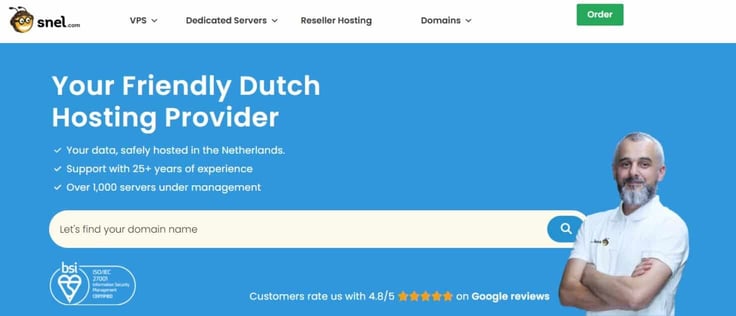
It’s the environment that Snel.com is living in, and probably why its pitch is aggressively simple: “Make hosting fast, reliable, and easy to work with.”
“Customers wanted enterprise-grade hardware without slow onboarding,” Aslan explained. “So we focused on quick delivery, transparent pricing, and human support with no fuss.”
Funnily enough, this works because of Europe’s energy crisis. Because any host that wants to move into a new region has to factor in the real costs of those risks, like grid congestion and rising electricity prices.
“Grid congestion is like a traffic jam on the power grid,” said Kees-Jan Rameau, chief executive of Dutch energy producer and supplier Eneco. “It’s caused by either too much power demand in a certain area, or too much power supply put onto the grid, more than the grid can handle.”
It’s kind of why Snel.com’s hyper-local strategy is key. It reports 793 Gbps of capacity, 110 thousand kilometers of fiber routes, 1,700 peers, and more than 1,000 servers running in the Netherlands alone. Is that proof the locally focused model is the way to go? Maybe.
As a host with one well-managed region — even if it’s a smaller pool to market to — the company offers what multi-regional providers can’t always guarantee:
- Steadier power expectations
- Simpler compliance (great for EU-only workloads)
- A clean, traceable audit trail
That last one is important because, in addition to the data sovereignty infrastructure that the EU is desperately trying to build, Aslan said “more customers [are] asking for EU-only hosting and clear audit trails.”
This time, it’s not the GDPR — a topic we always find ourselves back at — but the NIS2 Directive. NIS2 is a new EU cybersecurity law that will require faster incident reporting and stricter vendor oversight, which means a lot more paperwork. That also likely means hiring more staff just to keep pace.
Keeping up with costs tied to new rules and rising infrastructure bills may be part of the reason nearly 60% of organizations now have dedicated FinOps teams. They’re all asking the same question: Where is the money actually going, and is it justified?
But even this host isn’t immune to the energy crisis. A December 2024 blog post from the company indicated rising costs are forcing some price increases in 2025: “Like many businesses, we are facing rising costs for things like domain names, licenses and energy.”
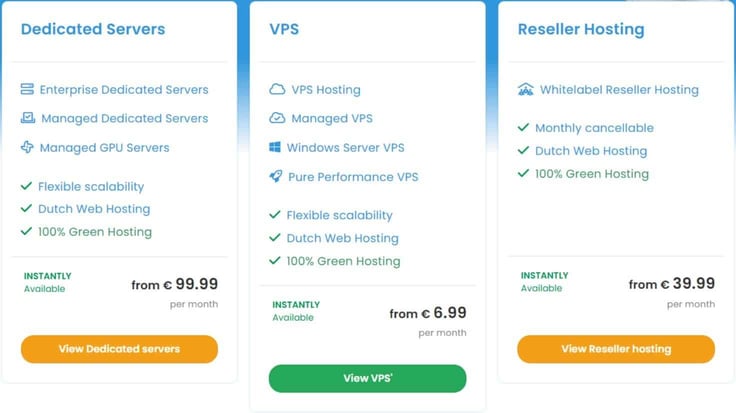
Yet, Snel.com appears very competitive in its pricing for shared/VPS offerings in the Dutch market with plans starting at 6.99 euros/month.
The Bigger Picture for European Hosts
One of the biggest problems around Europe’s energy issue is the fact that it’s delivering less power to data centers than it did a year ago — about 11% less, to be exact.
That means every host, colocation provider, and cloud operator in Europe has a customer base who wants to pay for the compute, but there’s no way to actually meet that demand.
Let’s draw a hypothetical: If all planned data centers in Europe were greenlit tomorrow, they could increase European demand by around 30%. That’s a big number that suggests Europe would basically have to power an extra country’s worth of load just to work its data centers.
Of course, one solution is to invest in smarter infrastructure and make greener investments. Take Infomaniak for example, which built a 100% renewable underground data center in Switzerland that uses its waste heat to warm about 6,000 local homes.
Or look to Data4 in France, which is building what they call a “biocircular data center” — any excess heat from servers is used to grow algae that absorbs CO₂ and can actually be reused in the local economy.
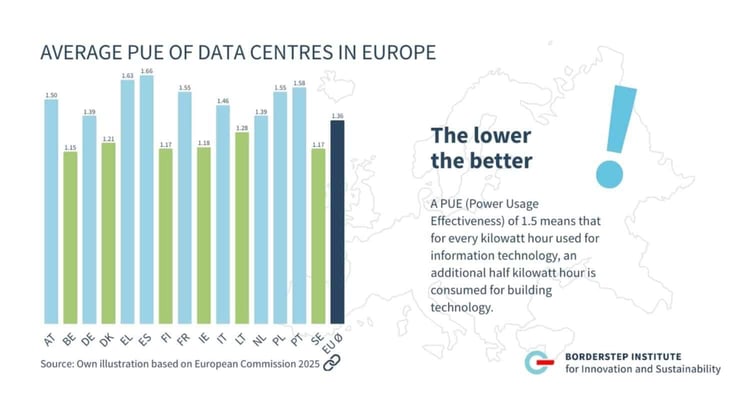
But even efficiency won’t save everyone. A recent EU-commission-backed study found the average Power Usage Effectiveness (PUE) for data centers across the bloc at 1.36, which means more than 25% of energy goes to cooling and powering servers instead of the actual computing.
That’s where Snel.com’s model becomes relevant on the infrastructure, environmental, and economic levels. The hosting provider runs in Smartdc’s Rotterdam facility, which operates on 100% renewable energy and uses heat-pump systems to recycle server heat.
But truthfully, there’s nothing revolutionary about it. With Snel.com managing its costs directly in the Netherlands, it has more visibility into where “rising costs” (energy, licenses, domain extensions) hit first and where it can choose not to raise prices.
It’s just as Aslan said: “We keep things friendly and direct — clear SLAs, fast responses, and engineers who actually solve problems.”
