



Writer: Jordan Sprogis


Editor: Lillian Castro


Reviewer: Cristian Lopez

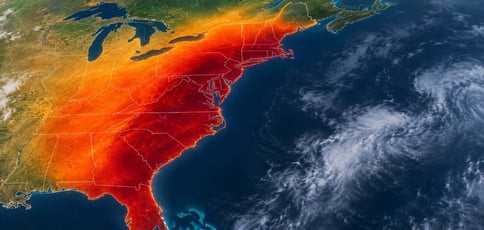
Although the East Coast is finally feeling some relief this week, last week was a trip to Hell itself. Meteorologists warned the heat wave was coming for days, but that didn’t make it any easier to endure as heat indices climbed past 110°F in some areas. The power grid hit 163 gigawatts (GW) of demand — which is just a couple gigawatts shy of its all-time record of 166 GW from 2006.
PJM Came Within 3 GW of Its All-Time Demand Record
Peak electricity demand reached 163 GW during the East Coast heat wave, which was just shy of the 165.6 GW record set in 2006.
Then came the weather: Fourth of July thunderstorms (fueled by that same heat) knocked down trees and power lines across state lines and topped it off with golf-ball-sized hail, leaving even more customers without power or internet.
It got so bad that utilities in Maryland asked customers to grill outside in triple-digit heat instead of using the oven, and New York City’s mayor asked residents to set their thermostats to 78°F.
And yet, most websites never skipped a beat. Even at the peaks of the heat and storm, major cloud providers, including Amazon Web Services, Microsoft Azure, Google Cloud, DigitalOcean, and Vultr, didn’t report any major heat-related outages.
Did Data Centers Actually Help Keep the Lights On?
Compared to just a decade ago, hosting infrastructure has really come a long way. In 2012, flooding Hurricane Sandy knocked multiple New York data centers offline after backup generator systems failed, taking major hosting providers and some of the biggest websites down with them.
Today, the standard for providers is to spread workloads across multiple regions to avoid outcomes like that.
But PJM Interconnection — which services 67 million people across 13 states, including Virginia’s Data Center Alley — isn't always so lucky. It had a lot on its plate well into the weekend to the point where Energy Secretary Chris Wright signed an emergency order authorizing PJM to direct large power users consuming at least 50 megawatts (MW) to switch to on-site backup generators.
This meant that if the grid started running out of electricity, some of its biggest consumers — yup, like data centers — should rely on their own power instead of pulling from the grid. The order was in effect from June 30 to July 3.
Electricity also got absurdly expensive because demand was so high and the supply had to be evened out. This happens because utility companies buy electricity ahead of time, so it therefore uses “day-ahead” predictions based on forecasted demand. Normal wholesale prices run around $40 per megawatt-hour (MWh), but day-ahead power last week topped $2,000 per MWh. That’s a 60x increase, which is something that's hard to prepare for.
The Government Reached for a Wartime Law
The order that the Department of Energy (DOE) issued is not unusual, but it’s also not very common. Under Section 202(c) of the Federal Power Act, the Energy Secretary is allowed to intervene under emergencies.
While "emergencies” has the potential to sound apocalyptic, it historically refers to major weather events, and, well, wars. The authority was actually first used in 1941, months before the U.S. entered World War II. So a good portion of the U.S. had to leverage wartime laws just so the power grid could cope in 2026.
Generally, Section 202(c) has been used more often. In January this year, the DOE exercised a power it had never used in the Federal Power Act’s 91-year history by authorizing grid operators to require certain data centers and other large electricity users to switch to on-site backup generation during emergencies. A May heat wave brought a second round and then PJM’s June order was its third of the kind this year.
It's safe to say that emergency federal intervention for energy is definitely becoming more common. AI infrastructure is consuming more electricity than ever, and PJM expects peak demand to increase by 32 GW by 2030, with almost all of it — 30 GW to be exact — coming from data centers alone.
It’s not just an East Coast or Data Center Alley thing, either: Similar Section 202(c) emergency orders have been issued for Duke Energy in the Carolinas (Order No. 202-26-34), ERCOT in Texas (202-26-04), and ISO New England (202-26-03).
Wherever you’re hosting, there's a good chance your local grid will face similar pressures if it hasn’t already.
