



Writer: Lynn Cadet


Editor: Lillian Castro


Reviewer: Christina Lewis

Key Takeaways
-
Vector databases are moving past the experimental stage, with 67% of surveyed engineers reporting their organizations already use them, and 76% favoring purpose-built, vector-native systems over retrofitted legacy databases.
-
Nine in 10 engineers said they manage more than 1 million vectors, with nearly half handling between 10–100 million, underscoring the need for infrastructure designed for high-volume, low-latency workloads.
-
Fragmentation defines the current landscape, with no dominant platform yet — Quadrant, Pinecone, OpenSearch, Weaviate, and Chroma all hold meaningful market share — suggesting the sector is still in a dynamic, early-stage phase similar to the early NoSQL era.
Survey Methodology: This survey was conducted in August 2025 among 300 U.S.-based engineers with at least three years of experience. Respondents held roles in Data Engineering, Machine Learning, Search Engineering, AI/ML Architecture, or Data Science.
The sample was specifically drawn from organizations within the Healthcare, Software, Information Technology, Finance, and Automotive industries, identified for their likelihood of having AI/ML computing needs. Respondents were selected from a third-party research panel.
To ensure the integrity of data collection, the researcher developed a proprietary machine-learning algorithm that can detect fraudulent responses early and remove inauthentic respondents immediately. The overall margin of error is ±3.1 percentage points at the 95% confidence level. Margins of error increase for subgroups such as age or gender.
If you build or scale AI systems for a living, odds are you’re already swimming in embeddings. Those high-dimensional vectors are the fuel that makes large language models, search systems, and recommendation engines actually work. The problem with traditional relational databases is that they were never designed to handle vectors efficiently at scale.
That’s where vector databases come in, and according to new research from HostingAdvice, adoption is moving much faster than most people realize.
67% of Engineers Say Their Org Uses a Vector Database
In a survey of 300 U.S.-based engineers across industries such as healthcare, IT, finance, and automotive, two-thirds (67%) said their organizations are already using a vector database. That’s a stunning level of penetration for a technology that was barely on the radar five years ago.
It isn’t just experimental adoption, either; 76% of these engineers say they’re working with vector-native databases, as opposed to bolting on vector search features to legacy systems. That suggests the industry is already past the dabbling stage and leaning into purpose-built infrastructure.
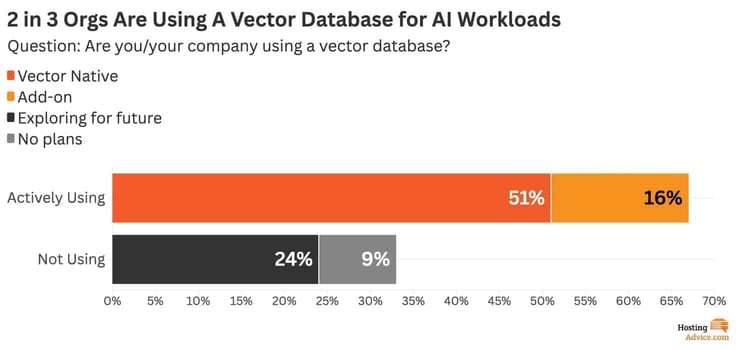
For those who said their organization is not currently using a vector database, 73% admitted they are exploring leveraging one for AI use cases in the future.
When it comes to which platforms engineers actually use, there’s no runaway winner to this point:
- Quadrant = 28% adoption among users
- Pinecone = 24%
- OpenSearch = 21%
- Weaviate = 13%
- Chroma = 11%
This fragmentation isn’t surprising in such a young category, but it highlights a shift in engineering culture: instead of one database to rule them all, teams are comfortable experimenting with highly specialized systems that do one thing very well.
If you think vector databases are just for experimental projects, though, think again. Nine out of 10 engineers surveyed said they’re managing more than 1 million vectors. The most common ranges were:
- 44% of respondents said their database handles 1–10 million vectors
- 46% said theirs handles 10–100 million vectors
- 5% said they store more than 100 million vectors
- Another 5% said they store less than 1 million vectors
That scale matters. Handling tens of millions of embeddings requires both algorithmic efficiency and infrastructure tuned for low-latency queries. It’s no wonder engineers are turning away from relational systems that choke on this large of a workload.
Vector databases are becoming a critical infrastructure for the AI boom. Consider these few forces at play:
- LLM integration: Retrieval-augmented generation (RAG) is fast becoming the standard way to inject private knowledge into large language models. Without a vector database, RAG is dead on arrival.
- Industry use cases: In healthcare, vector search powers patient record retrieval and diagnostic tools. In finance, it’s fueling fraud detection and risk analysis. In automotive, embeddings are behind autonomous driving perception systems.
- Cost and performance pressure: Training models is expensive. Organizations are looking for efficiency gains anywhere they can find them, and optimized vector stores are proving to be low-hanging fruit.
Gartner has already flagged vector databases as one of the “emerging technologies to watch” in data infrastructure. Vector search may turn out to be as foundational to AI workloads as SQL was to transactional systems just a few decades ago.
The Road Ahead
It’s worth noting that not every company is on board yet. About one-third (33%) of engineers surveyed said their organizations are not using vector databases. That gap represents a market opportunity for vendors. It also points to a risk for enterprises that may fall behind competitors who can deploy AI workloads faster and cheaper.
The question isn’t whether vector databases will become mainstream; it’s whether they’ll consolidate into a few dominant platforms or remain a fragmented ecosystem of players. The parallels to the early NoSQL era are striking; there’s plenty of experimentation, lots of hype, and the possibility that today’s favorite tool won’t even exist in five years.