


Writer: Lynn Cadet


Editor: Lillian Castro


Reviewer: Christina Lewis

Key Takeaways
- 58% say they would rather use a poorly optimized mobile website than be forced to download a mobile app.
-
Most people (75%) would prefer to use a mobile website that mimics app functionality than download an app.
-
The top reasons why people choose to download apps are for frequent use (49.8%) and for a better user experience (47.6%).
There’s an app for that… but does there need to be? We’ve all been there before. We fire up our mobile browser, type in a search, click a promising link, only to be told that to access the content, we need to download their app.
Brand apps have evolved into a source of frustration for many users. More than half (58%) of respondents say forced app installs are more irritating and inconvenient than poorly optimized mobile websites, according to a recent HostingAdvice survey.
In today’s digital age, mobile devices account for 63% of all internet traffic. Accessibility and convenience are king, and attention spans are short. Brands are taking a gamble every time someone clicks on their website and is told they cannot access the content without downloading their mobile app.
Getting consumers to become app users has many benefits for business owners, but trying to force them into a download may not be the best way to cajole them.
People have been burned too many times by apps that clutter their phones, send too many notifications, and fail to deliver much beyond what a mobile site could do.
Consumers Push Back on App Installs
Nearly 90% of smartphone users spend time on apps. While users like to seek out apps voluntarily, it doesn’t necessarily mean they want to be forced to use them.
Our study reveals that consumers are pushing back on mandatory app downloads, showing increased frustration over a lack of control when it comes to user access.
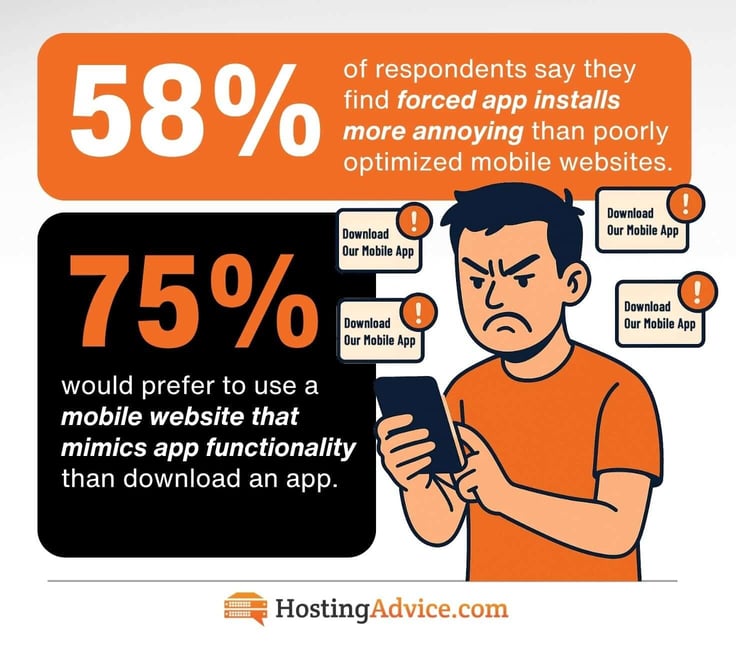
When asked to choose which is more annoying, being forced to download an app or using a poorly optimized mobile website, 58% choose being forced to download an app.
Among those who expressed distaste for mandatory app installs were baby boomers. In fact, 69% of boomers say they found being forced to install an app more annoying than using a poorly optimized mobile website.
Every generation had more than 50% of its respondent pool say that being forced to download a mobile app is more frustrating, except for millennials. Millennials reported a 50-50 split over whether using a poorly optimized mobile website or being forced to download a mobile app was more annoying.
These results show that consumers prefer flexibility and choice in how they consume their content, even if that means visiting a poorly designed website.
This is especially the case today as more people are being asked to pay for storage, and are using their phones as media hubs. Your brand’s app may not be worth precious space, but there is a good solution available.
“Apps and websites can often be similar in functionality, but there are still key differences. Apps installed on our phones feel a whole lot more permanent than websites do,” says Christian de Looper, Consumer Technology Analyst at HostingAdvice.
“It makes sense that users want to avoid downloading a whole app to their device, eating up its storage and cluttering up its home screen for a simple task that may only need to be performed once or twice. We’ve all gone through our apps list only to find dozens of apps that were only used once, and have sat on our devices since.”
Why Progressive Web Apps Are a Better Alternative
Mobile apps didn’t become a ubiquitous solution in our daily lives for no good reason. They have the ability to provide dedicated, tailored experiences that delight users with features that websites just can’t create — a sentiment our survey respondents agreed with.
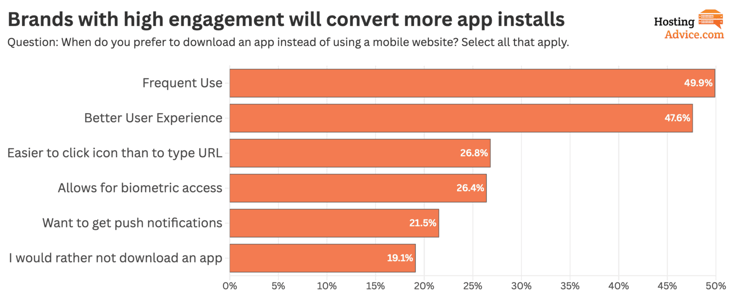
Our findings show that when people do choose to download a brand’s mobile app, it’s for these top reasons: frequent use (49.8%), better user experience (47.6%), and faster access (26.7%). Faster access simply means that it’s quicker to tap the app icon than to type in a URL after clicking into your browser.
In most cases, apps provide great convenience and accessibility. Yet, their initial allure has been overshadowed for many users due to intrusive permissions, bloated file sizes, and other factors.
In fact, about 75% of respondents say they would rather use a mobile website that acted like an app than download an actual app.
Thanks to Progressive Web Apps (PWAs), companies can make this a reality for audiences that are losing interest in downloadable applications.
Though they reside in-browser, PWAs blend the best of websites and mobile apps to give users the experience of a downloadable app. Here are reasons why you should consider PWAs as an alternative to mobile apps:
- Offline usability: People can use PWAs offline, allowing them to access information regardless of their location or connection.
- Fast and Compact: PWAs load much faster than traditional websites. They also take up less storage space than mobile apps.
- Push messages: If your brand site has push notifications, anyone who interacts with your PWA can receive those notifications.
- Security: Since PWAs only work through HTTPS, all data is encrypted during transmission.
- Cross-platform compatibility: PWAs function across different operating systems and devices with a single codebase. This means anyone can access your PWA regardless of their browser or device — no app store needed.
“Of course, often there’s no choice to be made — sometimes, you simply can’t perform the task that you want to without jumping through the hoops of downloading an app,” explains de Looper. “There are great middle-ground alternatives, like Progressive Web Apps, but adoption of PWAs is still a little limited.”
“Hopefully, adoption will increase as a great way for users to be able to perform tasks in a feature-rich environment, and without having to download more intrusive traditional apps,” he continued.
PWAs can solve the very problem users face with this mobile app crisis: inflexibility. Instead of being an obstacle in users’ paths, PWAs can offer companies a way to give their audiences more control over how they access their content and increase user engagement.
Apps shouldn’t be a barrier but a pathway for more simplified, convenient user experiences.
Methodology
This survey was conducted online in May 2025, among a nationally representative sample of 1,000 U.S. adults ages 18 and older. Respondents were selected from a third-party research panel, and the data were weighted to align with U.S. Census benchmarks.
To ensure the integrity of data collection, the researcher developed a proprietary machine-learning algorithm that can detect fraudulent responses early and remove unauthentic respondents immediately.
The overall margin of error is ±3.1 percentage points at the 95% confidence level. Margins of error increase for subgroups such as age or gender.
For media inquiries, please reach out to adam.blacker@hostingadvice.com.