

Writer: Sead Fadilpasic


Editor: Britain Simons


Reviewer: Cristian Lopez

Every year, the cybersecurity situation gets scarier in terms of attack sophistication and financial risk. But hey, at least there’s the small comfort of knowing that even the hackers are probably getting replaced by AI at this point, right?
Jokes aside, when a site goes down or data is leaked, the impact ripples far beyond an IT headache. It triggers a catastrophic chain reaction that halts business continuity, tanks your SEO rankings overnight, eats away at your revenue, and most critically, shatters the trust of customers who spent years becoming loyal to your brand.
So, it would be wise to treat the statistics provided in this report as a survival guide. Their intrinsic value lies in their ability to strip away the “it won’t happen to me” mentality. By looking at the actual cost of downtime and the rising sophistication of AI-driven breaches, you can better understand where your vulnerabilities lie.
For instance, did you know that:
1. Data Breaches Cost Companies an Average of $4.44 Million Per Incident
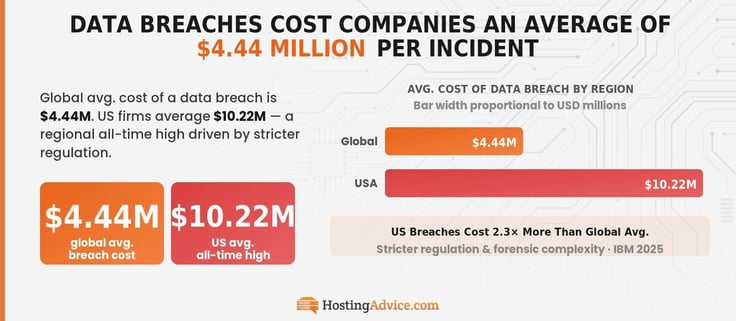
Per IBM’s annual report, the global average cost of a data breach has settled at $4.44 million per incident.1
However, those operating in the United States have it way worse, as the average cost for US companies has surged to $10.22 million. This all-time high for any region is driven by higher regulatory fines and the more complex nature of forensic investigations, including detection and escalation.
As a result, instead of investing in growth, R&D, marketing, or something else, businesses are forced to divert millions into damage control. This includes the arduous process of rebuilding a reputation that was compromised in minutes.
2. Global Data Breach Costs Decreased by 9% Year Over Year
The same report shows a 9% decrease from the 2024 peak of $4.88 million,1 which represents the first real dip we’ve seen in five years.
If we look back at the pre-2020 era, the cybersecurity landscape was defined by increased security budgets by roughly 8–10% annually. Yet, the average cost of a breach continued to climb steadily, from $3.5 million in 2014 to nearly $4 million by 2019.
These days, faster identification and containment of breaches are driving the cost down, at least for now.
3. The Average Time to Identify and Contain a Breach Reaches 241 Days
This is good news, since the total breach lifecycle is at a nine-year low, a continuation of a downward trend that started after a 287-day peak in 2021.1
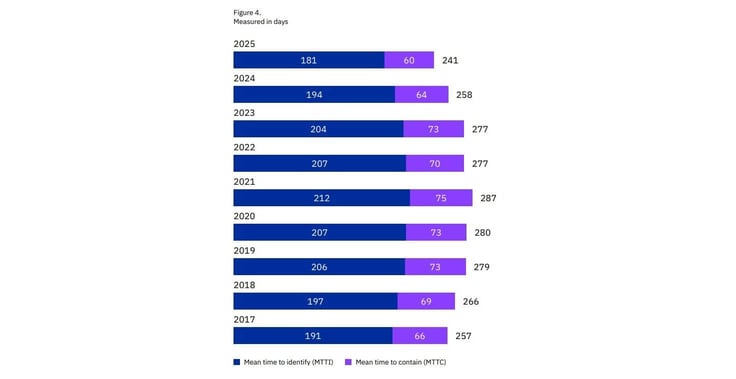
However, the bad news is that during those months, attackers aren’t just sitting still. They are quietly identifying the most valuable assets. This prolonged stay is what creates a multi-million-dollar disaster, as the longer an intruder roams, the more lateral movement they achieve, and the greater the damage.
The forensic bill alone is staggering because investigators have to deconstruct nearly a year’s worth of activity to make sure every backdoor is truly sealed.
4. Companies that Contain Breaches Faster Reduce Costs by About $1.14 Million
Organizations that detect and contain breaches in under 200 days save an average of $1.14 million compared to those that take longer.1
Through AI and automation, security teams are managing to identify and contain breaches faster, keeping the average costs to $3.87 million for data breaches with a lifecycle under 200 days. Meanwhile, data breaches with a lifecycle exceeding 200 days have the highest average cost at $5.01 million.
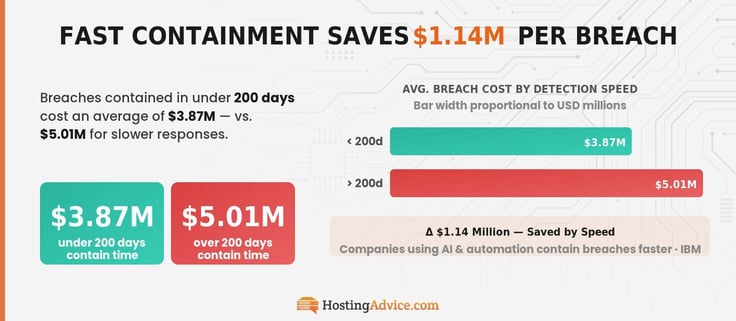
In short, every day you shave off that 241-day average is essentially money back in the business’s pocket.
5. Phishing Attacks Cause Roughly 22% of All Security Breaches
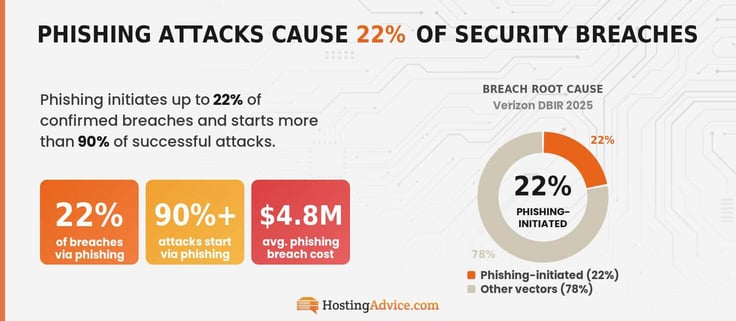
Phishing remains the primary catalyst for organizational compromise, initiating up to 22% of confirmed global breaches.2 It is social engineering, used to gain sensitive information, often by impersonation.
The three most common types of phishing schemes are cloned websites, fraudulent invoices, and fraudulent emails using spear-phishing to deploy malware. These phishing attacks often involve gaining login information by creating a sense of urgency (e.g., account deactivation or fake charges).
Perhaps the worst part is that more than 90% of successful attacks start with phishing. Thanks to the maturity of Phishing-as-a-Service (PhaaS), threat actors now distribute roughly 3.4 billion emails daily, maintaining the technique’s status as the most common entry point.
A lot of it is tied to weaponized generative AI, where PhaaS systems scrap publicly available data and automate the creation of hyper-personalized, error-free communication that mimics corporate tone. This makes it nearly impossible for untrained employees to distinguish legitimate internal communication from malicious one.
At an average of $4.8 million per breach,1 phishing is also one of the costliest attacks.
6. Stolen Credentials Contribute to About 22% of Breaches
While other methods, such as software exploits, are rising, simply using a valid (but stolen) username and password remains the most frequent way attackers gain initial entry into a system, with 22% of breaches occurring that way.3
Because people notoriously reuse passwords across platforms, a breach at a random third-party site poses a direct threat to any business sharing the same login credentials. Weak authentication fails to flag attempts from bots that try thousands of stolen combos in seconds, turning one external leak into a total system compromise.
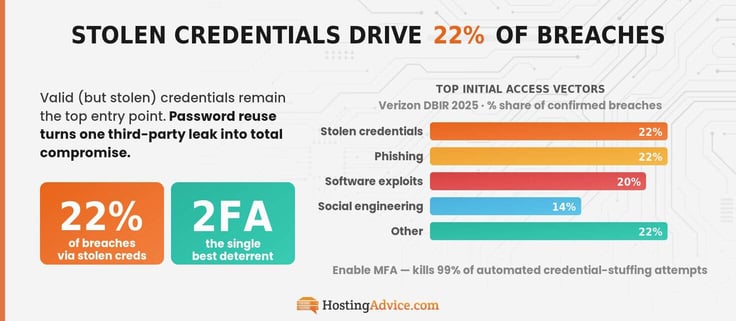
This is an example of why two-factor authentication has become so prevalent as a security measure. If you don’t have 2FA set up, now’s the time.
7. Weak or Reused Passwords Appear in About 84% of Security Incidents
Research from Specops shows that 84% of breached passwords with over 12 characters in length and at least two different characters are considered weak and vulnerable to brute-force attacks.4
If you raise the bar to passwords with 15+ characters in length and at least three different character types, only 1.5% are deemed strong.
This puts password hygiene and multi-factor authentication (MFA) as the ultimate deterrents to credential theft. For the former, length and uniqueness are key to combating AI-driven cracking tools. Using passphrases and dedicated password managers, you can eliminate password reuse and avoid becoming a less-defended target.
While basic MFA still thwarts the bulk of automated attacks by forcing hackers to bypass two separate security layers simultaneously, not all of it is equal.
Prompt bombing bypasses MFA by flooding the user with MFA login requests, while Adversary-in-the-Middle (AiTM) attacks intercept traditional SMS-based codes or push notifications. So, if authentication isn’t using hardware keys or biometric passkeys, the risk from stolen credentials remains considerable. Be highly vigilant with correct URLs – a site may look legit, but may be intercepting cookies and data between you and the real website.
8. Malware Accounts for Roughly 75% of Website Security Breaches
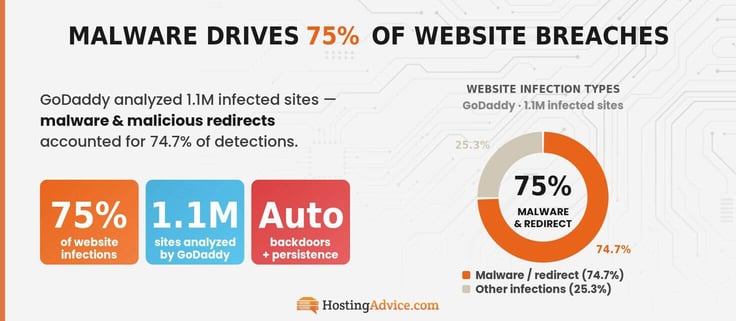
GoDaddy’s analysis of 1.1 million infected websites revealed that malware and malicious redirects dominated the threat landscape, accounting for 74.7% of detected infections.5
Malware typically enters through familiar weak spots, like a convincing phishing email, an unpatched vulnerability, a reused password that’s been around since the 2010s, and so on. Once inside, the malicious software quietly escalates privileges, moving laterally across systems and embedding itself where it’s least likely to be noticed.
From there, it installs backdoors and siphons data, turning the system into part of a larger botnet. The real trick is persistence, as malware modifies files, hides in legitimate processes, or sets up scheduled tasks so it survives reboots and casual cleanup attempts.
Big indicators of an infected site are unexpected sluggishness (high server usage with low traffic), error messages, spam emails from internal sources, new admin accounts, reduced security plugins, and Google Search Console blacklist notifications.
9. Ransomware Attacks Increase by About 32% Year Over Year
Comparitech reported that in 2025, there were 7,419 ransomware attacks worldwide, representing a 32% increase over the 5,631 attacks recorded in 2024.6
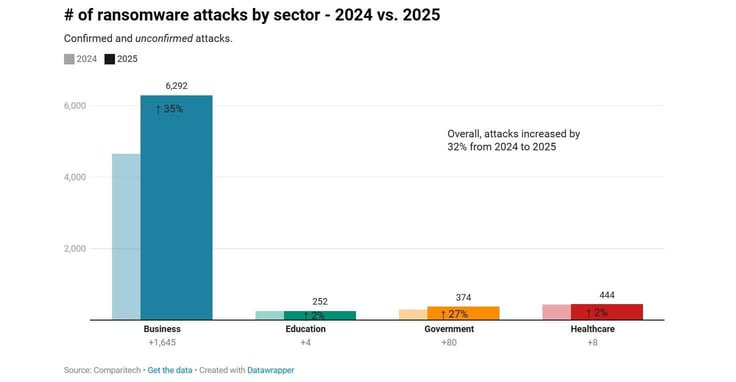
With numerous reports coming through months (or years, in some cases) after the attack, the 2026 figures might be even worse. But that’s ransomware for you – it keeps growing not because attackers are getting wildly more creative, but because they’re getting systematically better at scaling what already works.
The rise of ransomware-as-a-service (RaaS) means you no longer need to be a skilled hacker to launch an attack. All you need is a subscription (and questionable life choices), and you’re good to go. There is certainly no shortage of vulnerable systems and successful phishing methods around, which means there is a steady pipeline that reliably converts everyday mistakes into full-blown incidents.
Thankfully, we’re not all sitting ducks, cisa.gov/stopransomware – the Cybersecurity and Infrastructure Security Agency CISA) consolidates guidance, reports, and public alerts. Federal programs offer tech support and forensic analysis to victims.
10. The Average Ransomware Payment Reaches About $1 Million
Per Sophos, the average (median) ransom payment has fallen by 50% in 2025, down from $2 million in 2024 to $1 million in 2025.7
Around 64% of the victim organizations didn’t pay the ransoms, which is up from 50% in 2023. This could be partially responsible for the declining ransom amounts. Other data suggests that the primary factor behind the drop is a reduction in the percentage of ransom payments at or above $5 million. In 2025, to 20% of payouts hit that threshold, down from 31% of payments in 2024.8
Still, the information above needs to be taken with a grain of salt, as data on ransom payments is greatly limited. Organizations are not really keen on sharing whether they paid a ransom, even less so the specific amount. It’s bad press.
What is certain is the financial pressure on businesses after the deed is done to recoup losses and beef up security. The ransom is simply the opening act. The full cost is reflected in downtime, recovery, legal fallout, and lost customers, which can balloon to millions.
11. Small Businesses Experience About 80% of All Cyberattacks
Verizon’s data shows there are almost four times the number of small business victims than there are large organizations.2 More so, 88% of SMB breaches involve ransomware, as hackers seek the path of least resistance.
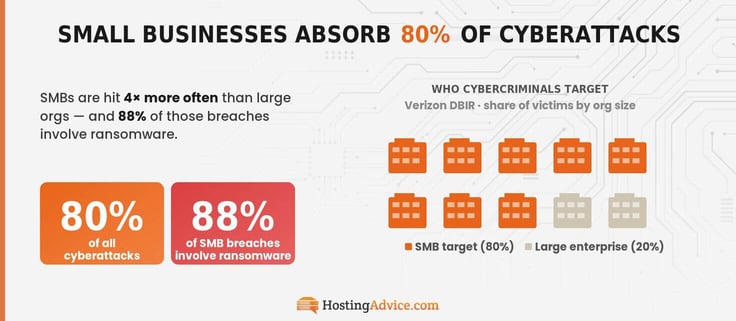
The reasons for such disparity are twofold: opportunity and lack of security.
First, there are more SMBs doing business than there are large organizations. Second, and more importantly, small businesses are the primary targets due to their weaker defenses and poorly guarded valuable data. With limited security budgets and staff, they’re less likely to identify sophisticated threats, representing a high-yield, low-effort investment for cybercriminals.
12. Around 32% of Small Businesses Close After Less Than a Day of Downtime
Almost a third (32%) of SMBs say they would be forced to shut down if a cyberattack caused either less than $10,000 in damages or less than 24 hours of interrupted operations.9 For 55% of SMBs, a financial impact of less than $50,000 from a cyberattack would put them out of business.
Considering that the average breach cost in 2026 is far more sizable than these 5-digit figures, the implication is severe: the gap between a minor glitch and a business-ending event has practically evaporated for small businesses.
Being able to recover may come down to regular data backups, proper reporting to authorities, insurance, and security checkups.
13. Human Error Contributes to Approximately 26% of Security Breaches
If we broaden the scope and include any form of human element (like manipulation) in the equation, the number is closer to 60%, but for simple errors, it falls to around 26%.2
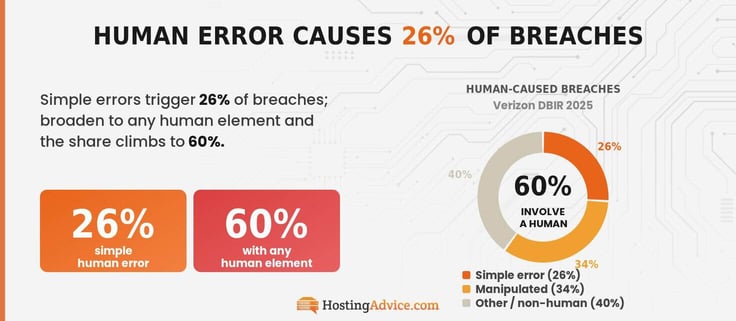
It’s because we humans handle a lot of things, which makes the error-prone surface that much greater. Whether it’s misconfiguring cloud storage or servers, sending sensitive data to the wrong person, or failing to apply security patches or updates on time, the uncomfortable truth is that we tend to mess up, and it costs big time.
14. Misconfigured Cloud Services Cause About 16% of Data Exposure Incidents
Misconfigurations relating to cloud services cost companies approximately $4 million in total losses.10
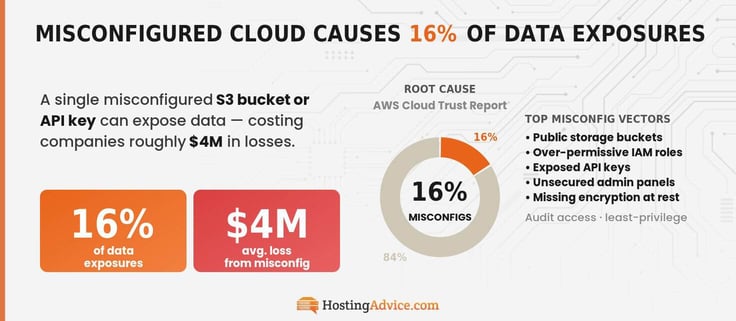
The number makes absolute sense when you take into account that cloud security depends heavily on configuration choices, identity management, access permissions, and overall visibility. A single misconfigured storage bucket or overly permissive API key can expose data and simply leave the door open. Such a small setup mistake can turn into a potentially large-scale incident.
15. Distributed Denial-of-Service (DDoS) Attacks Increase by Roughly 54% Annually
According to Cloudflare’s data from the 2020s, the average annual growth rate of DDoS attacks has been marked by a massive, non-linear surge.
Case in point: the total number of DDoS attacks reached 47.1 million in 2025, which is a 121% increase compared to the 21.3 million attacks recorded in 2024.11
So, factoring in data from 2020 to 2026 and calculating the average growth rate for the 6-year timeframe, the average annual increase stops at the 54% mark.11
Because of automated AI tools and massive botnets, the average organization now faces an average of 5,376 automated DDoS mitigations every hour. It’s no longer a matter of if an attack will take place, but whether your autonomous defenses can keep up with the sheer volume.
16. The Average DDoS Attack Size Reaches 3.6 Gbps
The average attack size soared to 3.6 Gbps, a staggering 70% jump, while the median duration plummeted from 39 to just 20 minutes.12
Though the average is in the low gigabits, the ceiling has been shattered. The Aisuru-Kimwolf botnet recently set the record with a 31.4 Tbps strike.11 It’s like bombarding you with the entire Peaky Blinders content on Netflix roughly 15 times every single second.
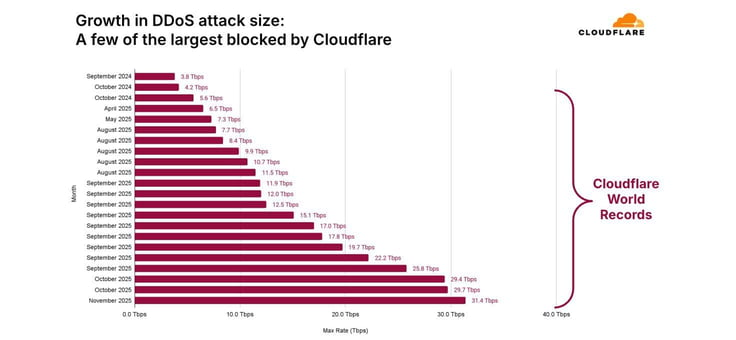
The attack scale is currently exploding due to the automation of botnet operations. Hijacking millions of poorly secured IoT devices and industrial routers, huge botnets orchestrate hyper-volumetric strikes capable of reaching record-breaking peaks.
And because AI-driven automation now manages these strikes in real time, modern malware uses machine learning to instantly pivot vectors if a firewall resists. This creates attacks that reach maximum intensity in milliseconds, making manual defense impossible.
It’s not all doom and gloom. Web security tools and plugins are advancing at the same rate.
17. Websites Without HTTPS Encryption Face Almost a 100% Visibility Risk
For any data transmitted over shared networks (thus effectively broadcasting sensitive user information to anyone listening), websites without HTTPS encryption face close to a 100% visibility risk.
That’s the mechanical reality of the web these days. While modern HTTPS traffic still faces a 4% to 10% interception rate13 due to sophisticated man-in-the-middle attacks or misconfigured proxies, those figures are a drop in the bucket compared to the total exposure of HTTP.
When you combine the absolute visibility of unencrypted traffic on shared networks with the baseline risks of the modern web, HTTP traffic is up to 25 times more likely to be successfully exposed under real-world conditions than its encrypted counterpart. Without the SSL certificate, that means nearly a 100% risk.
18. SSL/TLS Adoption Reaches About 89.5% of All Websites
As of April 2026, 89.5% of all websites use HTTPS by default.14
What’s more, between 95% and 99% of global web traffic is now encrypted, nudged along by free SSL/TLS certificates, browser warnings that politely shame insecure sites, and the growing realization that sending data unencrypted is a bit like mailing your passwords on a postcard with a clear plastic window. High-traffic platforms like Google and Facebook also play a part in protecting the bulk of internet traffic.
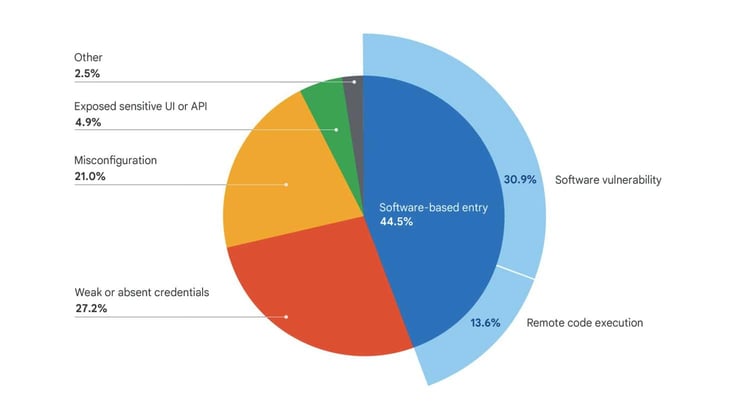
19. Vulnerabilities in Plugins and Third-Party Software Cause About 44.5% of Website Breaches
Per Google’s data, 44.5% of security breaches now originate from vulnerabilities in third-party software and plugins.15 This represents a staggering shift from early 2025, when software exploitation accounted for less than 3% of incidents.
Here, you’ll find H2 2025 distribution of initial access vectors exploited in Google Cloud:
(Data reflects a subset of observed activity and may not represent all customers.)
Unfortunately, CMS ecosystems are powerful for the same reason they’re risky – they’re built on layers of third-party code that you don’t fully control, and must work seamlessly together. Platforms like WordPress and Joomla rely heavily on plugins, themes, and integrations to extend functionality. Each of those components is effectively a new door into your system, and not all doors are built the same.
A single vulnerable plugin can expose the entire site, even if the core CMS itself is fully patched and secure.
Equally (or more) important is uneven maintenance. Many plugins are developed by small teams (or abandoned entirely without warning), which means vulnerabilities can linger unpatched while still being widely used. When you add the complexity of integrations like payment gateways and analytics tools, you get an ecosystem where trust is distributed across dozens of moving parts.
20. Websites That Apply Security Patches Quickly Reduce Risk by 34%
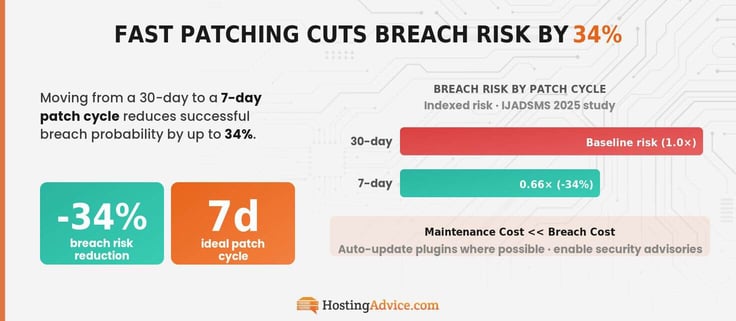
Moving from a 30-day to a 7-day patch cycle can reduce the likelihood of successful breaches by up to 34%.16
Timely updates and ongoing maintenance are the quiet backbone of website security. The harsh reality is that a significant portion of breaches happens because something old was left unattended. Regular updates close those gaps, often before anyone has a chance to exploit them. The cost of doing nothing can far exceed the cost of regular maintenance.
It’s worth remembering that maintenance is as much about reacting as it is about being proactive. Websites integrate new tools and grow more complex over time. Bad actors are not slowing down, so neither should you. Without consistent oversight, that complexity turns into risk.
21. Social Engineering Attacks Decrease by Approximately 5% Each Year
At first glance, it appears social engineering is losing ground with a 5% yearly decrease compared to all cyberattacks,2 based on Verizon’s data from 2020 to 2026. Its share of breaches has edged down from pandemic-era highs, slipping a few percentage points each year.
Looking at the big picture, the total number of cyberattacks is increasing, and social engineering is growing right alongside it. It’s simply no longer the only fast-growing tactic in the room. So while its percentage share dips slightly, its real-world usage keeps climbing.
That’s likely because it’s often easier to persuade a person than to outsmart a system. Instead of breaking through firewalls or cracking encryption, attackers focus on human emotions and instincts. A well-crafted phishing email doesn’t need to be overly sophisticated – it just needs to feel real enough to prompt an action, whether it’s a click or a quick credential entry.
In that sense, these attacks exploit vulnerabilities in attention and decision-making, turning everyday habits into entry points.
22. Data Breaches Expose an Average of 83.9K Records Per Incident
To be more precise, the number is 83,934 based on confirmed incidents in 2025, which is the digital equivalent of a small town’s population in one go.17
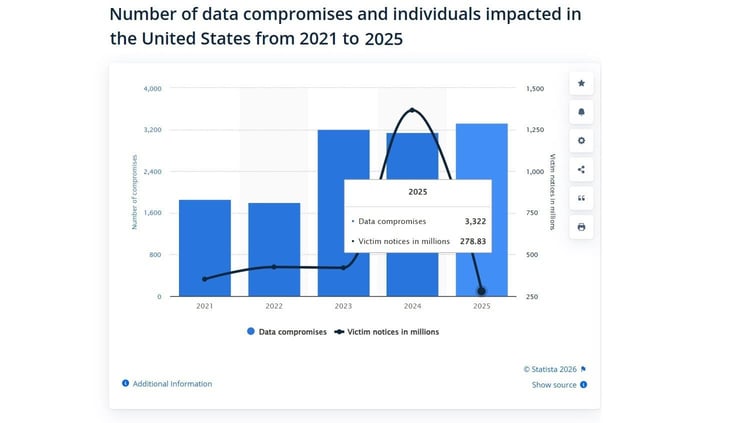
The stat might be more on the conservative side, since most breaches are relatively contained. Nonetheless, every so often, a massive incident spills millions of entries, and suddenly, the average jumps. It’s less a neat statistic and more a reminder that in cybersecurity, scale is occasional and explosive.
23. Organizations Detect Only About Half of Breaches Internally
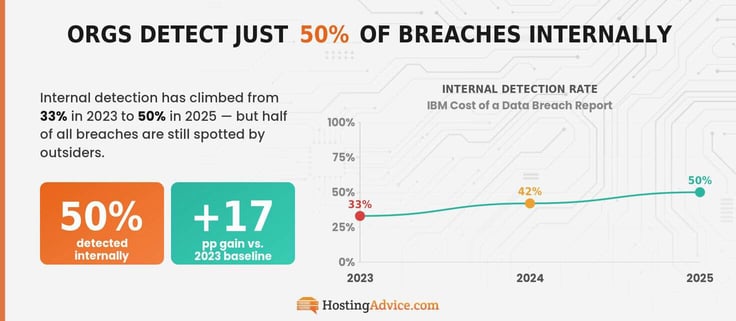
Teams and tools detected 50% of breaches in 2025, a considerable improvement over 2024’s tally of 42%, which itself was a jump from 33% in 2023.1
For years, numerous organizations had someone else discover their own breaches. Security researchers, customers, journalists, and even law enforcement would spot suspicious activity and raise the alarm. By the time a third party gets involved, the attacker has often had more time inside the system to do their dirty work while the organization remains unaware.
The jump to 50% internal detection signals that more companies are catching incidents through their own monitoring, logging, and response tools, reducing the time attackers can operate undetected. It’s not perfect (half of breaches still rely on external discovery), but it reflects a shift from reactive to proactive security.
24. Security Breaches Cause SEO Ranking Drops of Up to 90% After Blacklisting
Studies show traffic can fall by as much as 90% or more because users are actively warned away, and search engines pull visibility almost overnight.18
When a website gets blacklisted, it loses rankings, as well as trust.
In SEO, that’s the entire game. Search engines move quickly to protect users, often stripping visibility within a 12-hour window. The result is a traffic drop that, in extreme cases (like severe domain trust compromise), can result in near-total visibility loss.
What makes this particularly brutal is how indirect the damage is. The breach undermines everything SEO depends on, from trust and safety to user confidence. So even after the issue is fixed, recovery isn’t instant. In fact, the hardest part is often convincing search engines and users that it’s safe again.
25. Companies Intend to Increase Cybersecurity Spending by About 10% After a Breach
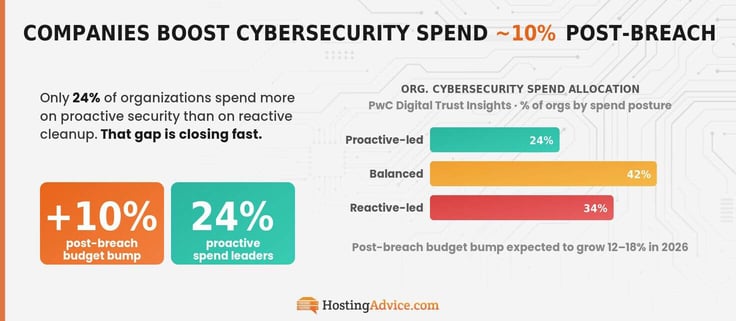
What’s more, PwC data (albeit from 2024) shows that only 24% of organizations are spending significantly more on being proactive (such as monitoring, assessments, testing, controls) than reactive measures (incident response, fines, recovery).19
While these measures are necessary for incident response, relying on them as a primary strategy creates significant risks and inefficiencies. As such, they are often seen as a sign of lower cyber resilience.
Looking forward, incorporating industry shift insights seen in 2025 and 2026, we can expect companies to move toward a 12% to 18% post-breach budget increase. The baseline for safety has moved, and companies are pivoting in response.
You aren’t just paying to fix what broke, but also for the AI-driven shields and higher insurance premiums required to stay in the game.
26. Organizations Save $1.9 Million By Extensively Using AI in Security
Even better, security teams using AI and automation extensively across the security lifecycle (in prevention, detection, investigation, and response) also shortened their breach times by 80 days compared to their peers who didn’t use these solutions.1
If fraudsters and PhaaS are threatening security with advancing AI, why not turn the tables with the same tech?
This goes to show that speed is the ultimate cost-saver. By using AI to automate the boring, manual parts of security (scanning millions of logs or triaging alerts), companies are effectively buying back time that would otherwise be spent letting an attacker roam free.
27. 4 in 5 Companies Lack Visibility Into Their AI Usage20
Around 81% of companies lack full visibility into how and where AI is being used across the software development lifecycle.20 In fact, 20% of breaches now involve shadow AI, which refers to unmanaged tools used by employees.
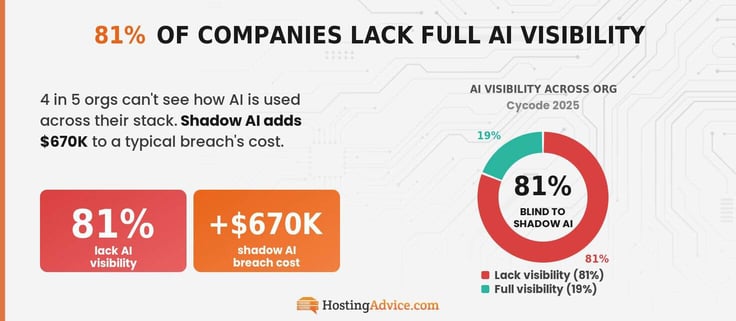
It’s a costly problem, too. For organizations with high levels of shadow AI, breaches added $670,000 to the average breach price tag compared to those that had low levels of shadow AI or none.1 To compound matters, these incidents also resulted in more personally identifiable information and intellectual property data being compromised.
So, while companies are saving millions with AI defenses, they are genuinely saving money only if they’re the ones controlling the AI.
What These Website Security Breach Statistics Mean for Online Safety
Data doesn’t lie.
With the average cost of a breach for US companies surging to $10.22 million, an incident is far closer to being a catastrophic blow than many are ready to face. The risks compound in terms of financial stability, customer trust, SEO performance, and long-term business viability, rather than being a manageable expense.
For the 80% of small businesses that find themselves in the crosshairs, a single breach can lead to total system compromise and permanent closure.
Ultimately, these statistics show that the most successful organizations these days are those that shift from reactive to proactive defense. By embracing AI and automation, teams are shaving nearly three months off the breach lifecycle and saving an average of $1.9 million per incident.
Don’t wait for a breach to find out where your weaknesses are. Evaluate your website’s security today, as it’s the only way to secure your brand’s future and the trust of everyone who interacts with it.
And HostingAdvice just might help — we have tons of performance and cybersecurity guides, and a new HostHelper™ smart tool to find what you need, so be sure to take a peek and follow us on social media for more good stuff.
Sources
1. https://www.ibm.com/reports/data-breach
2. https://kymatio.com/blog/2026-phishing-benchmarks-industry-click-rates
3. https://www.verizon.com/business/resources/infographics/2025-dbir-smb-snapshot.pdf
4. https://specopssoft.com/blog/breached-passwords-analysis-heatmap
5. https://www.godaddy.com/resources/news/godaddy-annual-cybersecurity-report
6. https://www.comparitech.com/news/worldwide-ransomware-roundup-2025-end-of-year-report/
7. https://assets.sophos.com/X24WTUEQ/at/9brgj5n44hqvgsp5f5bqcps/sophos-state-of-ransomware-2025.pdf
8. https://greymatter.com/wp-content/uploads/2025/06/sophos-state-of-ransomware-2025.pdf
9. https://go.vikingcloud.com/l/1000211/2025-03-14/3cnp1/1000211/1741984240VMSYEP7P/_Report__2025_SMB_Threat_Landscape_March25.pdf?_gl=1*106mq5e*_gcl_au*OTkwODA3MzczLjE3NzYwNjY5NTQ.
10. https://d1.awsstatic.com/onedam/marketing-channels/website/aws/en_US/whitepapers/compliance/Cloud_Trust_Report.pdf
11. https://blog.cloudflare.com/ddos-threat-report-2025-q4/
12. https://www.zayo.com/resources/2026-cybersecurity-trends-protecting-networks-in-the-intelligence-era/
13. https://jhalderm.com/pub/papers/interception-ndss17.pdf
14. https://w3techs.com/technologies/details/ce-httpsdefault
15. https://cloud.google.com/security/report/resources/cloud-threat-horizons-report-h1-2026
16. https://ijadsms.com/index.php/ijadsms/article/download/17/36
17. https://www.statista.com/statistics/273550/data-breaches-recorded-in-the-united-states-by-number-of-breaches-and-records-exposed/
18. https://www.safetybis.com/blog/google-blacklisted-removed/
19. https://www.pwc.com/hu/hu/kiadvanyok/assets/pdf/pwc-2024-global-digital-trust-insights.pdf
20. https://cycode.com/press/report-shadow-ai-crisis-looms-as-100-of-companies-have-ai-generated-code-but-81-of-security-teams-lack-visibility/