



Writer: Surajdeep Singh


Editor: Britain Simons


Reviewer: Cristian Lopez

Are you a gamer? I don’t have a fancy desktop gaming setup, but I proudly call myself one. I play FC Mobile (the smartphone version of FIFA) when I’m lazing around on weekends. I prep my pillows, put on headphones, adjust volume and brightness, tap the app, and lock in.
Sometimes, the app doesn’t work, and I get super annoyed. Server downtime — Seriously? Let me play! I just learned that EA Sports announces maintenance updates on X, so I’m adding that to my pre-game to-do list.
Every single app you use experiences server downtime — some more, some less. By the time you finish reading my 20 server downtime stats, you’ll know how outages really impact businesses and decision-making. Let’s get started.
1. 50% of Organizations Experience One Major Downtime Event Every 3 Years
The first thought that probably came to your mind is, “Why is he talking about a three-year period?” In my opinion, one bad event (like a full-blown cyberattack) may average out with smaller events over the course of a few years. This three-year window captures meaningful trends over time and provides actionable insights for organizations.
How about an example? In 2020 and 2021, when remote work was the “vibe,” 78% and 69% of organizations experienced at least one major outage, respectively. This figure came down to a solid 50% of organizations experiencing a major event in 2025.2,3,4
What does this tell you? Server uptime best practices are improving, but cyberattacks, software bugs, human error, and traffic spikes are still affecting businesses.
What are your top-five most used apps? Facebook, YouTube, WhatsApp, Instagram, and TikTok are in the mix. As a user, it’s an inconvenience when they don’t work, but it’s a full-on crisis for companies. If a gaming app gets me this worked up, can you imagine what server downtime does to businesses with millions of users? They cost a ton of money and resources!
Coincidentally, My YouTube was briefly down a few minutes ago (talk about timing).
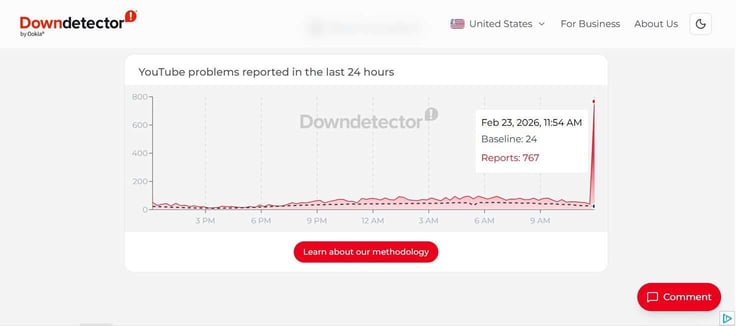
I thought my WiFi was acting up, so I switched to mobile data — same story. Turns out, 767 other people submitted a report to Downdetector (potentially thousands more experienced the outage). Even a short outage like this could have cost YouTube hundreds of thousands in ad revenue.
2. Average Uptime Across Hosting Providers Is 99.945%
I’ve been consistent with my love for Hostinger — its dependability is underrated. But does it offer the best average uptime rate across web hosting providers? Not entirely. It may seem like we’re splitting hairs, but “four-nines” is still the realistic gold standard.
Here are four of my favorite web hosts compared:
- Hostinger: 99.9%
- Bluehost: 99.99%
- GoDaddy: 99.9%
- SiteGround: 99.99%
That’s an average uptime of about 99.945% for website hosting services.5,6,7,8 I’ll take that as a semi-win for my industry. I expect Hostinger, GoDaddy, and any top-tier host that hasn’t adopted the “four-nines” (99.99%) yet to do so in 2026.
3. There are 7 Hours and 52 Minutes of Downtime Between 99.9% and 99.99% Uptime
On paper, 99.945% uptime sounds like a high percentage, but in the server world, a fraction of a decimal point means hours of outages, lost revenue, and all-around frustration. We’ll break down the numbers:
| Uptime | Downtime Per Day | Downtime Per Month | Downtime Per Year |
|---|---|---|---|
| 99.9% | 1 minute 26 seconds | 43 minutes 47 seconds | 8 hours 45 minutes |
| 99.945% | 47 seconds | 24 minutes 5 seconds | 4 hours 49 minutes |
| 99.99% | 8 seconds | 4 minutes 22 seconds | 52 minutes 33 seconds |
Can you see the difference in hours of downtime 99.9%, 99.945%, and 99.99% translate to?9 7 hours and 52 minutes is a lot of time. Every hour can cost millions in lost revenue, bounce rate, and maintenance costs.
4. Average Cost of Downtime for Enterprises Per Hour Is $50k to $500k
Are you watching “A Knight of the Seven Kingdoms?” It’s from the “Game of Thrones” universe, and I’m a huge fan of the show — I’m glued to my TV screen every Sunday night at 7 PM to watch the latest episode. No, this isn’t an ad, but do you know how much it would likely cost HBO Max if their servers were down when they drop the latest episode?
Apart from the wrath of unforgiving fans like myself on social media, around $1 to $2 million is lost per hour. For context, that’s around the yearly salary of a neurosurgeon in the US.
What about the implications of downtime on more powerhouse industries like finance and insurance? About $2.2 million per hour. Downtime isn’t pretty for any enterprise. I mean, the average downtime cost for enterprises is $50,000 to $500,000 per hour.10 I’ll bet you’re seeing the four-nines a bit differently now?
5. Average Downtime Cost for Small Businesses Is $10k to $25k
The bigger you are, the harder you fall. But if you really think about it, pain is subjective, right? A small or medium-sized business (SMB) doesn’t earn or churn as much as an enterprise, so the fact that it faces losses of around $10,020 to $25,020 per hour of downtime is pretty significant.11
Let’s assume a top-tier SMB is losing approximately $25,000 per hour on its business-critical server. A few hours of downtime could put their business at risk and will definitely require some reputation damage control if users can’t access services.
It’s all relative. Enterprises have deeper pockets, so they absorb the “fall.”
6. 67% of Companies Report Revenue Loss From Downtime
My colleagues at HostingAdvice conducted a poll for business owners in January 2026, and around 67% of them said they lost revenue from downtime. I’d like to pick the brains of the 33% who were unscathed — how does a business not lose money when its website is down?
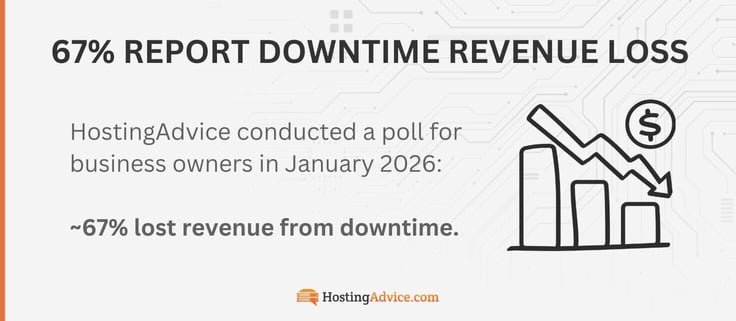
I can get losing less during “quiet” hours, but you’re still losing money, right? Maybe their businesses were experiencing a slow period… If anything, this next server downtime stat proves my point: 17% of the 67% said their losses were “significant.”12 That makes sense.
7. Power Issues Cause 45% of Server Downtime
I’ve talked about the frequency of major downtime events, the uptime you should target for your website, and the financial implications of downtime on different industries and business sizes. But what is the leading cause of server downtime?
Wait. Power issues? Just imagine the size a backup generator would need to be for a massive server farm!
Check out these causes of server downtime from the Uptime Institute:
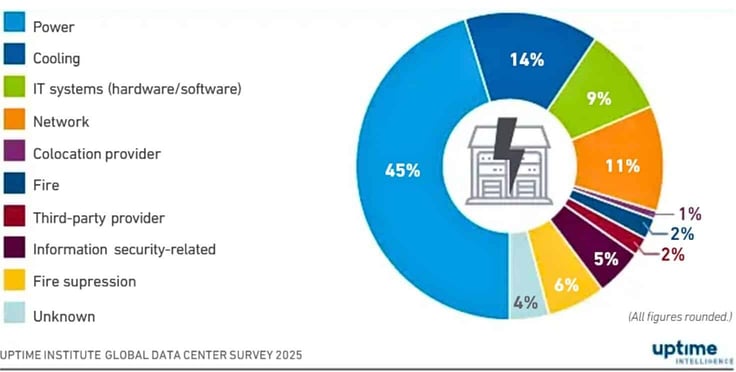
Well, if it were that easy to avoid power failure, we’d have 45% less website outages.3,4
For more context: when the main power source of a data center fails, the UPS (battery power), generator (secondary power source), and transfer switch (to switch sources) work in tandem to maintain consistant power for the facility.
Even with all that infrastructure, are you telling me they’ll work perfectly, all the time? 100% uptime? Nope. They’re just machines — and the top points of failure have to do with hardware and software: power, cooling, IT systems, network, and fires.
8. Approximately 14% of Downtime Is Attributed to Cooling Issues
Sometimes, I skip the desk and sit on the sofa with my laptop, sip coffee, and work. I have to place a cushion on my lap within minutes because of the amount of heat it generates (to protect my reproductive health — Google it).
If a laptop produces that much heat, can you imagine what rows of servers can do in a facility? It’s probably a daily sauna for workers! Unless… they’re cooled down. And cooled down they are — chillers, cooling towers, pumps, fans, you name it. Massive amounts of water — the cheapest cooling source.
The thing is, cooling systems need power as well (and can fail independently, of course).
So, if there are power issues in the facility, and backup power fails, cooling won’t work. The servers will shut down automatically to protect data — this causes 14% of outages.3,4 It’s by design!
9. IT System Failures Are Linked to 20% of Downtime
According to current available data, 59% of server downtime is due to infrastructure failures, and 20% is caused by IT system failures (hardware, software, and networking components).3,4 What does this tell you? It’s more cost-effective to manage IT failures, likely from human error, than to tackle aging infrastructure costs and technology limitations.
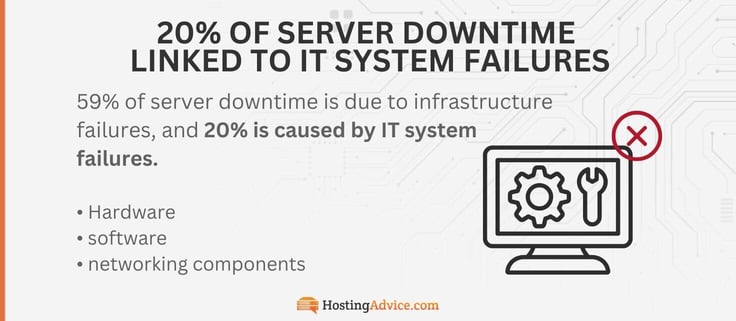
I mean, patching software, rolling back deployments, and routing traffic elsewhere is simpler than repairing a smoking generator, right? If I were a maintenance specialist, I would ask for a serious raise!
10. 85% of Human-Related Outages Are Due to Not Following Procedure
It’s impossible to get an exact percentage of outages due to human error, but we have a good idea. Approximately 85% of human-related outages are because staff don’t follow procedure.13,14 Yes! That’s close to ⅘!
We do know this may be caused by improper standard operating procedures, risk management, or simple mistakes like unplugging the wrong cables, entering incorrect commands, or failing software patches. In some cases, even ignoring alerts and alarms of the management systems.
Don’t they have SOPs? Let me make it clear. My expert take is they don’t “rebel” with weaponized incompetence. Maybe they skip steps to move faster, are overconfident because of their “experience,” or perhaps the SOPs are outdated.
Whatever it is, I want to see this figure decrease when I update this guide next year. Or else, well, AI is coming for their jobs. We are in the era of humanoid robots, thanks, Tesla.
11. There Were 7,515 Successful Ransomware Attacks in 2025
Imagine someone breaks into your house, changes all the codes to your safes, and demands a substantial fee to reveal them. That’s a ransomware attack for you, only it’s in software form. And of course, a successful attack means significant server downtime.
Now, there were only 7,515 publicly-revealed successful ransomware attacks in 2025.
I estimate there were at least 2,500 more that were hidden from us by some public relations and legal teams. And it’s only getting worse. The number of attacks in each quarter kept increasing. 2026 is going to be brutal.
There are more than 120 ransomware groups we know of, but the problem is nearly untouchable because of fully autonomous ransomware bots, actor adoption of AL/LLMs, and the ransomware-as-a-service model. Even worse, criminal networks are operating outside of US jurisdiction.15
If you disband one group, they’ll just go create a new one in a safe haven outside the US, beyond legal reach — the anonymous dream.
This is why you don’t ever click on fishy — ahm, phishy links!
12. 100% of eCommerce Businesses Experience Annual Downtime
See what I did there? This server downtime stat is tongue-in-cheek. There’s no app or website that has 100% uptime, so, of course, every single eCommerce business experiences annual downtime (yes, even Amazon). The real question is, how significant is the downtime they face?
The impact is 42% of eCommerce businesses lose around $6 million each year due to internet disruptions (including downtime).16
What about the remaining 58%? They may still lose money, more or less beyond this stat — no one can escape downtime-related financial loss.
13. 95% of Global Leaders Know Their Operational Weaknesses
I’m going to blow your mind with the next three stats. Have you ever felt like you know what’s good for you, but still don’t do it?
You can blame procrastination or a lack of drive, but most of us know what the right move is. That’s exactly what this stat tells me. According to “The State of Resilience 2025” report, 95% of global leaders are aware of their operational weaknesses.
And yet, 48% of them admit to being fully aware that they are still not doing enough to improve their resilience?17 If you know your house has cracks, why wouldn’t you fix them? Awareness clearly isn’t the issue. Execution is.
Get your house in order. No wonder ransomware attacks are on the rise.
14. 14% of Companies Experience Outages Daily
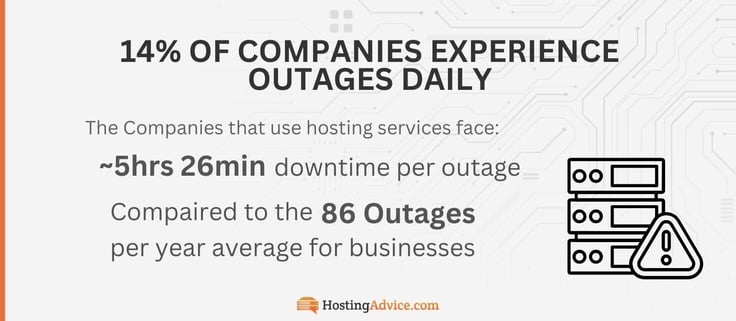
Yes, 14% of companies experience server outages every single day. But a more sensible outlook to put this into perspective — most businesses face 86 outages per year on average.
I want you to guess how many hours of downtime they face per incident. Two hours?
Unfortunately, it’s much more: around 5 hours and 26 minutes per outage. I know this sounds alarming, and you’re probably thinking about the uptime numbers I threw around in Stats 2 and 3. The thing is, those were just web hosting uptime figures — this is about the companies that use those hosting services.
Every single service you use is prone to downtime, so a more realistic overall uptime expectation should be above 96.79% (the global average).17
15. 70% of Enterprises Report Outages Over 1 Hour
I just want to put into perspective how “normal” outages are: 70% of enterprises experience outages that last at least 60 minutes to resolve.17 Do you know how crazy that is?
If we go by the average number of incidents from the previous stat, that’s a minimum of 86 hours lost each year (they’d surely go broke). Logic tells me that enterprises face fewer incidents than SMBs. According to a recent Cayosoft report, in partnership with Petri Knowledgebase, 70% of organizations expect to lose $100,000 per day in labor costs alone when their Active Directory is down.18
16. 41% of Enterprises Deploy High-Availability Servers
41% of enterprises deploy high-availability servers (redundant with automatic failover) for mission-critical workloads.
I find this really funny. Do you know why? Because 39% of companies (the numbers are independent of each other) still handle outages reactively.17,19
What’s the point of having HA (High Availability) servers if you’re still going to respond poorly to incidents? That’s like having access to the Bat Cave but ignoring nearly half of the Bat Signals.
I guess you can buy failover, but not discipline.
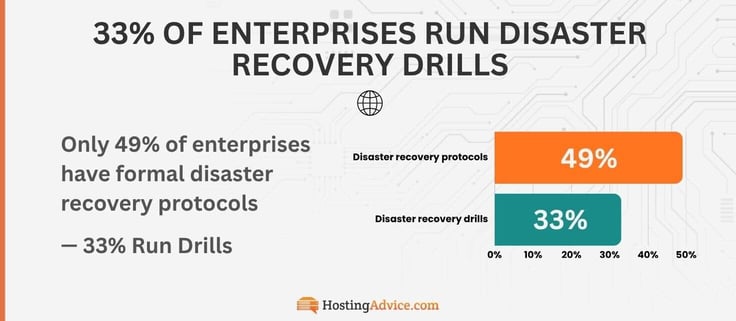
17. 33% of Enterprises Run Disaster Recovery Simulations
What if I told you only 49% of enterprises have formal disaster recovery protocols? Do you know how insane that is? 51% are just winging it!
If you’re going to react to unplanned downtime like people in horror movies do, let’s just say you’ll be left gravely wounded. That’s like going into 86 “battles” per year with a lollypop and a shrug. No clear disaster recovery plan.
You have to prepare yourself to fight. I’m happy that at least 33% of them perform disaster recovery drills.17 They almost certainly have a quicker mean time to recovery (MTTR). If you’re a eCommerce business owner, here’s something for the next meeting agenda.
18. 49% of Organizations Are Investing in AI Automation Solutions
You know what MTTR is. Any idea about its twin brother, MTTD?
MTTD = mean time to detect.
The real reason why 49% of organizations are investing in AI-driven automation is that it reduces both MTTD and MTTR.17 How? Well, AI follows the rule book. It can run autonomously in the background, so say bye-bye to procedure-related outages.
And, of course, AI flags issues early and can resolve them — providing a quick resolution without human intervention.
19. Using One Tool for Observability = 18% Less Downtime
Some people go overboard. Why do you need multiple tools for observability anyway? I mean, it’s not like these tools are spies that are going to gather secrets for you, from different parts of your kingdom.
Just one tool makes an 18% difference in downtime.
Observability tools monitor your website constantly and alert you fast when it’s down or acting funny. One tool is more than enough — it leads to fewer hours of annual downtime compared to multiple tools (249 vs 305).20
If you’re still unfamiliar, this equation should explain it: Alert chaos = slower decisions.
My recommendation — invest in Datadog (for anomaly detection) and PagerDuty (for automatic remediation). Simple as that.
20. North America Has 5X Less Downtime Than Asia Pacific
Okay, so before I get into the whole North America vs Europe vs Asia Pacific downtime debate, I’m going to refresh your memory.
Having network outages for days on end is the reality for many countries in the Asia Pacific region. For example, do you know how many days of downtime a company with a 96.79% uptime faces each year? Around 11.7 days. I’ll use this number as a reference point.
Take a look at downtime by regions:
| Region | Days Lost to Downtime Annually |
|---|---|
| North America | 4 |
| Europe | 9.5 |
| Asia Pacific | 19.5 |
This tells me North American and European countries have an above-average uptime. This could be due to highly developed infrastructure, high competition, and downtime regulatory efforts, like DORA (Digital Operational Resilience Act) in the EU.17
The Asia Pacific region? Just 94.66%, far less uptime than the generous 96.79% example, and miles behind the four-nines of Western countries.17,20
I guess their customers have a greater tolerance level than most.
Server Downtime Is Common; Don’t Sweat It
That’s the headline people want to sell you. Why? They’ve accepted mediocrity. Your business should do everything possible to improve uptime because the automation tools are widely available and improving by the day.
It’s also in every company’s best interest to improve protocols, manage human error, and use the free market to support hosting services implementing best practices. I don’t want you to break the bank; keep it simple yet effective. Treat uptime like a strategy, be resilient, not reactive, enforce procedures, and implement AI solutions where possible.
You should be able to achieve an above-average uptime if you follow these tips. Thank you for your time, my friend! ‘Til next time, and don’t forget to follow us on social.
One last thing! Use our AI Chatbot to answer any HostingAdvice-related questions you have!
Sources For Further Reading
1. https://downdetector.com/status/youtube
2. https://datacenter.uptimeinstitute.com/rs/711-RIA-145/images/2024.GlobalDataCenterSurvey.Report.pdf
3. https://uptimeinstitute.com/resources/research-and-reports/uptime-institute-global-data-center-survey-results-2025
4. https://www.scribd.com/document/948664420/Uptime-Institute-Global-Data-Center-Survey-Results-2025
5. https://www.hostinger.com/blog/uptime-guarantee
6. https://www.bluehost.com/terms/user-agreement
7. https://www.godaddy.com/en-in/legal/agreements/hosting-agreement
8. https://www.siteground.com/terms.htm
9. https://www.uptimia.com/99.9
10. https://newrelic.com/press-release/20250429-0
11. https://www.calyptix.com/wp-content/uploads/ITIC-2024-Hourly-Cost-of-Downtime-Survey-Results-Part-2.pdf
12. https://www.hostingadvice.com/studies/business-website-reliability/#b
13. https://uptimeinstitute.com/resources/research-and-reports/annual-outage-analysis-2025
14. https://resilienceforward.com/uptime-institute-releases-annual-outage-analysis-2025-report-looks-at-it-and-data-center-outage-trends
15. https://www.guidepointsecurity.com/wp-content/uploads/2026/01/GRIT-2026-Ransomware-and-Cyber-Threat-Report.pdf
16. https://www.catchpoint.com/press-releases/new-forrester-study-reveals-millions-lost-to-internet-disruption
17. https://www.scribd.com/document/800095318/the-state-of-resilience-2025
18. https://www.cayosoft.com/is-active-directory-forest-recovery-taken-serious-enough/
19. https://www.industryresearch.biz/market-reports/high-availability-server-market-113683
20. https://newrelic.com/sites/default/files/2024-10/new-relic-2024-observability-forecast-report.pdf