



Writer: Surajdeep Singh


Editor: Lillian Castro


Reviewer: Christina Lewis

I shop for all of my clothes online. I last bought an item of clothing in a physical store in December 2022 (the Argentina kit, right before the World Cup Final!).
For people like us, eCommerce is not a want — it’s a necessity. From foodstuffs to ready-made meals, clothes, shoes, jewelry, furniture, and even automobiles, we purchase almost everything online.
Ready to explore the numbers behind the eCommerce industry? Here are 74 official eCommerce statistics that are bound to have you “eWindow shopping” on Amazon in no time.
Top eCommerce Statistics
If you spend hours online shopping for almost everything, I know you’ll enjoy my selection of eCommerce stats:
- eCommerce Companies Will Earn Around $6.3 Trillion in 2025
- Amazon Has a Market Cap of Approximately $2.1 Trillion.
- 55% of All eCommerce Shopping Takes Place Through Mobile Phones
- eCommerce Websites Have a Bounce Rate of Between 20% and 45%
- Influencer Marketing in eCommerce Is Worth $32.55 Billion
Intrigued? Read on for more fun eCommerce stats!
1. The eCommerce Industry Will Generate $6.3 Trillion in 2025
If you’ve ever bought a personalized face mug or a costume for your pet on Etsy, I dedicate this eCommerce statistic to you: the eCommerce industry is expected to generate sales amounting to approximately $6.3 trillion in 2025.1 Yes, “trillion” with a “t.”
2. Global eCommerce Sales Grew from $5 Trillion in 2022 to $6 Trillion in 2024
I guess we shopped a lot during the COVID-19 pandemic. How else do you explain a ~20% increase in global eCommerce sales between 2022 and 2024?1 I wonder how much we spent on toilet paper…
3. Global eCommerce Sales Will Reach $8 Trillion in 2028
If you think we shop a lot right now, wait till you hear how much we’ll spend online in 2028: approximately $8 trillion! That’s a growth percentage of around 27%.1 Insane numbers. I know I’ll be shelling out at least $600 on the PlayStation 6.
4. Amazon Earned $153 Billion in 2024
When I last updated this stat guide, Alibaba was the king of eCommerce. Since then, Amazon has well and truly taken the throne. From gross merchandise value (GMV) to market cap, brand value, and worldwide revenue, Amazon tops every single chart.
For now, let’s talk about net sales: Amazon.com earned nearly $153 billion in 2024.2 Historic.
5. Alibaba and Pinduoduo Have the 2nd and 3rd-Largest eCommerce Market Caps
If Amazon is the Novak Djokovic of eCommerce, Alibaba and Pinduoduo are like Rafael Nadal and Roger Federer — seriously, they top most lists.
eCommerce companies with the largest market cap:
| Company | Market Cap |
|---|---|
| Amazon | $2.1 trillion |
| Alibaba | $316 billion |
| Pinduoduo | $170 billion |
| Shopify | $135 billion |
| Meituan | $128 billion |
| MercadoLibre | $105 billion |
| Sea | $74 billion |
| JD.com | $65 billion |
| Copart | $53 billion |
| Coupang | $43 billion |
In terms of market cap, for example, Alibaba (~$316 billion) and Pinduoduo (~$170 billion) are the world’s 2nd and 3rd-largest eCommerce companies.3
6. Amazon Has a Market Cap of $2.13 Trillion
I want to put into perspective just how far ahead Amazon is from Alibaba: Amazon’s market cap is around $2.13 trillion. Can you guess Alibaba’s market cap? Do you think it’s in the trillions? Wrong — about $316 billion. And if that’s not enough, Amazon’s brand value is more than double Alibaba’s!3,4
7. China’s Projected eCommerce Revenue in 2025 Is $1.38 Billion
With major Chinese eCommerce players like Alibaba Group, Pinduoduo, and JD.com leading the charge, China is the world’s largest eCommerce market, with projected revenue of about $1.38 trillion in 2025.
That’s approximately 22% of global revenue in 2025!1,5
8. The Chinese eCommerce Growth Rate Is 7.62%
Did you know you can order an iced tea online in China and have it delivered to your doorstep by a drone? Well, don’t be surprised — flying cars are around the corner too!
With such innovation at their fingertips, the Chinese will continue to spend big online. The Chinese eCommerce market is forecasted to grow at a CAGR of 7.62% between 2025 and 2029, resulting in projected revenue of approximately $1.86 billion by 2029.5
9. The Number of eCommerce Users in China Will Grow to 1.4 Billion by 2029
Alright, here’s the last Chinese eCommerce statistic: nearly 1.17 billion Chinese shop online. Does that astonish you? It should. This means that around 82.20% of them are online shoppers! And beat this: the user penetration is expected to hit 97.4% by 2029.5,6
10. The United States Will Earn $1.34 Trillion in eCommerce Revenue in 2025
I know you’re wondering which countries earn the most in eCommerce revenue after China. The United States is second-ranked, with around $1.34 trillion in estimated annual online sales in 2025. Can you guess who’s next on the list? It’s Japan, with about $191 billion.7,8
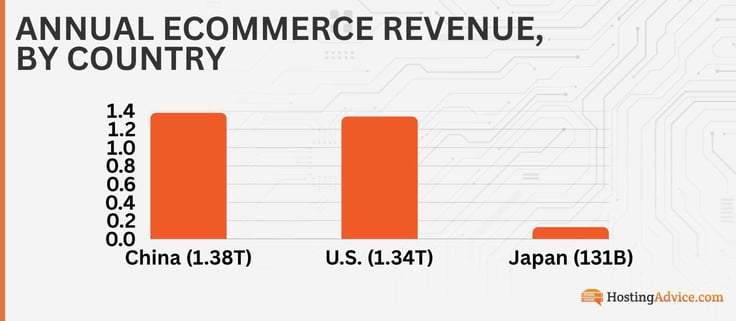
The eCommerce penetration rate in the U.S. is 87.8% and is expected to reach 97.09% by 2029. Now, while China is hands down the largest eCommerce market, a higher percentage of Americans rely on eCommerce — about 87.8%.8.9
Since eCommerce revenue is greater in China, what does this tell you about American spending habits? Americans probably spend more offline than the Chinese.
11. The ARPU in the USA Is $4,650
I had to dig deeper to figure out just how much American and Chinese users spend online. Turns out, Americans ($4,650) spend more than the Chinese ($1,330).5,10
The conclusion? While the U.S. has a greater penetration rate and a higher average revenue per user (ARPU), China has more users overall. I don’t expect the U.S. to overtake China anytime soon.
12. The Number of eCommerce Users in the U.S. Will Reach 333.5M by 2029
Let’s see if the math checks out. Since the ARPU in the U.S. is expected to reach around $5,515 by 2029, that means revenue will hit about $1.84 trillion by then. 10
13. Chinese eCommerce Revenue Will Grow to $1.86 Trillion By 2029
In the same period, considering an ARPU of approximately $1,318, Chinese eCommerce revenue will grow to $1.86 trillion.5,10
Yep, the numbers tell a tale. And hey, the U.S. might just come out on top in 2030!
14. The Turkish eCommerce Market Will Grow at 11.67% Between 2025 and 2029
Have you heard that football players go to Turkey for hair transplants? According to rumors, Lionel Messi and Cristiano Ronaldo have also had hair restoration procedures in the country!
Here’s another win for Turkey: it’s the fastest growing eCommerce market (11.67% CAGR).11
15. Brazil’s eCommerce Market Will Grow at 11.66% Between 2025 and 2029
While “Samba” and “Sambar” have nothing in common, if you know the basics about Brazil and India, you’ll understand exactly what I’m talking about!
Here’s something these countries do have in common: they’re among the fastest-growing eCommerce economies — they’ll grow at a CAGR of 11.66% and 11.58% between 2025 and 2029, respectively.11
Fastest eCommerce growth rates:
| Country | CAGR |
|---|---|
| Turkey | 11.67% |
| Brazil | 11.66% |
| India | 11.58% |
| Mexico | 11.39% |
| Russia | 11.04% |
| Thailand | 11.03% |
| China | 10.09% |
| Italy | 10.04% |
| Canada | 9.82% |
| Spain | 9.81% |
16. Amazon Has an eCommerce Market Share of 37.6% in the USA
If you’re an American, you probably buy stuff on Amazon all the time. After all, it’s the largest retail eCommerce company in the US, with a commanding market share of approximately 37.6%.12
17. Walmart Has an eCommerce Market Share of 6.4% in the U.S.
I remember visiting Walmart as a kid and trying free food samples in the grocery aisles. I haven’t visited one in years! Walmart now has thousands of retail stores and is still more famous for its physical stores than its eCommerce segment.
It’s the second-largest retail eCommerce company in the U.S., with a market share of about 6.4%.12
18. Apple, eBay, and Target Account For 8.5% of the U.S. eCommerce Market
The last time I visited an Apple store was during my trip to Dubai in 2024 — it was huge. I’m going to keep this eCommerce market share stat short: Apple (3.6%), eBay (3%), and Target (1.9%) are the third, fourth, and fifth-largest eCommerce companies in the USA, respectively. 12
19. Amazon Had $438 Billion in Sales in the USA in 2024
You know me — I had to run the numbers. Since there are only a couple hundred million American online shoppers at the time of writing, that means each person is spending an average of $4,650 per year on Amazon.
U.S. Amazon shoppers are spending big bucks. How else could Amazon have made around $438 billion in sales in 2024 in the U.S. alone? To put it into perspective, Germany ranked second with about $40 billion in sales.10,13
20. Clothing (43%) Is the Most Popular Online Shopping Category in the U.S.
Honestly, I thought food would be the most popular category for online purchases in the United States! Who doesn’t like having groceries delivered?
Instead, clothing (43%) and shoes (33%) lead the way.14
21. Brazil and Mexico Account for Nearly 60% of the eCommerce Market in Latin America
I was going to ask you to guess the two biggest eCommerce markets in Latin America, but well, I already gave you the answer: Brazil and Mexico.
Combined, they have around 60% of the eCommerce market share.15 Alright, here’s a question for you: which online shopping category is most popular in the region? If you guessed electronics, you’re right!
22. Latin America Accounts for 317 Million eCommerce Users
Have you watched “Modern Family?” It’s one of my favorite TV shows, and, of course, Gloria Pritchett is one of my favorite characters! She’s gorgeous and is the perfect representative for Latin America. The region is known for its tradition, food, culture, and landscape.
It also happens to be one of the more popular markets for eCommerce companies, with around 317 million users.15
23. Online Sales in Latin America Will Reach $319 Billion in 2025
No doubt Latin Americans spend a lot on footballs, football equipment, and jerseys! I’d probably be a professional football player if I were born in Brazil. One thing’s for sure: Latin Americans love online shopping just as much as football — the region is expected to experience more than $319 billion in online sales in 2025.15
24. Messi Is the #1 Selling Jersey in the MLS
Since the previous eCommerce statistic was about Latin America, I had to include a Lionel Messi stat.
Messi is the best player in the MLS (by a mile) and sells the most jerseys as well.16 Is that even a surprise? According to my estimates, he has sold more than 30 million jerseys since his debut. Talk about being a record-breaker on and off the field.
25. MercadoLibre Generated Revenue of $21 Billion in 2024
Have you heard of MercadoLibre? It’s an Argentinian eCommerce company.

While some sources say it’s the largest eCommerce company in the region, all signs point to Amazon being the market leader — MercadoLibre “only” earned around $21 billion in 2024.17 Surely Amazon generated more revenue?
26. The eCommerce Market in Europe Is Projected to Grow to $961 Billion by 2029
If Lionel Messi is the face of Latin America, we both know who’s the man in Europe: Cristiano Ronaldo. I mean, even I have a CR7 shirt! From the UK to Germany, France, Italy, and Spain, football is king.
And so is eCommerce — the eCommerce market in the region is expected to grow to a mammoth $961.27 billion by 2029.18
27. A Whopping 50% of German eCommerce Users Use PayPal
Do you use PayPal? One of my childhood friends lives in Germany, and he confirmed that PayPal is the preferred payment method for online shopping in Germany — nearly half of them use it.19 Other leading payment methods include debit cards, credit cards, and paying by invoice.
28. About 85% of People in the UK Purchase Goods Online
Of the 70 million people in the UK, about 84.7% use eCommerce. That roughly equates to 59.3 million users.20 I wonder how many of them are Manchester United fans… I can confidently say 10 million of them must be!
29. Nearly Two-Thirds (66.4%) of Germans Shop Online
Alright, enough football talk. It’s time to get serious — we’re talking about Germany, after all. Germany is the car capital of the world, so I wonder if people buy cars online. Probably not. But you can order your favorite beer online.
About 66.4% of the population shops online!21
30. eCommerce Revenue in the UK Will Reach $142 Billion in 2025
The Premier League is the best football league in Europe, and the United Kingdom is the most lucrative eCommerce market. Remember when I talked about the countries that earn the most eCommerce revenue? The UK is fourth on that list.
Top eCommerce countries by revenue:
| Country | eCommerce Revenue |
|---|---|
| China | $1.38 trillion |
| United States | $1.34 trillion |
| Japan | $191 billion |
| The United Kingdom | $142 billion |
| Germany | $108 billion |
For a population of nearly 70 million, a projected eCommerce revenue of around $142 billion isn’t bad!20,22
31. A Slow Website Could Cost an eCommerce Platform $2.5 Million Annually
Grab a cup of coffee: it’s time for you to read fun eCommerce statistics! I mean… not everyone loves revenue stats as much as I do. If you operate a top eCommerce website that makes more than $100,000 in sales daily, a slow website could cost you at least $2.5 million in lost sales each year.23 Ouch.
32. Roughly 32% of Marketers Cannot Implement AMPs
I want you to try loading a random webpage (or your business website) on your laptop and smartphone. If it loads slower on your smartphone, it probably isn’t fully optimized for mobile. Slow mobile page load speeds could be detrimental to your eCommerce business.
While accelerated mobile pages (AMP) technology is a solution I recommend, unfortunately, approximately 32% of marketers don’t have the developer resources to implement it.23
33. The Average Website Page Takes 2.5 Seconds to Load
What exactly is a slow website? Well, the average website page takes around 2.5 seconds to load on a computer and 8.6 seconds on a smartphone.24 This basically means that online shopping on a computer is faster than on a smartphone!
So, if your website is slower than that, boy, oh boy, do you have some work to do!
34. GreenGeeks Offers a Quick Page Loading Speed of 118.6 ms
Maybe you’re not part of an eCommerce business but want to build one. In that case, you need a quick web hosting provider that ensures your users have the best possible experience. You don’t want them to bounce, do you?
GreenGeeks is one of the fastest web hosting providers, with a webpage loading speed of 118.6 ms. Hostinger (136 ms), SiteGround (139.6 ms), and Bluehost (153 ms) are fast as well.25,26
35. Slow Websites Reduce Customer Satisfaction by 16%
Slow websites (a one-second delay) reduce customer satisfaction by just 16%?27 I bounce if a website takes more than two seconds to load — I’m 100% dissatisfied with a slow website!
The quicker a webpage, the more likely it is to retain our interest. Right?
36. An Astounding 70% of Customer Purchase Decisions Are Impacted by Slow Websites
Now, this webpage loading time statistic is more like it! When I set out to buy something, I’m excited. The last thing I need is a slow website dampening my mood!
It’s time for you to invest in a fast web host if your eCommerce business experiences slow webpage loading speeds — around 70% of customer purchase decisions are impacted by slow webpage speeds.27
37. Roughly 32% of Visitors Will Abandon a Slow Website
Approximately one in three website visitors will abandon your website if it takes between one and three seconds to load. Since the average loading speed of a webpage is 2.5 seconds, you should target a loading speed of around one second.24,27
38. First Page Google Search Results Have an Average Webpage Speed of 1.65 Seconds
Surprise, surprise: the Google Search engine prefers fast websites. Websites on the first page of Google Search results experience an average webpage loading speed of just 1.65 seconds.27 HostingAdvice.com fits the bill. Does your website meet this criterion?
39. Around 55% of eCommerce Activity Takes Place Through a Smartphone
Honestly, I do all of my online shopping through my smartphone — even for something like a sports bike. In fact, around 55% of all eCommerce activity takes place through mobile phones.27
The lesson? It’s super important to optimize your website for mobile.
40. China Is #1 for Website Loading Speeds
Let’s explore a few more webpage loading speed statistics, shall we? The last five — I promise. China has the fastest websites in the world. Why? Most of their retail happens online.

Can you guess which countries have the slowest websites? India and Brazil are the culprits.27
41. eCommerce Websites Should Load Within Two Seconds, According to Google
Apparently, Google says all websites should load within three seconds. Considering your website needs to load within 1.65 seconds to even stand a chance of appearing on Google Search’s first page, I agree. And yes, the limit is just two seconds for an eCommerce website.27
42. Research Shows 18% of Customers Will Abandon Their Cart if a Website is Slow
Let’s say you’ve found the perfect wedding gift for your dear friend. You grab your credit card and are ready to make the payment, but the checkout pages are way too slow! What would you do? Would you abandon your cart? Well, around 18% of customers would.27
43. Checkout Speed is the Priority for 51% of American Shoppers
It gets worse if your eCommerce business is based in the U.S. — if the checkout speed is slow, approximately 51% of your customers will abandon their cart. And it’s safe to say many of them won’t come back.27
44. About 64% of Online Shoppers Will Shop Elsewhere if Dissatisfied
A good shopping experience isn’t limited to your website’s loading speed. Your customers are looking for easy navigation, clear product information, and seamless checkout.
Almost two-thirds (64%) of online shoppers will shop on a different eCommerce platform if they’re dissatisfied with your website.27
45. eCommerce Websites Experience a Bounce Rate Between 20% and 45%
Alrighty, this is the last eCommerce statistic related to speed! And really, how can I talk about speed without mentioning website bounce rates? It’s simple: the faster your website is, the greater the chance your visitors won’t bounce.
Website bounce rates by website type:
| Website Type | Bounce Rate |
|---|---|
| eCommerce | 20% to 45% |
| Blogs | 70% to 90% |
| SaaS | 35% to 55% |
| Services | 10% to 50% |
| B2B | 30% to 55% |
| B2C | 35% to 60% |
| News | 60% to 85% |
Website speed is the real king of eCommerce.28
46. Poorly Designed Websites Deter 42% of Users
Your customers will judge your website by its cover — they won’t give you a second chance either. If your website is poorly designed, you can expect approximately 42% of visitors to wave you goodbye.29
47. Only 23% of People Prefer Yellow Websites
Whatever you do, don’t pick yellow for your eCommerce site — only about 23% of people prefer the color yellow in website designs. Blue is a better choice (43%).29
48. WordPress Powers 43.5% of All Websites
Who’s your favorite midfielder of all time? For me, it’s Zidane. If you really understand football, you can’t win titles without a magical midfield.
WordPress is like the Zidane of content management systems (CMSes) — it’s versatile, reliable, and with the right ingredients, can turn any project into a winner. That’s why it drives approximately 43.5% of all websites.30
49. Around 13.35 Million eCommerce Websites Use WordPress
Since there are about 30.7 million eCommerce websites, can you help me figure out how many of them use WordPress? Just use the figure from the previous WordPress usage statistic to do the calculation! Did you arrive at ~13.35 million?30,31 Well done.
50. WordPress Has 59,000+ Free Plugins
If you choose WordPress for your website, one of the ingredients that can turn your website into a success is plugins. You can think of WordPress plugins as the building blocks for your website.
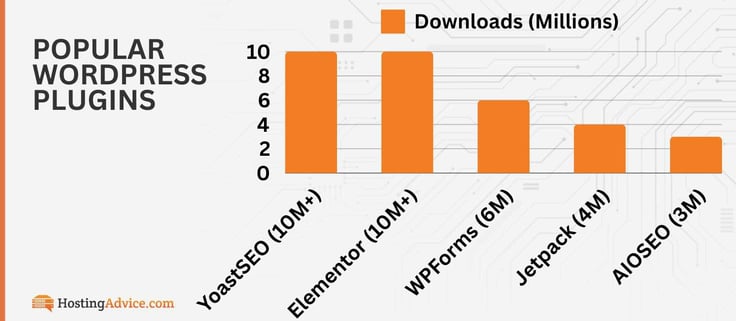
Need SEO optimization? Yoast SEO it is. Enhanced eCommerce functionality? WooCommerce. Optimized website speed? WP Rocket. The WordPress plugins store has more than 59,000 free options — build that website.32
51. At Least 10 Million WordPress Websites Use Elementor
If you want to build a pixel-perfect website for your eCommerce business and don’t know how to code, you should consider Elementor — it’ll help you develop your dream website without a single line of manual coding!
More than 10 million active WordPress website owners swear by it!32
52. WordPress 6.8 Has Been Downloaded 28.5 Million Times
I want to clarify that WordPress has been downloaded way more times than 28.5 million — it has had 52 major releases since May 2003.33,34 WordPress 6.8? Well, it’s the latest version at the time of writing.
53. WooCommerce and Shopify Hold 46% of the eCommerce Software Market Share
If you want to use WordPress as your CMS, WooCommerce is the perfect ally for adding eCommerce functionality to your website. In fact, many web hosting companies offer hosting plans that are optimized specifically for WordPress with WooCommerce.
Shopify is both a CMS and eCommerce software. Together, they hold approximately 46% of the eCommerce software market share.35
54. Shopify Holds 26.2% of the eCommerce Software Market Share
In 2023, Shopify was behind both WooCommerce and Squarespace in this segment. Now? It rules the roost.
And I understand why: from domain registration and website hosting to eCommerce tools, payment processing, inventory management, marketing features, and customer support — it unifies all of your eCommerce activities on a single platform.
That’s why it commands about 26.2% of the market. WooCommerce usage? Just around 20.1%.35
55. Wix Holds 16.2% of the eCommerce Software Market Share
I know you were expecting Squarespace (15.6%) to at least feature in third place. Well, no: Wix (16.2%) has taken over.35
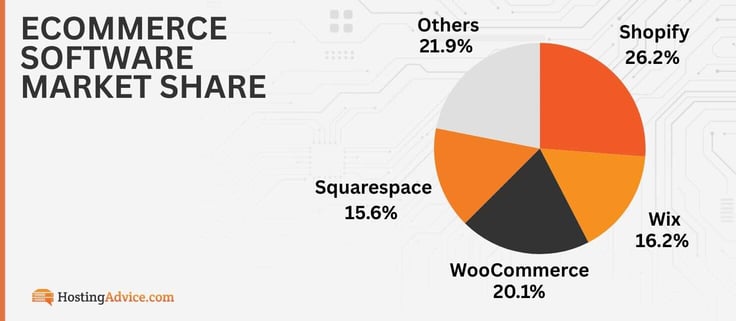
If you want a smooth ride, I recommend WordPress with WooCommerce or Shopify. Wix is good, but I want you to have the best tools at your disposal.
56. Shopify Powers 5.54 Million Businesses
Can you figure out what Allbirds, Gymshark, Heinz, Kylie Cosmetics, and Fashion Nova have in common? These high-profile websites are backed by Shopify, alongside around 5.54 million other businesses!36
57. More Than 700 Million People Will Buy from a Shopify Store in 2025
According to my estimates, more than 700 million people will buy from a Shopify merchant in 2025. And since the success rate of a Shopify store is between 5% and 10%, I’d say your eCommerce business has a decent chance of making it if you go with Shopify!36
58. There are 45,087 Shopify Plus Stores
You can think of a Shopify Plus store as owning a luxury penthouse with a bunch of househelps — it’s royalty. There are approximately 45,000 Shopify Plus stores, and yes, brands like Heinz, Allbirds, and Gymshark use it.36
59. Shopify Drives $444B in Economic Activity Annually
$444 billion? That’s a lot of money. Now, considering Shopify has around 4.6 million visitors every day and the average conversion rate for a Shopify store is approximately 1.4%, if you manage to create a visually appealing, high-performing eCommerce store that sells niche products, you might earn serious dough.36
60. The USA has 56.7% of all Shopify Stores
There’s one more similarity between the Shopify-empowered businesses I listed previously — 80% of them are based in the U.S. What does this tell you?
It’s likely that a majority of Shopify stores are in the United States, right? Yep — about 56.7% (3.14 million) of all stores.36
Share of Shopify stores by country:
| Country | Store Distribution |
|---|---|
| United States | 56.7% |
| United Kingdom | 4.0% |
| Australia | 2.8% |
| Germany | 2.7% |
| Brazil | 2.2% |
| Canada | 2.2% |
| India | 1.7% |
| France | 1.6% |
| Netherlands | 1.3% |
| Others | 24.8% |
61. About 3.66% of the Top 10,000 eCommerce Websites Are on Shopify
I’ll be honest with you: I expected this number to be much higher. But then I thought, why would a top eCommerce company like Amazon or Walmart use Shopify? They probably own or control their own infrastructure.
So, yes, approximately 3.66% of the top 10,000 eCommerce websites are hosted on Shopify.36
62. An Estimated 2.71 Billion People Shop Online in 2025
Take a guess: how many people are on the internet? Around 5.5 billion. And approximately 50% of them (2.71 billion) shop online!37,38 If you ever wanted to get into the eCommerce game, now is the time.
63. Temu was Downloaded 86 Million Times in the U.S. in 2024
Before you get any funny ideas about the quality of my research, let’s address the elephant in the room: a large chunk of eCommerce users in the United States already had the Amazon app on their smartphones in 2024.
Temu? Well, not quite. That’s why it was downloaded more than 86 million times that year. And Shein was downloaded more than 46 million times.39
64. About Two-Thirds (66%) of Online Sales in the U.S. Are Through Smartphones
I guess I’m the only person on this planet who strictly uses their laptop for work — I don’t even open YouTube on my device.
So, yes, 100% of my eCommerce activity is through my iPhone. I guess approximately 66% of people in the U.S. are like me — they use their smartphones for online shopping.40
65. Data Shows 40% of Consumers Have Bought a Product They Saw on Social Media
Have you ever bought a product that you saw on social media? I once did — an astronaut that beams starlight from its eyes. I don’t regret the purchase.

Apparently, about 40% of people have bought a product they saw on a brand’s social media page.41
66. Roughly 34% of eCommerce Users Shop Weekly
I shop online almost every day, so I find it hard to believe only around 34% of eCommerce users shop at least once a week!42 And hey, I’m not a shopaholic — I just buy everything online… I mean, I even order eggs online!
67. The Influencer Market Is Valued at $32.55 Billion in 2025
Who would have thought influencer marketing would be valued at approximately $32.55 billion in 2025?43 It’s a concept that didn’t even exist twenty years ago. Yet, here we are!
68. The Majority (70%) of Millennials and Gen Z Follow Influencers
Alright, at least I can brag that I don’t follow any influencers. I mean, what do you even see in people like Logan Paul, KSI, and iShowSpeed? Anyway, I’m not one to question your life choices — apparently, about 70% of Millennials and Gen Z follow influencers.44
69. Almost Half (49%) of People Trust Influencer Recommendations
I only trust influencers who genuinely use the products that they advertise — I don’t like it when celebs endorse products they don’t use. So, yes, I understand why only about 49% of people trust recommendations made by influencers.44 That’s still a pretty big number.
70. Nearly 60% of Marketers Struggle to Find the Right Influencers
Since around 49% believe in influencer recommendations, logic suggests you should hire a few for your eCommerce business, right? Well, think again: it’s not easy to find the right ones — approximately 60% of marketers struggle to do so.44
71. Micro-Influencers Have Engagement Rates Between 3% and 5%
I think you should invest in micro-influencers. Yes, I understand they’re not as flashy as Khaby Lame, but they generate engagement rates of between 3% and 5%.44 And they cost less. So, if you invest in a few of them, you could achieve a good ROI.
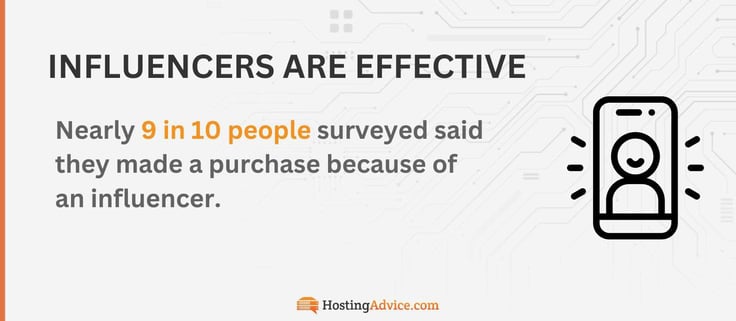
72. About 46% of Instagram Users Purchase Products Through Influencer Marketing
Hold on: I don’t mean 46% of all Instagram users. I’m talking about 46% of users who engage with an influencer’s post. So, if you invest in a micro-influencer who has 5,000 followers and their engagement rate is 3%, you can expect approximately 69 people to buy your product.44 Not bad, right?
73. Companies Will Spend $277 Billion On Social Media Advertising in 2025
Social media advertising isn’t limited to influencer marketing, obviously. Those pesky ads you see when you’re swiping through Instagram stories or scrolling your feed? All part of the marketing game. And guess what? Companies will spend an estimated $277 billion on it in 2025.45
74. People Spend 141 Minutes Daily on Social Media
Let’s wrap things up with a social media statistic. Since people spend about 141 minutes on social media each day, you should take advantage of this opportunity.45
Create a world-class eCommerce website, invest in micro-influencers, and target audiences on social media!
What Is the Future of eCommerce?
If you swear by offline shopping, don’t worry — your favorite local shops, supermarkets, boutiques, and malls will continue to thrive. But seriously, you should explore online stores.
I mean, with large-scale AI/ML integration just around the corner, you might be able to buy a perfectly-fitting t-shirt or shoe without even physically trying it on. Just click a picture of a product whose fit you like and voilà — you’ll have a selection waiting for you.
And if you’re someone who wants to step into the eCommerce business, there’s no time better than the present. Just check out the Shopify website when you have some spare time today. I’m sure you’ll be inspired.
Sources and Further Reading
- https://www.statista.com/statistics/379046/worldwide-retail-e-commerce-sales
- https://www.statista.com/forecasts/860716/top-online-stores-global-ecommercedb
- https://www.statista.com/statistics/245340/leading-large-cap-e-commerce-companies-market-cap
- https://www.statista.com/statistics/267870/brand-value-of-the-leading-most-valuable-retailers-worldwide
- https://www.statista.com/outlook/emo/ecommerce/china
- https://www.worldometers.info/world-population/china-population
- https://www.statista.com/outlook/emo/ecommerce/united-states
- https://www.statista.com/outlook/emo/ecommerce/japan
- https://www.statista.com/statistics/273958/digital-buyer-penetration-in-the-united-states
- https://www.statista.com/outlook/emo/ecommerce/united-states
- https://www.statista.com/forecasts/220177/b2c-e-commerce-sales-cagr-forecast-for-selected-countries
- https://www.statista.com/statistics/274255/market-share-of-the-leading-retailers-in-us-e-commerce
- https://www.statista.com/statistics/672782/net-sales-of-amazon-leading-markets
- https://www.statista.com/forecasts/997093/most-popular-categories-for-online-purchases-in-the-us
- https://www.statista.com/topics/2453/e-commerce-in-latin-america
- https://www.transfermarkt.co.uk/lionel-messi-at-the-top-the-most-sold-jerseys-in-major-league-soccer/view/news/443978
- https://www.statista.com/statistics/730403/mercadolibre-revenue
- https://www.statista.com/forecasts/715663/e-commerce-revenue-forecast-in-europe
- https://www.chargeflow.io/blog/paypal-statistics-facts
- https://www.statista.com/outlook/emo/ecommerce/united-kingdom
- https://www.statista.com/outlook/emo/ecommerce/germany
- https://worldpopulationreview.com/countries/united-kingdom
- https://www.websitebuilderexpert.com/building-websites/website-load-time-statistics
- https://www.tooltester.com/en/blog/website-loading-time-statistics
- https://www.bitcatcha.com/my/hosting-reviews/fastest
- https://codeless.co/fastest-web-hosting
- https://electroiq.com/stats/website-load-time-statistics
- https://www.causalfunnel.com/blog/average-bounce-rate-by-industry-2025-benchmarks
- https://colorwhistle.com/website-design-statistics
- https://w3techs.com/technologies/details/cm-wordpress
- https://seo.ai/blog/how-many-ecommerce-sites-are-there-in-the-world
- https://wordpress.org/plugins
- https://wordpress.org/download/counter
- https://wordpress.com/blog/2025/04/17/wordpress-market-share
- https://www.mobiloud.com/blog/woocommerce-vs-shopify-market-share-statistics
- https://www.shoptrial.co/shopify-statistics
- https://www.statista.com/statistics/273018/number-of-internet-users-worldwide
- https://capitaloneshopping.com/research/online-shopping-statistics
- https://www.statista.com/statistics/1343548/most-downloaded-shopping-apps-united-states
- https://www.statista.com/statistics/201680/retail-site-device-visit-order-share-usa
- https://whop.com/blog/social-commerce-statistics
- https://analyzify.com/statsup/ecommerce
- https://influencermarketinghub.com/influencer-marketing-benchmark-report
- https://supplygem.com/publications/influencer-marketing-statistics
- https://www.brandvm.com/post/social-media-statistics-2025