




Writer: Jordan Sprogis


Editor: Lillian Castro


Reviewer: Cristian Lopez

Key Takeaways
- The cloud is a fantastic tool, but the excitement has worn off. Now, even Fortune 500-level companies are rethinking what should have moved to the cloud in the first place.
- Deloitte veteran David Linthicum warns that the real problem wasn’t the cloud, but the strategy. And companies are about to repeat those mistakes with AI at 10 times the cost.
- Recent AWS and Cloudflare outages exposed how fragile the ecosystem really is because businesses never built their own resiliency.
Who remembers the very beginning of the cloud? When it was practically evangelized, with industry leaders talking about it like the Second Coming of technology. Microsoft’s Steve Ballmer called it the future of everything. Jeff Bezos promised it would be cheaper than modern-day solutions. Salesforce’s Marc Benioff advocating the death of software in the wake of the cloud.
The cloud delivered on most of the promises — scalability, speed, global reach — but the bill came due in ways early advocates never advertised, or, quite honestly, understood.
Yes, the cloud can streamline ops and cut certain costs, but it can just as easily drain a budget if enterprises are not deliberate about it. In fact, Flexera’s 2024 report shows 82% of enterprises now rank managing cloud spend as their No. 1 challenge. Figuring out if it’s worth using “OPC” — that is, Other People’s Computers, bringing us right back to the ownership versus renting debate.

But it’s David Linthicum — an internationally known enterprise technology thought leader whose cloud computing course is LinkedIn’s top-ranked class — told us that using OPC often means paying five times as much for the same compute.
“That was a big misunderstanding in the early days of cloud. I heard ‘cloud’s always going to be cheaper, cloud’s always going to be better,’” Linthicum told us. “It can be better, often not cheaper. And people now understand that if you’re going to pay for somebody else’s infrastructure, they’re going to charge you a good penny for it.”
Ask anyone this year and you’ll find that many companies are discovering that the cloud solved one set of problems while simultaneously creating another.
Flexera’s 2024 State of the Cloud report shows 82% of enterprises now say managing cloud spend is their No. 1 challenge. And the recent outages from AWS and Cloudflare just tacked on lost revenue for hundreds, if not thousands, of companies relying on that infra.
This was the landscape that Linthicum was ready to address at CloudFest Miami 2025. This time, HostingAdvice’s conversation wasn’t a Zoom interview or a vendor webinar: It was in person on the WebPros stage with a deep-purple backdrop and a couple of spotlights hitting the center.
And the audience was full of people who were being asked if their cloud choices still made sense.
The Cloud Hangover
Before anybody could automatically assume the worst, Linthicum made it clear that the cloud is not dead. It’s not even dying. It’s just being…repurposed. As a 30-year Deloitte veteran and cloud/IT consultant, it’s something he’s seen firsthand across dozens of multimillion-dollar clients.
“It’s never a cloud-only strategy; it’s a cloud-sometimes strategy,” Linthicum explained to us. “Now [companies are] looking at cloud as one option among many — heterogeneity, multi-cloud, on-prem versions.”
If money is an object (of course it is), then many experts recommend using the cloud for the things that scale fast. Things like highly variable workloads, global content delivery, and GPU bursts. Basically, anything that could spike, is seasonal, or gets distributed belongs to the cloud.

It’s using the clouds for the basic workloads that’s draining budgets. The cost of hardware ownership was severely challenged amid the rise of the cloud, but now many companies are reconsidering it. Dropbox was among the early realizers, saving $75 million over two years after it switched many workloads from the cloud and onto its own infrastructure.
“Everybody thought the cloud was going to deliver all this value ten years ago,” Linthicum explained. “Now the focus is finally on strategy — pragmatic use of the technology, common frameworks, and actually delivering the value people expected a decade ago.”
As with every tech fad — 3D TVs, Google Glass, metaverse real estate — the cloud was oversold before it was understood. The difference is the cloud never truly went away; we just finally learned what it’s actually good for.
The Real Failure? No Resiliency Strategy
How long before you admit you’re beating a dead horse and not just waiting for the cloud to suddenly reveal its hidden value? When asked how to tell when it’s time to move to a different option, Linthicum’s answer is almost comically simple.
“If it’s more expensive, that would be the key signal to me,” he said. “What’s the total cost of ownership of running something on Amazon, Microsoft, or Google versus running it on private cloud, neo-clouds, or other alternatives? Typically the costs are way less on the alternatives.”
Most people go for one of the Big Three because they’re among the most trusted and widely distributed companies in the world.
“Enterprises are myopic. They always choose the brand-name hyperscalers. They chase the hype, not the business realities. They think in terms of crowds — they go to re:Invent, take pictures of the architecture slides, bring them back, and use them without any changes,” Linthicum said.
Because surely Amazon, Microsoft, and Google provide more uptime than a private cloud or colo facility, right? Not necessarily. Just take a look at the several internet-breaking outages from AWS, Microsoft, and Cloudflare we’ve been seeing over the past couple of months.
AWS’s US-East-1 data center took down Snapchat, Reddit, and Roblox, along with thousands of smaller apps. Cloudflare — which controls about 20% of global traffic — followed with two back-to-back incidents in November and December, stalling everything from eCommerce carts to ChatGPT and X.
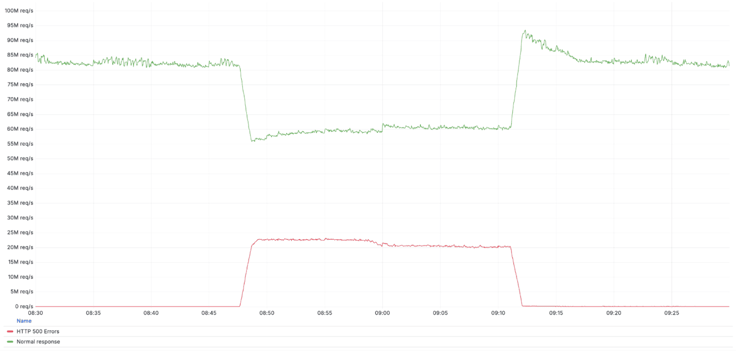
At one point, 28% of all HTTP traffic running through Cloudflare’s network was affected, with some analysts estimating businesses lost millions of dollars in revenue during those few hours.
But Linthicum doesn’t pity those companies. They should have known better.
“They didn’t do their [Business Continuity and Disaster Recovery] strategy effectively; people run systems blindly on the hyperscalers, expecting nothing’s going to occur,” he warned. “The laws of physics exist for the hyperscalers like they do with everything else out there. Things are going to go wrong.”
You know how they say history repeats itself? The same pattern Linthicum just described with the cloud boom is already forming around AI. You know, the same blind optimism.
Only this time, the tech isn’t nearly as forgiving. Operating AI is so much more expensive and complex. And unless something changes, he thinks the industry is about to learn that the hard way.
“We have huge amounts of repatriation right now because people moved systems to the cloud for hype reasons, not because it was the right platform,” Linthicum said. “And we’re about to make the same mistakes with AI — only this time the costs are ten times higher.”
Coming Soon: A companion piece, “Are AI Bankruptcies Coming? AI Expert Says the Industry Is About to Touch the Stove Again.”
