




Writer: Jordan Sprogis


Editor: Lillian Castro


Reviewer: Cristian Lopez

Key Takeaways
About 30,000 Oracle employees in development, engineering, and support found out they were out of a job via a 6 a.m. mass email on March 31. The message thanked them for their dedication.
“Well, after 30+ years at Oracle, I join the 30,000 or so laid off today. Quite a shock,” one employee wrote on Reddit.
The email read:
“We are sharing some difficult news regarding your position. After careful consideration of Oracle’s current business needs, we have made the decision to eliminate your role as part of a broader organizational change. As a result, today is your last working day. We are grateful for your dedication, hard work, and the impact you have made during your time with us. After signing your termination paperwork, you will be eligible to receive a severance package subject to the terms and conditions of the severance plan. You will receive an email from DocuSign to your Oracle email address with details on your severance and termination date.”
Oracle hasn’t explicitly said what the cuts are for, but it may be worth noting that that about a year ago, the cloud company committed to helping fund a multibillion-dollar AI project.
Oracle is currently one of the main investors in the Stargate Project, the $500 billion AI infrastructure initiative alongside OpenAI and SoftBank. Unfortunately, it’s not going as well as many thought it would.
A year in, the project hasn’t secured a data center deal or added hires. Partners are reportedly still working through land acquisition, power contracts, and grid approvals.
What This May Mean for Hosts
Among the 30,000 people fired last month are 12,000 positions cut from Oracle’s India development centers alone. The job cuts were made across multiple divisions, including AI/ML functions and customer service.
Here’s the problem with that. Oracle’s enterprise clients aren’t turning to chatbot help desks to run massive databases and workloads. They expect someone who’s seen the issue before, maybe even numerous times, and those are the people Oracle just cut across development, engineering, and support.
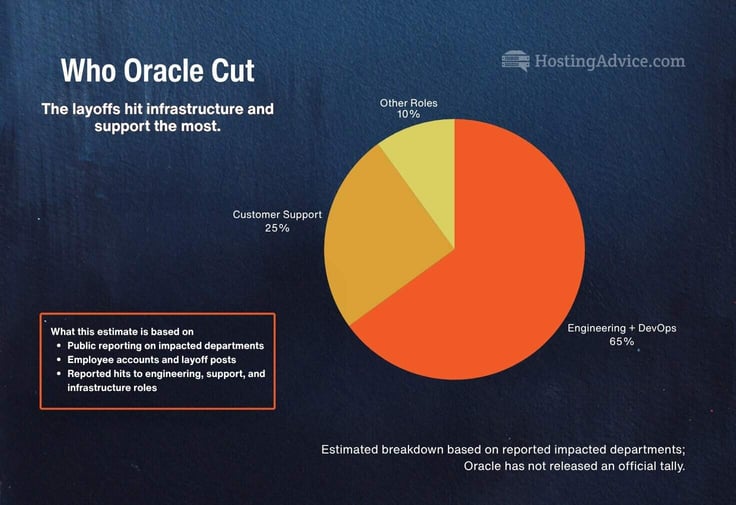
Still, enterprise clients will probably be fine, at least on paper. Their high-tier plans typically come with priority support, SLAs, and specifically dedicated escalation paths. But that doesn’t mean every issue gets instant, expert attention, and it definitely doesn’t mean the same engineers who built or deeply understand the system are still there to fix it.
For hosting providers running on Oracle, this likely means picking up the support and technical slack that Oracle’s own teams used to handle.
Sound familiar? After Broadcom acquired VMware, it cut large portions of VMware’s partner ecosystem and reduced direct support channels. And it ultimately forced customers to migrate, rely on fewer support channels, or go without support entirely in some cases.
Loyalty, it turns out, has a shorter shelf life than a GPU cluster.
