



Writer: Jordan Sprogis


Editor: Lillian Castro


Reviewer: Cristian Lopez

Key Takeaways
In the months following Broadcom’s 2023 acquisition of VMware, several analysts and surveys warned of a looming “mass exodus.”
The upheaval didn’t quite happen the way most predicted it would. But that doesn’t mean it’s not happening at all: A new CloudBolt survey says 86% of organizations are actively reducing their dependence on VMware, meaning they are looking to leave.
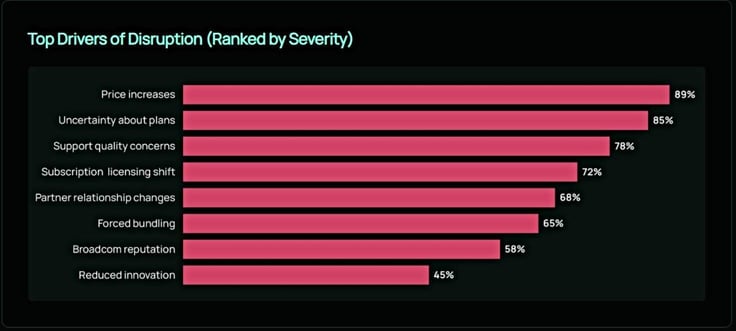
The main reason? Price.
The timing isn’t a coincidence. Susan Odle, the CEO of StorMagic — one of the places that many VMware customers are flocking to — said it’s more contractual than emotional.
“Broadcom forced 3-year renewals shortly after acquiring VMware, those terms are coming up for renewal again, at the same time as customers that renewed for 3-5 years before the acquisition are coming up for renewal,” said Odle.
Customers likely used the renewal window to assess possible alternatives, even test workloads, and make migration plans. Broadcom’s leadership will officially hit three years come this November.
Odle added, “We anticipate the next two years will see the majority of these migrations actualize.”
Customers have reported price increases of three to six times on average, with some experiencing increases of twentyfold. Some have even reported that they’re unable to get a hold of any support. Broadcom says all of this is in the name of smart strategy for the company long term.
And yet, cost alone doesn’t fully explain the “exodus.”
“There is no confidence that what a customer will negotiate on the renewal today will be reasonably close to what it might be on the next renewal. On a technology level, what features available today might be withdrawn in the future?” Odle said. “It is impossible to manage a business when you can’t trust the ground underneath your systems to be stable. The risks are incredibly significant.”
CloudBolt’s survey reported “extreme disruption” dropped from 46% in 2024 to 25% in 2025, but 88% still say Broadcom’s changes remain disruptive. And 56% say they’ve altered their VMware strategy two or more times since the acquisition.
A Slow Unwind
As Odle said, the next two years will show us just how steep the move from VMware is going to be.
But it’s definitely a slow unwind. Large-scale data center migrations typically take 18-48 months, while multisite VMware estates can stretch beyond three years. The Register noted that each virtual machine can cost between $300 and $3,000 to migrate.
And of course, if you ask who’s actually done it, more than 60% will tell you that migration timelines are much longer than originally expected.
Right now, CloudBolt’s survey shows that will unravel as companies plan ahead:
- 37% are staying on VMware as they look for other options
- 72% of VMware migrations are going to public cloud IaaS
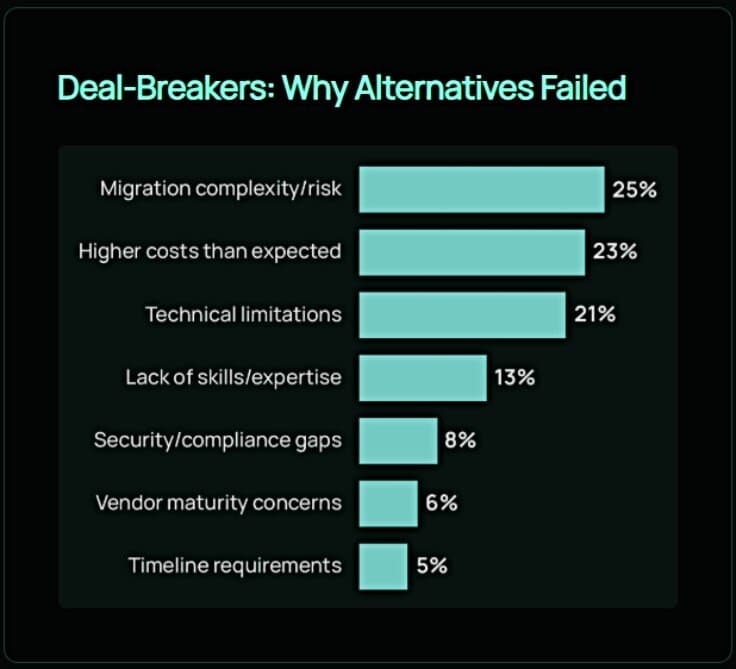
- Hyper-V/Azure Stack (38%) and SaaS replacements (34%) are the most common alternatives
Hyperscalers are clearly absorbing a major share of those transitions. AWS and Azure both also actively pitch VMware migration services. But Odle warns that not all workloads are treated equally.
“It’s important that customers distinguish between virtualization needs in the enterprise data center and at the edge,” she told us. “The requirements are not the same and if you apply one technology everywhere, it will get significantly expensive and likely will be too much or too little in each environment.”
In large enterprise datacenters, alternatives such as Nutanix, Red Hat, and HPE are seeing increased interest. Nutanix, for example, reported 17% growth between 2024 and 2025.
Some organizations are evaluating open-source platforms like Proxmox, which has seen substantial adoption growth over the past several years. Others are looking at vendor-supported platforms designed specifically for edge environments.
“StorMagic replaces VMware on existing hardware or any new x86 hardware outside of the enterprise datacenter. So if a customer has a requirement to ensure availability of mission critical workloads at the edge, we’d love to talk to you,” Odle said.
Broadcom Remains Optimistic
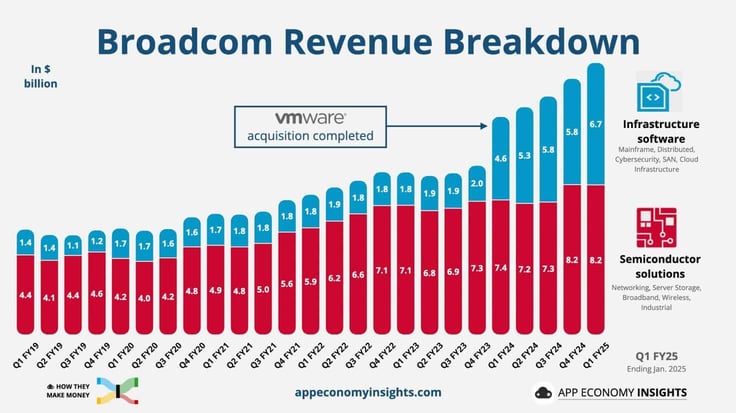
Though the numbers clearly suggest that organizations are planning to move away from VMware, Broadcom reported that VMware’s revenue climbed 26% year over year in its latest earning call.
Revenue reflects the contracts already active and signed, so it’s not surprising that VMware is seeing a positive upfold. CloudBolt’s data, of course, only predicts future intent.
Not to mention that organizations locked into multiyear renewals are still paying because of those agreements. But as this cycle of renewal comes to a close come winter 2026, many may be unwilling to commit again at the same licensing tiers, particularly at the bundled, premium stack levels.
Broadcom replaced VMware’s known perpetual licensing with subscription bundling (VCF/VVF services), which hasn’t received the best feedback.
The new licensing model has higher minimum core requirements from 16-core to 72-core minimum, meaning that even if a user only needs 16 cores, they have to pay for 72.
Yeo and Yeo reported that this could raise annual support costs from $2,000 to more than $10,000.
“Previously general available features have been reduced to Broadcom’s ICP (Ideal Customer Profile),” Odle said. “It’s time to get real about the vendor that cares about you, especially when they tell you so clearly who they care about.”
While not the apocalyptic-level that many people predicted when Broadcom acquired VMware, it may actually still be happening. But it’s definitely still coming.
