




Writer: Jordan Sprogis


Editor: Lillian Castro


Reviewer: Cristian Lopez

Key Takeaways
For most of the internet’s history, web hosting was a pretty unglamorous proposition: You paid for disk space and uptime, you got disk space and uptime. Everyone went home happy.
Fast-forward a few years and AI tools have completely changed the way it means to build and run something online. Customers have noticed, too.
So, we asked the experts at Hostinger, Kinsta, and 10Web a simple question: If AI now handles most of the creative and technical work, what exactly are hosting providers for?
#1: AI Changed What Customers Expect
The simplest place to see just how far the floor has moved is to look at today’s customer expectations.
If people can build a website by chatting with AI, then everything around that experience (setup, optimization, marketing) needs to feel just as simple, said Saulius Lazaravičius, the VP of product at Hostinger.
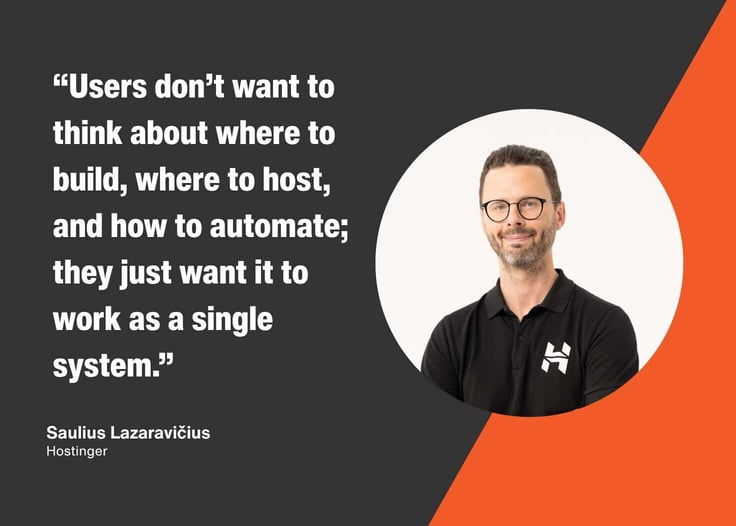
“What used to take hours and even days is now achievable in minutes,” he said. “Users don’t want to think about where to build, where to host, and how to automate; they just want it to work as a single system.”
Narek Torosyan, CEO of 10Web, agreed that what customers are measuring has changed.
“AI has shifted the metric from uptime and page speed to time to revenue and hours saved,” he said. “Customers don’t want to manage infrastructure; they want to run their businesses.”
That’s a pretty big change from what hosting providers were asked to do, right?
Historically speaking, we know their job was just to set up the connections. Now, they’re expected to be a single seamless layer in a multilayered stack the customer doesn’t even want to think about.
Roger Williams, the community manager at Kinsta, sees the same thing from the user’s side.
He shared with us that he’s watching a new category of web builder emerge, one where marketers and small business owners who would have never called themselves technical, is now using Claude Code to build and manage their sites.
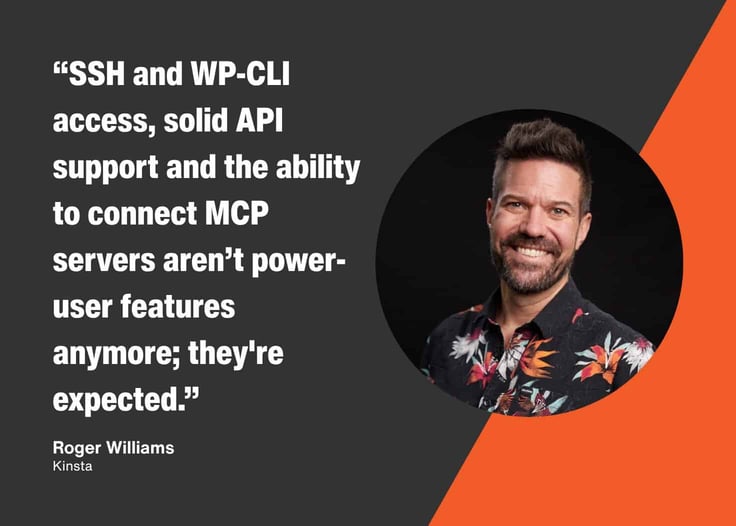
“For hosting providers, this means the bar for ‘table stakes’ has risen,” he said. “SSH and WP-CLI access, solid API support, and the ability to connect MCP servers aren’t powerful features anymore. They’re expected.”
#2: AI Makes Building (& Breaking) Easier
MCP, or Model Context Protocol, keeps coming up in the conversations we have with industry experts. It’s what lets AI tools connect directly into a hosting environment, which is now becoming a basic expectation for users who may be “experimenting more boldly” — as Williams put it — and need the infrastructure to keep up.
But experimentation isn’t always good news for providers. Sometimes, bold users make bold mistakes. Williams was candid about what Kinsta’s users have been asking for in this regard.
When people are using AI tools to automate changes on their sites, they need a pretty hefty “undo” mechanism for when they make mistakes. AI removed the knowledge barrier and people walked right through it, but it doesn’t eliminate system downtime or insider failures.
“People will experiment more aggressively when they know they can roll back,” Williams noted.
That’s a feature that could earn trust directly: Users don’t really think about backups until they desperately need them. It’s the digital equivalent of throwing out the recipe before you’ve finished cooking, then fishing it back out of the trash.
One way to help combat those big mistakes is to increase customer education: “Documentation quality now matters for the AI tools your customers use, not just the customers themselves,” Williams said.
If your platform’s documentation is thin or poorly structured, the LLM your customer is using to build on your infrastructure will make worse recommendations because remember: Your docs have a new audience, and it doesn’t read the way humans do.
#3: The Choice Is Yours: Platform or Commodity?
So, what are these big players doing themselves to keep up?
Lazaravičius describes Hostinger’s vision in explicitly expansive terms: not a hosting company that added some AI features, but “an AI-driven online business growth platform.”
Hosting, in this perspective, is one layer in a larger system that includes building (Horizons, AI Website Builder), running (Node.js, modern frameworks, MCP integrations), and automating (one-click tools like OpenClaw, n8n and Paperclip). The goal is to own the full journey from idea to operational business.
“Most small business owners juggle roles they were never trained for,” Lazaravičius said. “Our role is to make their journey seamless, with deployment, updates, and optimization handled in the background.”
Torosyan’s perspective is economic as much as technical: “Margin and value are moving up toward intelligence, orchestration, and agentic workflows.”
10Web’s plan is to give hosting providers the agentic infrastructure — a fully white-labeled builder — to make that leap without building everything in-house, like its Agentic Website Builder API.
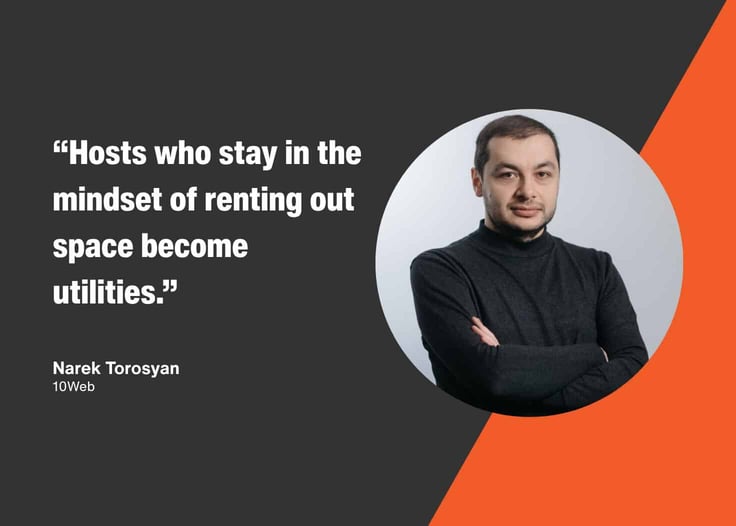
“Hosts who stay in the mindset of renting out space become utilities,” he said.
Williams has a similar perspective.
“Hosting providers have always been infrastructure platforms. What AI is doing is making that role more visible, and raising the stakes for getting it right,” he said. “The best thing a hosting provider can do is get out of the way and let people build. AI doesn’t change that philosophy. It just makes it more urgent.“
#4: The SMB Is the New Power User
Ask all three experts and they agree on one thing: The customer who is most changed by AI is the small business owner.
AI tools have handed this person capabilities that used to require hiring specialists. The hosting provider who can serve that person is in a fundamentally different business than the one they were in five years ago.
It’s why Torosyan says that hosts are positioned to become “the operating system for SMBs online.” Big claim, but not implausible: They already own the persistence, permissions, and proximity — the three things, as he put it, that “code alone can’t provide.”
The hosting layer is the natural foundation for all of it.
Whether most providers will be able to hold water there is another question because the gap between “we support Node.js and have an API” and “we are the operational backbone of your business” is not a small one.
