



Writer: Jordan Sprogis


Editor: Lillian Castro


Reviewer: Cristian Lopez

Key Takeaways
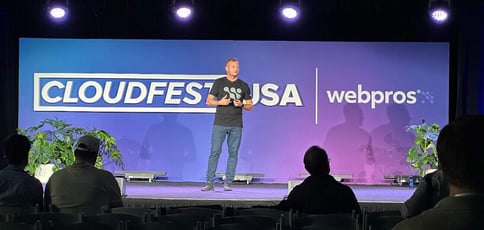
- CloudFest Miami 2025 doubled its expected attendance, drawing major names like Kinsta, WebPros, Sharktech, and Enhance for two full days from Nov. 5-6, 2025.
- Couldn’t make it to Miami? HostingAdvice did. Here’s what hosts, MSPs, and platform builders said they were paying attention to at this CloudFest.
- Plus, check out some photos from the two-day event!
What started at 700 presale signups ended up doubling by opening day for CloudFest Miami 2025.
When doors opened at the Ice Palace Film Studios, providers from across the world piled in for two days of panels, keynotes, and demos on the expo floor, while Miami’s mid-80s weather was the backdrop for social hours, food trucks, and, of course, the World Server Throwing Championship.
HostingAdvice was on the ground in Miami, and here’s what everyone kept talking about.
The Biggest Themes at CloudFest Miami 2025
Marrying Security and Support
One could hear it in the keynotes and amid the hallway chatter: Hosts are faced with the types of threats that move faster than most of their defenses can.
Elliot Taylor, Patchstack’s Head of Engineering, broke it down for HostingAdvice: The time to exploit — the gap between a vulnerability becoming public and someone actively weaponizing it — is collapsing.
“That window’s shrinking fast because of AI and automation tools,” Taylor said. “It used to be that, when you found a vulnerable plugin or package, you could patch it in your own time. Now it’s immediate, and there’s a huge pressure on hosts and site owners to resolve it fast.”
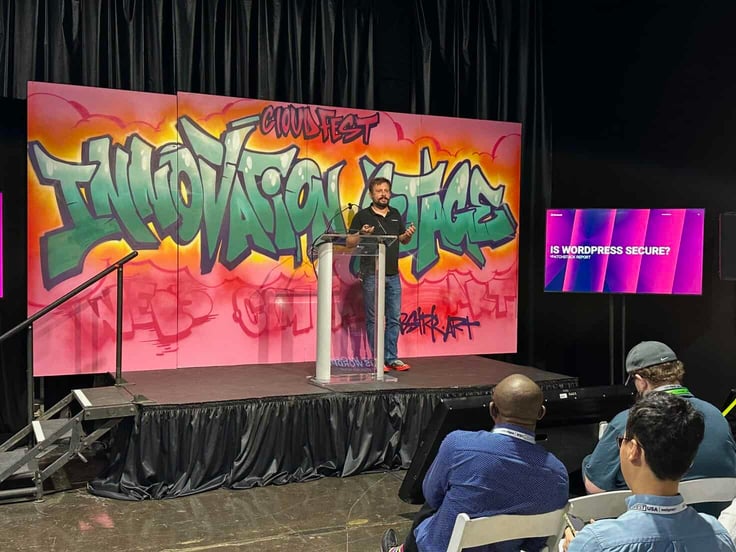
Nearly 30% of exploits in 2025 typically occur within the first 24 hours after a vulnerability is made public. So for example, if Cloudflare announces that one of its regions is experiencing DNS errors, there’s a decent chance that bad actors will flood it within a day.
Plenty of those actors are using the same tools everyone else is. Bots now account for nearly 40% of all internet traffic, and the bad ones are growing faster than the good ones. That’s what makes it incredibly difficult for hosting platforms to tell the difference between a routine bot hit — like a ChatGPT agent scraping to answer a user’s query — versus an actual attempted attack.
“Attacks are coming from many different vectors now, so web hosts have to work harder to protect data, emails, and all customer assets,” JetHost’s Metodi Drenovski and Lyubomir Rusanov said. “But it’s also about educating customers, because security isn’t one-sided.”
The issue, Luke Marr, CEO of Blue Ivory Creative, said, is that many providers aren’t clear about that educational aspect.
“A lot of legacy hosts have massive knowledge bases that are outdated or written in dry, overly technical language,” Marr said. “Meanwhile, tons of people building websites today aren’t technical.”
It’s a good point and it’s one CloudLinux’s session, “A Trusted WordPress is a Good WordPress,” also emphasized. The speakers walked through how “smart hosting decisions” — i.e., straightforward security practices that even end-users can understand — directly shape whether they trust a site at all.
But, as with most things in cybersecurity, the picture is a case-by-case basis. And Kinsta’s Partnership Manager, Roger Williams, argued that education only scratches the surface.
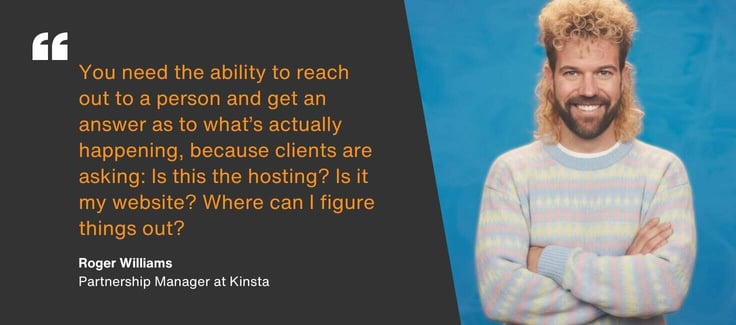
“You need the ability to reach out to a person and get an answer as to what’s actually happening, because clients are asking: Is this the hosting? Is it my website? Where can I figure things out?” Williams said.
And that’s what we call hosting responsibility. And Taylor emphasized that security can’t be something that hosts should trust the end-user to know how to handle, and only step in when things go awry.
“Hosts shouldn’t see it as ‘the user’s problem,’” he added. “A lot of times, hosts end up cleaning up after the fact — which is reactive and negative for the industry. We’ve got to be proactive as well as reactive.”
AI…But Make It Useful
Most people don’t start with a ticket. They start with a bot.
One recent survey found that 86% of customers try to solve an issue on their own before contacting support, usually via knowledge bases, FAQs, or AI-powered chatbots.
It makes sense that CloudFest kept coming back to the same idea of “useful AI.” But they were talking well beyond chatbots and generative add-ons. It’s more so about how AI can be used to do something purposeful — things like cutting support queues, handling tedious tasks for developers, or helping customers manage the platforms they’re using.
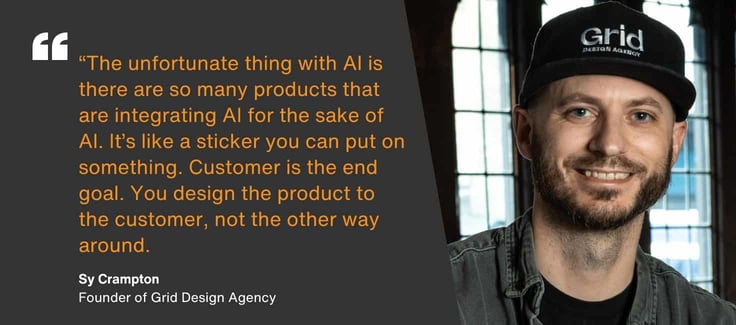
“The unfortunate thing with AI is there are so many products that are integrating AI for the sake of AI. It’s like a sticker you can put on something,” said Grid Design Agency founder Sy Crampton. “Customer is the end goal. You design the product to the customer, not the other way around.”
But Rocket.net’s Jessica Frick said customers are now showing up to hosts with problems plus whatever an AI chatbot already told them, whether or not they’re accurate.
“AI has changed how people interact with their hosting providers — customers now expect a certain level of support that can validate or correct the advice they’re getting from large language models,” Frick told us.
That creates a very specific kind of headache. If someone walks in with a misunderstanding, hosts can’t just punt them back to a(nother) bot.
Additionally, the JetHost team said AI has given smaller clients a way to experiment quickly before they ever talk to a host.
“With AI, especially in the last six months, small businesses are getting new possibilities. They can build websites faster and experiment more easily, then approach professionals with a clearer understanding of what they want,” Rusanov said. “AI can help narrow down the issue. But the real solution always comes from experts.”
It’s why teams like Grid Design Agency and Blue Ivory Creative say they use AI to support human work.
“What we’re focused on is helping companies use AI in ways that still connect with people. We want to make sure the content feels human — and to be honest, to catch some of the BS floating around out there,” Blue Ivory Creative’s Marr said. “The last thing the world needs is AI shouting into an echo chamber of bad facts.”
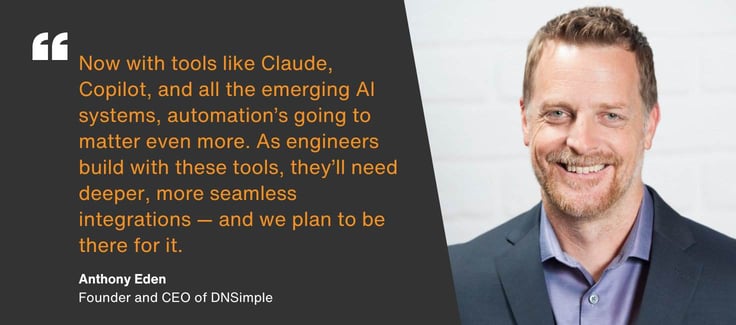
But for anything on the hosting end to work, the foundational layer needs to, well, work, too. DNSimple’s Anthony Eden pointed to the unsexy but critical layer — things like automatic DNSSEC key rotation, certificate renewals, and clean integrations.
“Now with tools like Claude, Copilot, and all the emerging AI systems, automation’s going to matter even more. As engineers build with these tools, they’ll need deeper, more seamless integrations — and we plan to be there for it,” Eden said.
Actually, one great example of “useful AI” that HostingAdvice came across is 10Web’s newest tool, AI Web Coding for WordPress. Arto Minasyan had the tool available for demo on the floor, which is described as a no-code frontend with WordPress as the backend.

Minasyan told us, “We’re bringing the best of AI to the WordPress world, and offering it both as an API and as a self-hosted solution for hosting providers.” It’s a win-win-win.
The “Own-Your-Stack” Countertrend
There’s a problem that almost every small and mid-market host is experiencing right now, and it’s that they’re getting priced out of the hyperscaler cloud.
When month-to-month bills vary each month because of things like egress costs, AI workloads, or whatever fee shows up this quarter, that goes straight to their customers. It’s a full cycle of unhappiness and frustration.
Cloud costs are why providers are moving away from solely depending on someone else — the old-school kind of ownership, where they buy the servers, rack the hardware, and the investment goes directly back into their hosting platform.
Global cloud spend is set to hit $723.4 billion in 2025 thanks to AI workloads. At those levels, more and more hosts are asking the obvious question: If the cloud keeps getting pricier, why not own the part of the stack you can actually control?
It’s exactly what came up in Limestone Networks’ session, “David vs. Goliath: Unlocking Growth in the Alternative Cloud Market.” They said that, in a market this crowded, the only real advantage is controlling the parts of your stack that actually determine your performance and your costs.

So HostingAdvice asked around to see what service providers are doing.
“We’re now providing scalable cloud solutions that can actually compete with the big three tech providers. That’s our edge,” Sharktech CEO, Tim Timrawi, said. “We’ve developed a full-scale, hyperconverged cloud solution based on OpenStack, and we’re able to offer it at a very cost-effective rate.”
At Enhance — the fast-growing competitor for cPanel, who has been criticized heavily for year-after-year price hikes — Adam Smith explained how the same thing applies at the software layer:
“Our panel is an on-premise panel that runs on your own infrastructure. A lot of newer ones are SaaS-based, which means you’re handing customer data over to another provider,” he said. “That’s not our ethos. Ours is: it stays within your garden. We don’t have access to your customization or data.”
Now that’s a compliance dream.
Or take the DIY method like Canadian cloud hosting provider Oriso did.
“We built this product to solve our own needs first. We wanted a tool to manage Proxmox and Scale faster and more easily — so we created it,” Charles-Alain Roy told us. “When you build something for yourself, you know exactly what the pain points are, so you can build the best solution.”
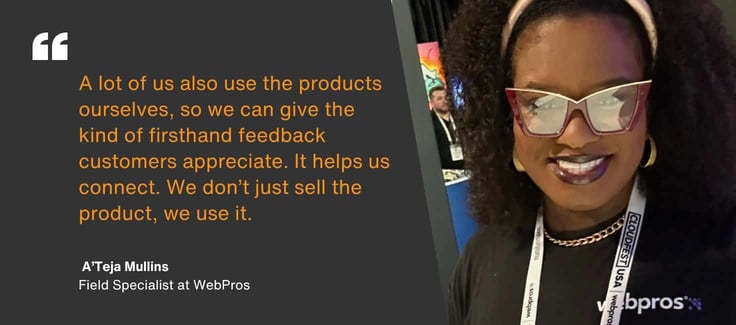
Even the biggest names take the use-it-yourself-first route. A’Teja Mullins from WebPros told HostingAdvice: “A lot of us also use the products ourselves, so we can give the kind of firsthand feedback customers appreciate. It helps us connect. We don’t just sell the product, we use it.”
This isn’t about old-school self-hosting vs. cloud dependency; it’s the idea of owning the pieces your platform uses every day, and source cloud partners only for what you don’t need to run yourself, like global delivery, traffic bursts, or edge capacity.

It’s probably why CloudFest felt like a collaborative showroom this year.
Squarespace expanded its reseller program so partners can sell full websites and domains. Sharktech announced a hyperconverged OpenStack partnership aimed at helping smaller customers get scalable cloud infrastructure without building it from scratch.
The future looks a lot like partnerships.
The next CloudFest will be held at Europa-Park in Germany from March 23-26. Details are on the official site.
