




Writer: Jordan Sprogis


Editor: Lillian Castro


Reviewer: Cristian Lopez

Key Takeaways
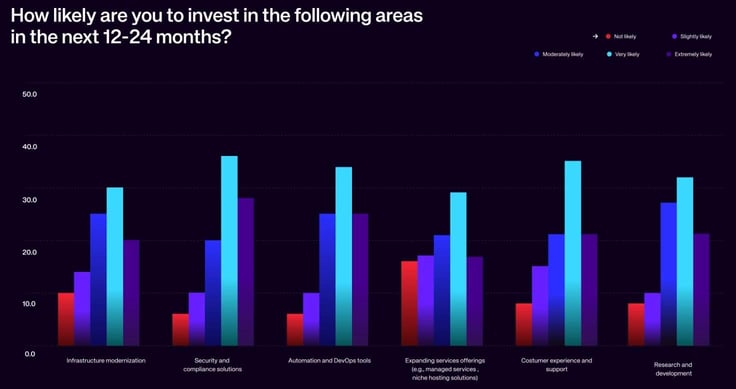
- A recent global UpCloud survey shows where hosts are investing their money over the next 12 to 24 months.
- Between 80% and 85% of providers are most interested in automation, DevOps, and security, with R&D and customer support following close behind.
- But fewer than half plan near-term spend on managed services or infra refreshes. It’s a pause InMotion Hosting’s Trey Faison says is more about timing than trouble.
A recent global UpCloud survey shows hosting providers are investing in four main sectors while cutting back on two others. The results are unsurprising: Most are prioritizing security, AI integration, R&D, and customer support.
Areas losing focus generally center around spending on managed services, niche hosting, and infrastructure modernization. And yet, even the investments that have low interest right now aren’t completely doomed.
Trey Faison, InMotion Hosting Director of Products and SME, suggests that many hosts nowadays are happy to stretch their existing setups until they meet the market’s demands first, especially amid recent tariffs, taxes, and rising hardware costs.
What Hosts Are Prioritizing
UpCloud’s survey identified these numbers for providers who are either moderately, very, or extremely likely to invest within the next 12-24 months:
- Automation and DevOps: about 85%
- Security and compliance: about 80%
- Research & development: about 80%
- Customer support: about 60%
Note: Exact numbers may differ. Percentages are rounded from survey graphs.
Automation and DevOps
About 85% of hosts said they’re prioritizing automation and DevOps tools within the next two years.
Take a look at any mid-to-large host, and it’s easy to see that much of their budgets is going straight to backend tooling to meet what is required to power AI, like CI/CD pipelines and automatic failover.
“It comes back to running the business as efficiently as possible,” Faison told HostingAdvice. “Automation is the best way to keep costs down while freeing up your staff to focus on the challenges you cannot yet predict or anticipate.”
Faison added a warning for those looking for a shortcut: “If you’re trying to do that manually, you’re already behind. Automation is the only way to keep up with customer expectations and the competitive pace of this market.”
Security and Compliance
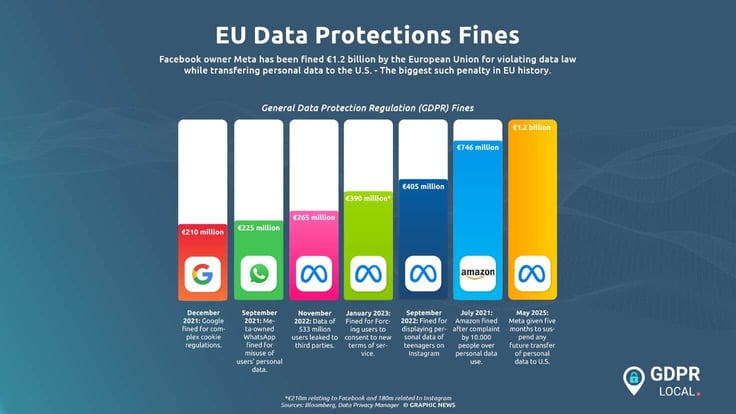
Security and compliance ranked as a top priority for 80% of surveyed providers. This feels like a no-brainer when almost half of businesses have faced hacking attempts between 2024 and 2025, and a third report breaches tied directly to poor hosting security.
Regulated punishment is also a big motivator. GDPR fines have climbed as high as 1.2 billion euros, and HIPAA in the U.S. can hit $50,000 per violation. GoDaddy is required to undergo audits every two years for the next two decades, and 1&1 has been fined $1 million for failing to protect customer data.
“By definition, our customers are exposed to the open web and all the risks that come with it. The effort and expense required behind the scenes to keep them protected is enormous, but also nonnegotiable,” Faison said.
And with AI, it’s even worse: Security is now necessary at every single layer of the stack thanks to backdoor entries and prompt injections.
More than 90% of security leaders expected daily AI-driven attacks last year, with a third saying these threats have already forced organizations to change their security strategies. But being nonnegotiable doesn’t mean take away the biggest hurdle: deciding how to pay for it.
“With security, the risks themselves act as a forcing function, especially for a web host. You do not really have a choice. The real struggle is figuring out how to do it cost-effectively,” he said.
Research & Development
R&D shows a similar pattern, with about 80% of providers expressing interest in boosting their budgets for some innovation research.
The issue, of course, is cost. Saying innovation is expensive is like pointing out the sky is blue. Hosting is a saturated market and infrastructure isn’t cheap, especially in this year’s landscape with tariffs and taxes. Even large hosts are completely putting off funding long-term projects that can’t deliver immediate ROI.
Even the big names are getting cagey. In April, Microsoft confirmed it was pausing several AI-focused data center projects, including a massive $1 billion facility in Ohio.
Faison stressed that it isn’t a lack of ambition, but a question of timing: “AI has…changed what R&D looks like in the short term, as everyone grapples with the seismic changes coming from LLMs.”
Customer Support
Customer support has the attention of nearly 60% of providers. Arguably a smart area of focus — because research has shown that increasing customer retention by just 5% can boost profits anywhere from 25% to 95%.
As for what Faison takes from this, he said: “I think it depends on what support really means.” He added: “A lot of companies are chasing the AI chatbot dream of lower costs and investing heavily in it.”
Not to knock chatbots, of course. They’re helpful and can help sort and mitigate simple issues, but many companies are realizing that they’re not actually any good for retention. Which is why customers want human support.
“We are actually seeing many companies move in the opposite direction, with uneven results,” Faison said. “We believe it is a competitive advantage to have humans handling customer issues. When customers are in trouble, they absolutely care that the person on the other end is fully trained, capable, and empathetic to their concerns.”
What’s Going to the Wayside
UpCloud’s survey identified these numbers for providers who are either not likely or only slightly likely to invest within the next 12-24 months:
- Infrastructure modernization: 25%
- Expanding service offerings: 25%
Note: Exact numbers may differ. Percentages are rounded from survey graphs.
While it appears that many hosts do have plans to upgrade, they’re still happy to continue relying on existing hardware. Uptime Institute reports something similar in their stack: Data center server refresh cycles are slowing, with many purposely running older hardware.
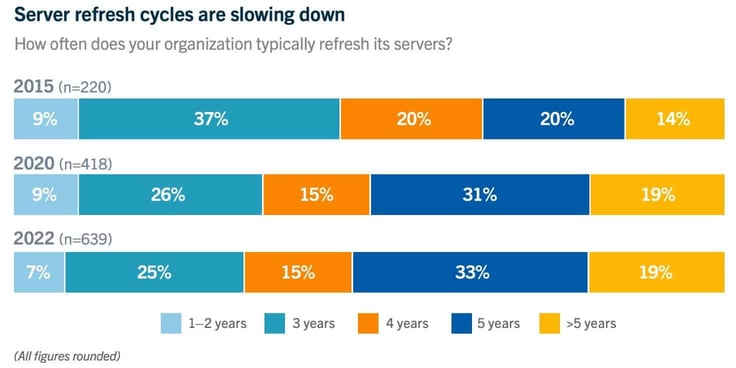
Of course, none of this means modernization is being completely ignored. Sooner or later, upgrades will be unavoidable, especially as AI and edge computing require more powerful infra.
But from his own experience, Faison said sometimes it’s just about the timing. InMotion Hosting just followed a similar path: “I see this as cyclical. [InMotion Hosting] just came through two years of infrastructure and data center upgrades, and now we are shifting more spending toward product development.”
That brings the weakest category overall: service expansion — but particularly managed services and niche hosting. Fewer than half of providers said they plan to prioritize it within the next two years.
Ironically, another aspect of the same survey shows a heavy interest in managed services. Analysts also expect the global managed services market to more than double from $335 million in 2025 to $731 million by 2030.
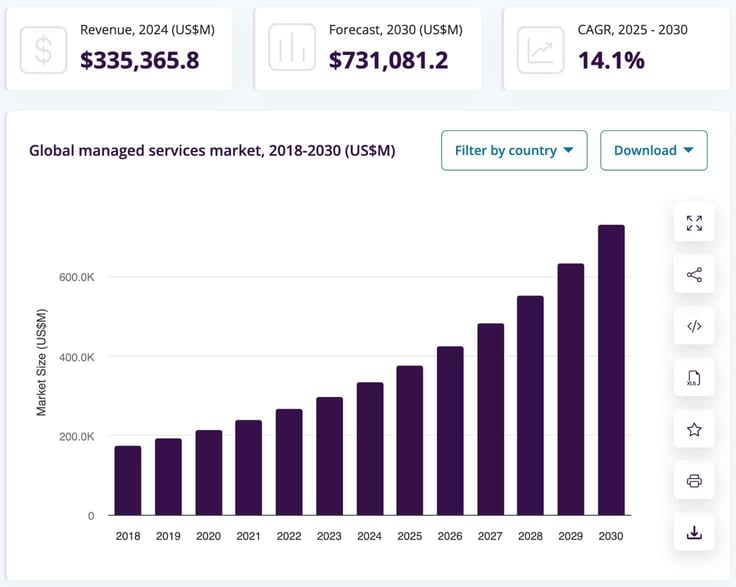
But a healthy market projection doesn’t reflect every provider’s reality. For small and midsize hosts, it’s likely that hesitation comes down to cost and resources. It requires funding and investments to expand infrastructure with new servers and data center space or to hire specialized staff.
It’s as Faison said: “It simply means the near-term focus is on how products evolve. Everyone is trying to figure out where AI can be integrated to create real value for customers, and trying to avoid doing that poorly.”
