




Writer: Jordan Sprogis


Editor: Lillian Castro


Reviewer: Cristian Lopez

Key Takeaways
- ChatGPT accounted for 45% of all AI tool visits between May 2025 and April 2026, with Canva and Gemini trailing behind.
- AI crawlers can drive up both server workload and bandwidth, with some sites cutting bandwidth by 75% after blocking them.
- “Allow AI” isn’t a simple yes-or-no decision when different crawlers serve different purposes.
A new analysis from OneLittleWeb looked at more than 9,500 AI tools and found something that will shock absolutely no one: Nearly half of those visits went to a single platform, ChatGPT.
ChatGPT accounted for 64.7 billion visits between May 2025 and April 2026, which is about 45% of all visits to AI tools. Its traffic was six times that of Canva, the second-most visited AI tool at 10.5 billion visits.
The analysis covered 144.5 billion visits across more than 170 categories, including chatbots, writing assistants, music generators, translators, image tools, sales platforms, and more. But even with that breadth, ChatGPT was in a league of its own.
The Middleman = The Only Man?
ChatGPT started as a chatbot that the average joe used to write emails, answer questions, and cheat on homework. Now, it can search the web and pull information without letting users do a single lick of research themselves anymore.
That doesn’t mean nobody clicks through. AI referrals are very much a thing, and some research suggests those visitors who do click through an AI mention or citation can actually be more engaged than traditional search traffic. Whether that’s good or not probably depends on your current traffic flow though.
ChatGPT Captured Nearly Half of AI Tool Traffic
Top AI tools by share of 144.5 billion recorded visits. Source: OneLittleWeb
- ChatGPT
- Canva
- Gemini
- Google Translate
- DeepSeek
- Claude
- Grok
- Perplexity
- Magnific (Freepik)
- Character AI
The thing is that AI platforms need websites because they supply the information AI companies crawl. Crawling isn't free for websites though: Every request consumes some combination of bandwidth, server resources, and database queries.
It’s easy to think of an AI crawler as a basic search crawler like Googlebot, which has been around since 1996. But the way AI crawls the web is done systematically. It can also dive into long-tail content that hasn’t been accessed in months. If those pages aren’t cached, requests have to go back to the origin server, which then has to build and serve the page.
Cloudflare found that AI bots accounted for an average of 4.2% of HTML requests across its network in 2025, compared with about 4.5% for Googlebot, with more than half going toward AI training rather than search.
Website owners may want their content to appear in ChatGPT's search results while having no interest in letting AI companies use that same content for training. That means hosts have to ask: Which AI? For what purpose? And at what cost?
To Block or Not to Block...
Cloudflare has documented several cases where aggressive automated crawling created problems. Wikimedia, for example, saw a 50% increase in multimedia bandwidth usage that was mainly driven by automated bots scraping images for AI training. For a free educational resource that relies on donations, it did the only thing it could do, and that was to block all crawler traffic.
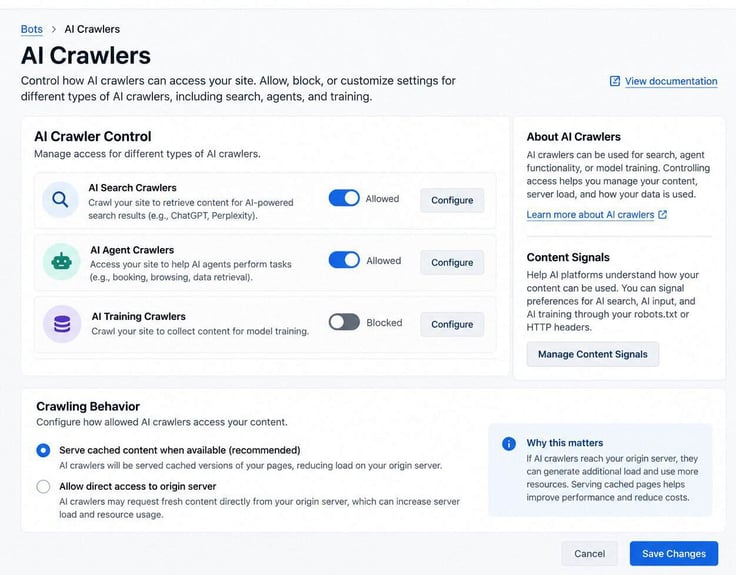
Site owners are getting more control over what different AI crawlers can access, though. Cloudflare, again, is ahead of the game by introducing controls for managing AI crawlers in July 2025 and later expanding them to let customers separately manage Search, Agent, and Training crawlers. Content Signals can also distinguish between AI search, AI input, and AI training.
The checkboxes are nice to have, but it's not as simple as "allow" or "block." It's configuration. It's letting hosting customers decide: Do you want your content showing up in AI search? Do you want companies using it to train models? How much crawling are you willing to tolerate to get there?
