




Writer: Jordan Sprogis


Editor: Lillian Castro


Reviewer: Cristian Lopez

Key Takeaways
Amazon just announced it will invest up to $25 billion more into Anthropic, bringing its total stake in the company to $33 billion. At the same time, Anthropic is committing something bigger: up to $100 billion in AWS infrastructure spend over the next 10 years.
It’s a two-sided deal that may just change hosting-as-a-service.
Anthropic has also agreed to run its future LLMs on AWS’s proprietary Trainium chips for the next decade. AWS will bring nearly 1 gigawatt of Trainium2 and Trainium3 combined, plus 5 gigawatts of total capacity, by the end of 2026.
Meanwhile, Anthropic’s annualized revenue has also surpassed $30 billion in 2026, up from $9 billion at the end of 2025.
If you’re a hosting provider of any size, this should get your attention. And no, it’s not just because the numbers sound absurd.
Why Is AWS Building Its Own Chips?
For years, NVIDIA was the one that almost all infrastructure providers looked to to power AI workloads. Clearly, AWS decided to go its own route.
OK, let’s start with the obvious: NVIDIA’s hardware isn’t cheap. At the scale AWS operates, dependency on a single provider’s pricing is risky.
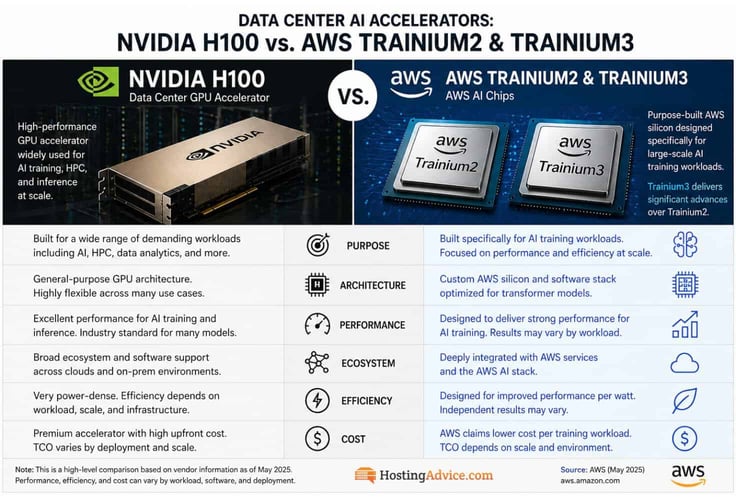
Then, there’s the supply chain issue. NVIDIA depends heavily on TSMC’s fabrications out of Taiwan, which have been under a microscope lately due to U.S.-China tensions and export controls.
And perhaps most strategically, it comes down to differentiation. If you’re running the same NVIDIA hardware as every other cloud provider, what exactly is your competitive edge? Trainium chips are AWS’s answer to that question.
What Providers Should Keep In Mind
Trainium chips are built specifically for AI training. Bundle that with exclusive model access and your own infrastructure layer, and you’ve got something hard to copy.
Others are doing their own versions of it: Oracle is working on its GPU cluster buildout while Google has its TPU-plus-Gemini announcement at Cloud Next 2026.
But that’s exactly where things get a little annoying. If you want to use AWS’s chips, you’re joining its ecosystem. NVIDIA, for the most part, works across providers; AWS, GCP, and Oracle don’t. The more you build on top of that stack — like your workflows, your APIs, your deployments — the more dependent you get on a single platform.
Anyone already using AWS could lean into these changes and become familiar with Trainium-optimized deployment. If your customers are Google Cloud shops, the equivalent play is getting deep on Vertex AI and building around Gemini’s API before that ecosystem gets as locked down as this one.
If that’s where this is heading, AWS just gave us the clearest picture yet of what hosting-as-a-Service could actually look like: infrastructure, chips, and AI all integrated into a single, dependent platform.
