




Writer: Jordan Sprogis


Editor: Lillian Castro


Reviewer: Cristian Lopez

Key Takeaways
Agencies that specialize in web development, design, and marketing say that AI is changing the way they deliver websites to their clients. The problem is that these expectations are moving way faster than infrastructure providers can realistically keep up with.
WP Engine’s report surveyed 214 digital agency professionals in North America. The findings pretty much show that AI has moved well beyond DIY tools and into professionally built, client-facing work, and it’s changing what agencies expect from their hosting partners.
The report splits agencies into two camps: “leaders” and “laggards.” They’re the two coined terms based on how deeply an agency has adopted AI tech. Leaders are already successfully integrating AI into their business (whether that’s internal or external) while laggards are still playing with ideas and concepts.
There’s No Playbook, But There Is a Pattern
If agencies are already struggling to keep up, what chance do the providers behind them have? It’s a fair question. But maybe there’s some good news. While WP Engine doesn’t draw us a map that takes us to the X, there are a few things “AI leaders” are doing to make it work.
First, they’re investing. We already know that more than 60% of agencies are putting money into new AI tools, with 60% training staff and more than 50% having already created internal policies around how AI should be used.
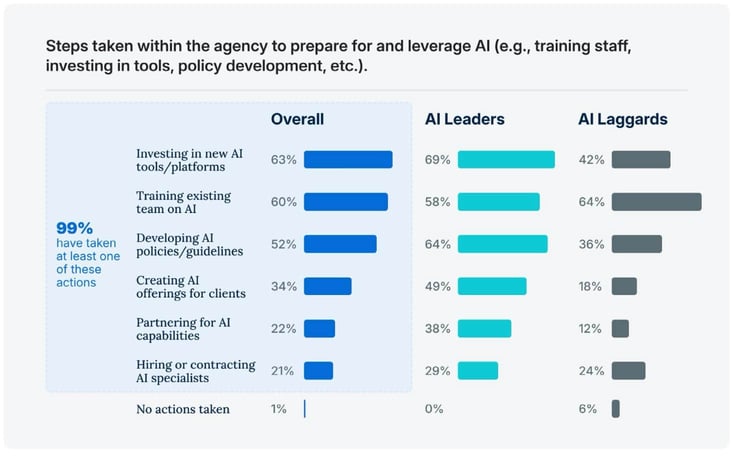
Second, the agencies that consider themselves AI leaders have already launched new services and many treat it as a core part of their services.
And most importantly, agencies have pretty much accepted that there’s no finish line.
WP Engine says it’s imperative to constantly educate and train with AI. Which is really just a nicer way of saying this won’t slow down, so it’s time to move forward or get stuck. Here are a few things that hosts may want to know about their agency customers.
#1: Hosts Are Not Just Where Sites “Live”
Agencies are eagerly including AI in client deliverables. Add a bit of a gold rush mentality (no one wants to be the agency that’s “behind”), and it multiplies fast:
- 63% are investing in new AI tools/platforms (design assistants, content generators, automation)
- 34% are turning those into actual client-facing AI services (chatbots, custom LLM use)
And those tools have got to live somewhere, right? But obviously most infrastructure is designed to run websites — dynamic, yes, but websites nonetheless — not support a fast-spreading, thickening layer of AI tools, workflows, and integrations.
Agencies want the same thing your average consumer wants: simpler environments where hosting, CMS, deployment, and AI tools work together. Which is exactly why all-in-one platforms took off in the first place. In other words, DIY is out.
#2: AI Is Literally Moving too Fast
When asked what their biggest challenges are, most said it’s keeping up with how fast AI is changing:
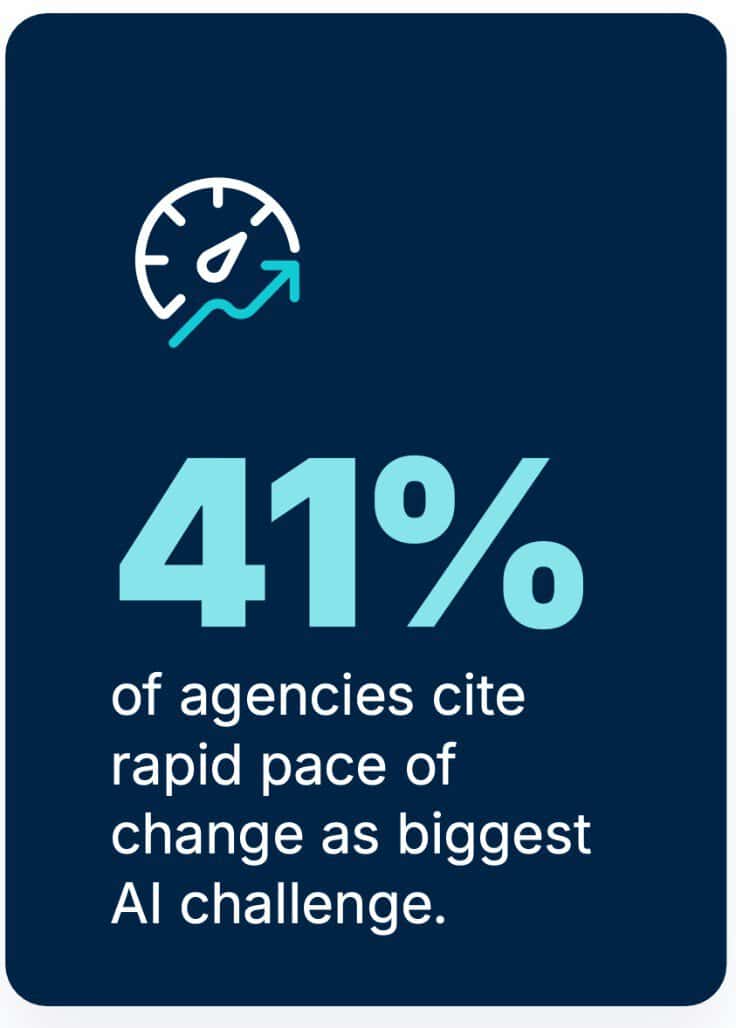
- Keeping up with how fast AI is changing (41%)
- Clients aren’t fully bought in yet (17%)
- Teams don’t have the skills in-house (15%)
- Hard to prove it’s worth the cost (12%)
- Not enough time or budget to do it right (11%)
It may not come as a surpise to many that the pace of AI outweighs cost and client interest.
Hosts already know this: AI might simplify things for users, but it makes everything more complex.
Although agencies say pace of change is their number-one concern, that’s not to say that cost isn’t important: 12% of agencies said that unclear ROI is their top challenge.
It may sound small, but clients aren’t going to throw money at AI forever without proof it’s actually doing anything.
The good news is that about 9 out of 10 agencies in the survey said they can point to at least one positive outcome from their AI work.
As for which parts of AI? Well, that’s the tough part. Proving which improvements come from AI specifically and connecting that to ROI is still genuinely difficult, and hosts should probably expect hesitation to remain a mentionable concern.
#3: You Have to Optimize for Machines
More than 70% of agencies say they’ve already adjusted their development and design practices specifically to better serve AI systems, like search algorithms and summarizers by AI chatbots and organic search.
Sites now have to be machine-readable. A structured site with schema markup and content summaries is all that shows up in search and AI-generated answers.
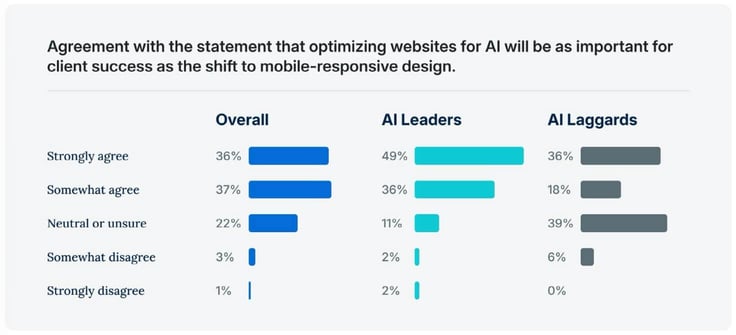
Seventy-three percent of agencies say optimizing for AI will be critical to client success. WP Engine compares it to the shift to mobile-responsive design.
The difference this time is speed. It took years for everyone to get on board with mobile optimization — and it wasn’t until Google made it a ranking factor that a lot of people changed their perspective.
Everything is always on with AI. It’s the new, real, sometimes unfortunate expectation. And it’s exactly why “keeping up with the pace of change” ranked as the top challenge and, at the same time, proves who the winners and losers are.
