


Writer: Lynn Cadet


Editor: Lillian Castro


Reviewer: Christina Lewis

Key Takeaways
- More than half (51.5%) of all surveyed Americans say they wouldn’t mind paying to have an ad-free online experience.
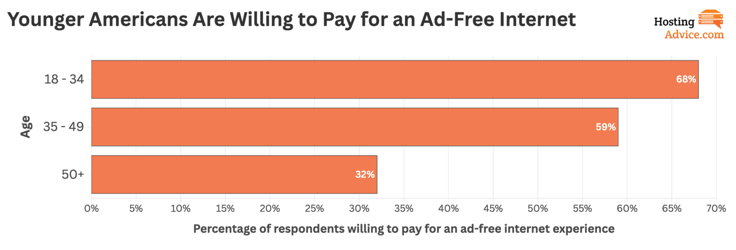
- 68% of people aged 18-34 would spend money to remove ads, showing the most support for a paid ad-free experience.
- Women showed more tolerance for ads, with 56% saying they wouldn’t pay to avoid ads, compared to 41% of men.
You’re watching your favorite content creator on social media when you’re hit with not one, or two, but three ads within a 10-minute span. For some, this is just another day of viewing content online. But for others, that final ad might also be the final straw.
No matter where you land in your opinion of ads, you’re not alone. A recent HostingAdvice survey reveals that just over half (51.5%) of surveyed Americans would prefer to pay to skip ads than watch them. While the other 48.5% view ads as either a tolerable evil or a normal part of the online experience.
Most people agree that ads are somewhat of a disturbance, yet their attitudes toward tolerance are more split. This clear divide points to two opposing viewpoints: indifference and intolerance.
With the increase of ads and tracking in the internet era, people tend to have a negative perception of digital advertisement when ad agencies and marketers aren’t careful. Increased excessiveness could make audiences unreceptive to marketing campaigns, shifting their indifference to intolerance.
Mid-Roll Ads Cause the Most Frustration
To put this into perspective, our study explored how people perceive different ad placements and whether some cause more frustration than others. We asked respondents to rank specific ad formats from the most annoying (1) to least annoying (5).
Here is how the rankings stacked up (from most to least annoying):
- Mid-roll ads, average rank of 2.99
- Pre-roll ads, average rank of 3.07
- Pop-up displays, average rank of 3.45
- Outstream video ads, average rank of 3.48
- Sponsored content, average rank of 3.8
- Banner ads, average rank of 4.2
Where an ad is placed certainly influences how a user views it.
It’s not very surprising that mid-roll ads were ranked the highest for irritability, as they appear in the middle of videos, typically breaking the flow of a viewing experience. The more mid-roll ads appear, the more disjointed a viewing (especially live videos) can become, causing the experience to become less enjoyable.
On the other hand, banner ads — voted the least annoying — are placed around content on a webpage, meaning it doesn’t necessarily divert attention from the original content. People can still browse without too much disturbance and have more control over their experience, which may suggest why banners are seen as less of a concern.
When on the internet, people seek personalized enjoyment and tailored experiences. Advertisements can play a role in this, but they can also infringe on it unless they’re done the right way. A study by Bango Audiences revealed that 49% of consumers enjoy advertisements for products they are interested in.
“In an ideal world, ad-free browsing and streaming would be the norm,” says Christina Lewis, Web Design Expert and Editor at HostingAdvice. “From a user experience perspective, ads interrupt users while they’re enjoying your content. However, it’s not always realistic to go ad-free.”
Christina adds, “If you need ads on your site, try to minimize Cumulative Layout Shift. CLS happens when ads load after the main page content. It causes large shifts, which can be very annoying for users about to click on something. Thankfully, you can prevent CLS. Try loading your ads asynchronously, set fixed content dimensions with CSS, or just avoid placing ads above your main content altogether.”
Our results indicate users prefer a seamless browsing experience where they can control what they see and encounter fewer interruptions. But that doesn’t mean ads can’t fit into that picture — If companies focus on creating better targeting strategies, it can allow audiences to view ads as less intrusive and more relevant to their experience.
How Much Will People Pay to Avoid Ads?
Eliminating ads from your online experience isn’t exactly cheap. Just ask the Twitch subscribers who pay $11.99 a month to skip ads on streams. However, for many people, paying those prices can be a worthwhile decision if it means hours of uninterrupted access to their favorite content.
While 48.5% of Americans may be indifferent to digital ads, another 51% are prepared to pull out their wallets for a distraction-free experience. Most respondents said they’d be willing to pay up to $20 per month to escape infuriating ads.
Among those who were willing to pay for ad-free web sessions, here is how the support varied based on pricing:
- $1.99 per month – 36%
- $4.99 per month – 35%
- $9.99 per month – 25%
- $20 or more per month – 4%
By demographics, younger generations showed more interest in paying to remove ads from their browsing sessions. In fact, 68% of respondents aged 18 to 34 say they would opt for paid, ad-free content:
As for gender comparisons, men were more likely to say they would pay for ad-free browsing than women. Female respondents showed more tolerance for ads, with 56% of women saying they wouldn’t pay versus 41% of men.
The advertising industry may face significant challenges as more individuals actively seek to eliminate ads from their online experiences. This trend could make it increasingly difficult for advertisers to effectively reach their target audiences.
It may be time for the industry to pivot again, focusing more on user-first marketing that resonates. Similar to social media algorithms, advertisers will have to make the extra effort to integrate ads into the user experience based on user interests and behavior.
Methodology
This survey was conducted online in May 2025, among a nationally representative sample of 1,000 U.S. adults ages 18 and older. Respondents were selected from a third-party research panel, and the data were weighted to align with U.S. Census benchmarks.
To ensure the integrity of data collection, the researcher developed a proprietary machine-learning algorithm that can detect fraudulent responses early and remove unauthentic respondents immediately. The overall margin of error is ±3.1 percentage points at the 95% confidence level. Margins of error increase for subgroups such as age or gender.
For media inquiries, please reach out to adam.blacker@hostingadvice.com.