



Writer: Jordan Sprogis


Editor: Lillian Castro


Reviewer: Christina Lewis

Gone are the days when you had to buy physical IT infrastructure to host your applications. Today, you can host your website in the cloud — an interconnected network of virtual servers.
If you’re interested in learning more, here are 38 cloud adoption statistics that’ll shed some light on the cloud and its adoption.
1. A Significant 94% of Companies Use the Cloud in 2025
I think what’s more remarkable about this cloud usage stat is that 6% of companies in 2025 still don’t use the cloud!1
Now, I’m sure a majority of them are from highly regulated industries, like the government, banking, and healthcare — I understand their need to store sensitive information on-premises.
If you aren’t part of such an industry and choose to avoid the cloud due to “cultural resistance,” it’s your loss, my friend. If you’re a non-believer, here’s another way of reading this stat: at least 94% of your direct competitors are ahead of you.
2. Roughly 80% of Companies Used Cloud Services in 2020
You know what? Let’s address the elephant in the room — the COVID-19 pandemic. I can’t quantify the impact it had on families, healthcare systems, and economies with my words. It was devastating for many.
All I can say is, despite the hardships, it led many businesses to adopt hybrid work and, consequently, cloud computing — only around 80% of companies were using the cloud in 2020.1
So, while the pandemic drastically altered the lives of the common man through social distancing, lockdowns, and travel restrictions, it also shaped today’s digital landscape.
3. Nearly 62% of People Prefer Free Cloud Storage Plans
Let’s take a quick breather before we move to the other heavy-hitting cloud usage statistics. Be honest with me: Do you pay for Google Drive storage space? I don’t think I’ll outgrow my 15 GB free limit anytime soon — I’ve only used 2.42 GB of cloud storage space so far!
I do pay a few dollars a month for my iCloud+ plan, though, so I can’t say I’m among the roughly 62% of people who pick free cloud storage plans for personal use.1
My only advice to you is to upgrade to Google One when your Google Drive space runs out — please don’t open a new Gmail account instead!
4. Public Cloud Services Spending Will Reach $723.42 Billion in 2025
Cloud infrastructure is used just about everywhere. If you swipe through the apps on your smartphone, for example (not Tinder), I can confidently say most of them leverage the cloud (apps like Notes, Clock, Contacts, and Calculator don’t necessarily use it).
So, is it really a surprise that spending on public cloud services is estimated to reach approximately $723 billion in 2025? No.
To put it into perspective, the public cloud computing market was “only” worth around $100 billion in 2017!2 It’s just a matter of time before it reaches $1 trillion.
5. Enterprise Public Cloud Spending Will Reach $400 Billion in 2025
Now, the previous cloud adoption statistic reflected both enterprise and individual spending on public cloud services.
As you might imagine, enterprises spend more on cloud IT infrastructure than individuals — enterprise public cloud spending is projected to reach around $400 billion in 2025.
That means enterprises spend about $323 billion more than individuals like you and me on cloud services.2,3 Honestly, I was expecting the gap to be much, much more! Props to the likes of iCloud+, Netflix, and Spotify!
6. Roughly One Out of Six Enterprises Spend $2.4M+ on Public Cloud Infrastructure
According to my research, around 17% of enterprises spend at least $2.4 million on the public cloud.4 While this seems like a lot of money (and it is), you need to consider how COVID-19 led many businesses to cloud migration — I guess every “cloud” has a silver lining.
7. The Cloud Migration Market Is Growing at 28.24%
Remember how I mentioned industries like finance and healthcare were hesitant to move to the cloud? Well, they’re now accelerating cloud migration, so cloud adoption numbers might be much higher this time next year!
Cloud maturity and regulatory clarity are some of the reasons why their initial hesitation has faded away (who can forget the financial benefits of it!).
Cloud migration providers are helping companies move their information and servers to cloud platforms, and the market is valued at $300 billion in 2025.
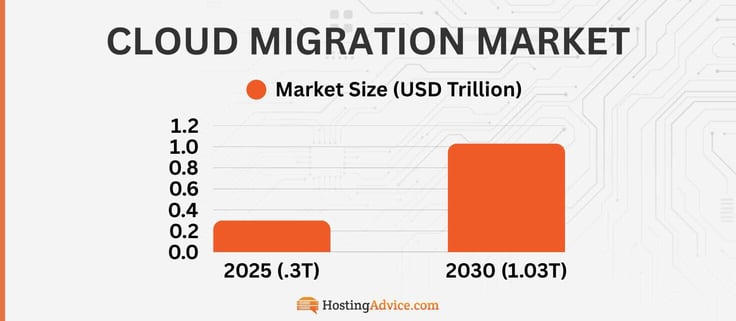
Do the math with me: at a CAGR of 28.24%, the cloud migration market will reach an estimated valuation of $1.03 trillion by 2030.5 Not bad at all!
8. AWS Controls 30% of the Cloud Infrastructure Services Market
I’m sure you’re wondering who leads the cloud services infrastructure market. I mean, you probably know the answer already: Amazon Web Services (AWS).
The real question is, how much of the market does it control? Take a guess. 15%? 20%? 25%? Well, if you guessed these figures, you’re close.
Amazon Web Services holds a hefty 30% of the cloud infrastructure services market share. Microsoft Azure and Google Cloud Platform (GCP) are the other giants in this category, with market shares of 21% and 12% respectively — every other cloud vendor dwarfs in comparison.6
9. AWS Generated $29B in Cloud Revenue in Q1 of 2025
What’s the last show you watched on Netflix? I wrapped up “Mad Men” a few days ago, and it feels like there’s a small hole in my life! Don’t worry, I’ll “fill” the hole with a new show very, very soon! Anyway, you might think a streaming giant like Netflix owns its own cloud infrastructure — but it doesn’t.
It relies almost entirely on Amazon Web Services for streaming and data storage. It must be paying hundreds of millions of dollars to the company each year!
No wonder AWS generated about $29 billion in cloud revenue in the first quarter of 2025. Google Cloud Platform, which supports Spotify, brought in approximately $12.26 billion in the same period.7,8
10. The Cloud Computing Market Will Be Worth $2.3 Trillion by 2030
A lot of people think the public cloud and cloud computing are the same thing — the public cloud is actually a subset of it. If you want the perks of the cloud with the security of on-premises infrastructure (perfect for banking, for example), you could opt for another subset of cloud computing — private or hybrid cloud.
While AWS is primarily known for its public cloud services, it offers these cloud solutions as well. And, of course, private cloud services are the most secure.

Now that you know the three subsets of the cloud computing market, it’s the right time to tell you it’ll be worth around $2.3 trillion by 2030.9
11. A Whopping 89% of Businesses Prefer Multicloud Setups
The next two cloud adoption stats will teach you a lot. Do you know what a multicloud setup is? When I first learned about the cloud, I thought a multicloud approach meant using a combination of public and private clouds; I was wrong. This approach is called hybrid multicloud (or just hybrid cloud).
A multicloud setup actually means using more than one public cloud. For example, you could benefit from the best features of both Amazon Web Services and Google Cloud Platform.
This approach is cost-effective and will help you avoid vendor lock-in. Go for it — about 89% of businesses prefer it.10
12. About 80% of Companies Use a Hybrid Multicloud Setup
This cloud stat shows most companies don’t just pick one strategy: approximately 89% use multicloud and 80% use hybrid cloud too.10 Sweet, right? Let’s make this easier to understand with an example. Many companies choose AWS to run their apps and Google Cloud Platform specifically for machine learning models.
That’s a multicloud setup right there. Now, if they keep their sensitive financial data in an on-premises private cloud, we have a hybrid cloud!
13. Most (72%) Businesses Exceed Their Cloud Budgets
While the pay-as-you-go (PAYG) business model is attractive, it’s complicated as well — you can end up paying more than you bargained for.
For starters, accurately predicting usage is difficult. Complex pricing models and hidden costs (surprise, surprise) don’t help either.
These are some of the reasons why about 72% of businesses exceed their cloud budgets.11 I recommend using tools like AWS Budgets to set spending limits, continuously monitor cloud service usage, and, of course, spend wisely!
14. Nearly 80% of IT Professionals Experience Improved Productivity and Budget with Cloud Migration
Now, let me make myself clear: while budgeting for cloud services is difficult, it’s not impossible.
Seek help from an experienced cloud professional to ensure a seamless cloud migration. I don’t want you to use the previous cloud adoption challenge as an excuse to stick with your on-premises infrastructure!
For perspective, close to 80% of IT professionals say moving to the cloud improved their productivity, saved money, and provided better security.12
How’s that for a solid endorsement? Besides, it’s hard to put a price on the benefits of negligible downtime.
15. Almost 60% of SMBs Store Data in the Public Cloud
Around 60% of small and medium-sized businesses store data in some shape or form in the public cloud.13 This doesn’t mean they store all their data in the public cloud — I’m certain sensitive data is reserved for some on-premises or hybrid cloud arrangement.
Even if an SMB opts to store such information in the public cloud, it’s encrypted with AES-256 protection, which is virtually unbreakable. To be on the safer side, avoid it.
16. Roughly 11% of Businesses Encrypt a Majority of Their Data in the Cloud
I was curious to know how much data businesses usually encrypt in the cloud, and I was genuinely pleased to come across this stat: about 11% of businesses encrypt at least 81% of their data in the cloud.
Additionally, around 27% of businesses encrypt at least 41% of their data in the cloud.14 I’m guessing the larger the business is, the higher percentage of data they dedicate to these services — SMBs don’t quite have the same resources.
17. An Incredible 200 ZB of Data Will Be on the Cloud by 2025
An incredible 200 zettabytes (ZB) — or 200 trillion gigabytes — of data will be on the cloud by the end of 2025.14
That’s enough data to power 200 billion Apple iPhone 15 Pro Max smartphones (with 1 TB storage each) — if Apple sold that many smartphones, Tim Cook would most definitely be the richest man alive!
Here’s another mind-boggling stat for you: we are likely to enter the “Yottabyte Era” in 2030 — generating an estimated 1,003 ZB of data that year.15
18. Approximately 72% of Businesses Report an Increase in Productivity After Cloud Investment
According to the same report, investing in the cloud increased the productivity of 72% of companies. So, what did the other 28% do wrong? Without a solid strategy and skilled execution, it doesn’t matter if you’ve spent millions on cloud infrastructure — you’re bound to fail.
Additionally, 31% of respondents didn’t see an improvement in customer experience or innovation in products and services.16 I believe you can join the dots.
19. Cloud Investment Leads to a Faster Time to Market for 69% of Companies
According to a survey by PwC, 69% of top-performing companies experienced a faster time to market after investing in the cloud.16 What does this mean for you? Poor planning and strategy, lack of expertise, and inefficient use of cloud services could hold you back.
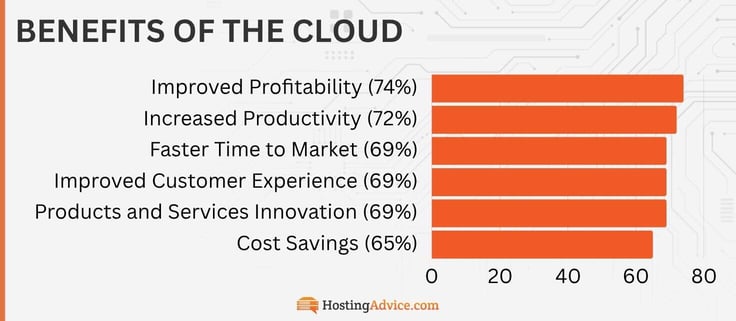
A majority of respondents did the right things (to the best of their ability) and reaped the benefits of the cloud. The first thing you should do when making a cloud investment is to define clear business goals and objectives.
20. More Than Half (63%) of Companies Are Increasing Their Cloud Budgets for GenAI
Remember the PwC report I talked about earlier? Well, it’s back with a bang. While you might have heard of and used basic Generative AI (GenAI) tools like ChatGPT, Midjourney, and Tabnine, enterprises are taking AI usage to the next level.
I’m talking about AI chatbots, coding assistants, predictive analytics, and marketing and media tools. Together, they boost productivity, reduce costs, enhance creativity, and deliver better customer experiences.
The roles of the thousands who have been fired in 2025 are being replaced with AI, and while 63% of companies are increasing their cloud budgets to accommodate this, they’re actually saving money in the process.16
21. About 67% of Companies Have Redefined Their Cloud Strategy to Include AI
It’s rather silly to say AI is a trend; it’s here to stay. So, even though it’s a double-edged sword, adopting AI to boost productivity is a must.
You should join the 67% of companies that have redefined their cloud strategy to include AI workloads.16
22. Half (50%) of Cloud Computing Power Will Be Dedicated to AI by 2029
You might have heard that Microsoft laid off 6,000 employees in May 2025. At the time of writing, more than 61,000 tech jobs have been slashed this year. The main “culprit”? Artificial intelligence.
AI can automate routine tasks, assist in software development, improve efficiency, and, in turn, lead to cost savings.
You need to upskill and make AI your best friend — not your enemy. For context, around 50% of cloud computing power will be dedicated to AI workloads.17,18
23. Cloud Spend Will Reach $288.50 Per Employee By 2027
This cloud usage stat supports the previous one — enterprises spend a lot on the cloud. It’s estimated that enterprises will spend an average of around $288.50 per employee by 2027.
Now, this stat is an aggregate. I’m sure large enterprises spend much more per employee — how else would 17% of them end up spending $2.4 million on public cloud services?4,19
24. The Global AI Market Will Grow to $826 Billion by 2030
The global artificial intelligence market was worth “just” $184 billion in 2024 and is set to grow by about 349% by 2030, reaching more than $826 billion!20
We both know what that means: if you don’t adopt AI — like, yesterday — your company is likely to be redundant. With investment in AI, you can take things to the next level.
25. One-Fifth (20%) of Organizations Lack Cloud Cost Visibility
Did you know more than 20% of organizations don’t have visibility into their cloud costs? Well, you do now — be among the 80-odd percent.
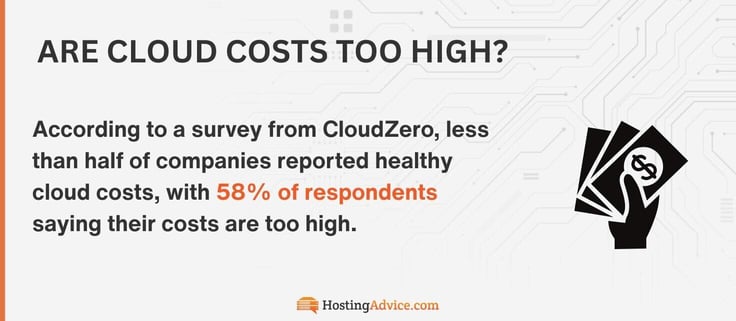
What’s more, roughly two-thirds of companies can’t accurately report their unit costs of cloud computing.21
26. Businesses Can Reduce Their TCO by 40% Through Cloud Migration
I want you to imagine the cost benefits of eliminating on-premises infrastructure. It reduces your IT headcount, speeds up the development and deployment of your apps and services, improves resource utilization, and most importantly, lowers the risk of business disruption.
Put simply, through cloud migration, you can reduce your total cost of ownership by around 40%.22
27. Only 5% of Companies Plan on Switching Back to On-Premises Infrastructure
Not all companies need to be in the cloud. For example, if you prioritize data security, performance, control, and compliance over the flexibility and scalability of cloud computing resources, feel free to switch back to on-premises infrastructure — approximately 5% of companies are doing so.22
The technical term for this is “cloud repatriation.”
28. Cloud Migration Reduces Carbon Emissions by 84%
One of the more underestimated benefits of moving to the cloud is the positive impact it has on the environment.
Data centers are the hub of all cloud operations, and they’re becoming greener by the day.
If not for the overpowering benefits of cloud technology, you can still choose cloud migration for the good of the environment — it reduces carbon emissions by about 84%.22
29. The U.S. Will Generate $466 Billion in Public Cloud Revenue in 2025
Let’s talk about revenue. The United States is quite obviously the leading revenue generator in the public cloud market, with forecasted revenue of around $466 billion in 2025.
If we treat Central and Western Europe as one entity, they’d come in second place, with an estimated revenue of about $151 billion.23 Mind you, public cloud spending and revenue aren’t the same thing, so don’t get confused.
This cloud usage stat basically means that American cloud companies earn the most from public cloud spending. And we both know that the U.S. is the leading spender, too!
30. The China Telecom Cloud Computing Inner Mongolia Information Park Is 10.76M Sq Ft
I’m certain you thought the world’s largest data center was in the United States. I’ll be honest with you: I did too. Well, turns out we’re both wrong.
With around 10.76 million sq ft of area, China Telecom Cloud Computing Inner Mongolia Information Park takes the honors. With approximately 7.2 million sq ft of coverage, America’s very own Switch TAHOE RENO data center in Nevada also deserves a mention.24,25
31. There Are an Estimated 12,000 Data Centers Globally
I had to include a couple of stats about data centers! After all, they’re the physical backbone of cloud infrastructure.
Number of Data Centers by Country:
| Country | Data Centers |
|---|---|
| 1. United States | 5,426 |
| 2. Germany | 529 |
| 3. United Kingdom | 523 |
| 4. China | 449 |
| 5. France | 322 |
| 6. Australia | 314 |
| 7. Netherlands | 298 |
| 8. Russia | 251 |
| 9. Japan | 222 |
| 10. Mexico | 173 |
According to research I did for a previous article on HostingAdvice.com, there are about 12,000 data centers in the world, and the United States has around 5,400 of them.26,27 Phew.
32. About 2.3 Billion People Use Personal Clouds in 2025
What do you think a personal cloud service is? iCloud+ is one such example — it stores all your data in one place, and you can access it from just about any device. If you use personal clouds like iCloud+, Google Drive, and Dropbox, you’re among the 2.3 billion people who use these services.28
33. Misconfiguration (68%) is the Greatest Cloud Security Threat
If I were a cloud security specialist and my company faced a data breach due to a misconfiguration I made, I’d feel terrible.
If this has happened to you, you’re only human — it’s the greatest cloud security threat, causing around 68% of security issues.28
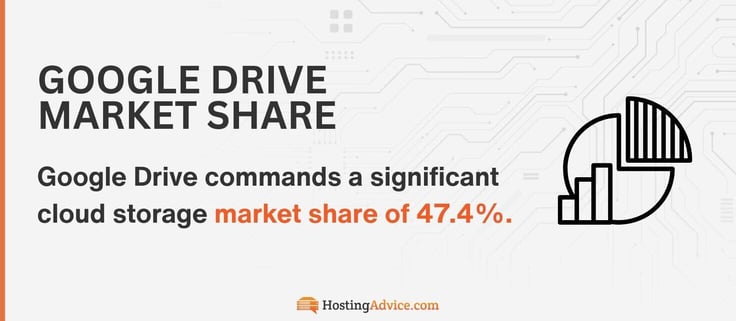
34. Google Drive Has More Than One Billion Users
It’s almost like I have a love affair with Google Drive — I can’t stop talking about it. Considering I use it for eight hours a day, of course, it’s on my mind. Well, turns out I’m just one of a billion-odd users who use Google Drive.29 Looks like it’s a one-sided romance.
35. In 2030, Everyone Will Be Connected to the Internet
This is more of an internet usage goal than a statistic. With the help of world governments, the United Nations says it aims to bring everyone online by 2030.30
With just five years left to achieve this and billions of people still offline — there are about 5.56 billion internet users compared with more than 8 billion people on Earth — our governments need to step up quickly.31
36. Cloud Gaming Revenue Will Reach $25.30 Billion by 2029
You know you don’t need to buy an expensive gaming setup to play your favorite computer games, right?
I mean, if you have an old laptop or a low-end desktop setup, you can play video games in the cloud. All you need is a superfast internet connection — the cloud will take care of the performance load for you.
Such is the demand of the global cloud gaming market that it’s expected to reach revenue of approximately $25.30 billion by 2029.32
37. Nearly 21% of Companies Expose Personally Identifiable Information
This heading sounds clickbait, right? Unfortunately, it’s not.
If you don’t know what personally identifiable information (PII) is, here’s a quick explainer: it includes any information that can be used to identify you, including your full name, phone number, address, or Social Security number.
Cloud storage buckets are containers for storing data within a cloud storage service, and 21% of companies have at least one that exposes your PII.33 The cloud feels a little stormy, huh?
38. The Average Cloud Data Breach Costs $4.88 Million
Well, here’s some thunder and lightning to add fuel to the fire: the average cloud data breach costs an astronomical $4.88 million.34 You see, the cyber threat landscape is real, and our growing reliance on cloud infrastructure only expands our potential attack surface.
Make sure you actively monitor and protect your infrastructure and take proactive security measures if a breach occurs.
May the Cloud Shower You with Success
These cloud adoption statistics highlight how important it is for you to adopt cloud technology. The cloud isn’t just a technological shift — it’s the foundation where the hundreds of thousands of zettabytes of data we’ll eventually create will be stored.
Adopting the cloud isn’t just a choice — it’s one small step for your company and a giant leap toward the future.
Further Reading and Resources
- https://colorlib.com/wp/cloud-computing-statistics
- https://www.statista.com/statistics/273818/global-revenue-generated-with-cloud-computing-since-2009
- https://www.statista.com/statistics/1114926/enterprise-spending-cloud-and-data-centers
- https://www.statista.com/statistics/817311/worldwide-enterprise-public-cloud-monthly-spend
- https://www.mordorintelligence.com/industry-reports/cloud-migration-services-market
- https://www.statista.com/statistics/477277/cloud-infrastructure-services-market-share
- https://www.statista.com/statistics/250520/forecast-of-amazon-web-services-revenue
- https://www.statista.com/statistics/1254388/google-cloud-revenue-by-quarter
- https://www.grandviewresearch.com/industry-analysis/cloud-computing-industry
- https://edgedelta.com/company/blog/how-many-companies-use-cloud-computing
- https://www.computerweekly.com/news/366579513/Forrester-IT-departments-are-blowing-their-cloud-budgets
- https://www.praecipio.com/resources/articles/atlassian-cloud-migration-roi
- https://www.flexera.com/blog/finops/cloud-computing-trends-flexera-2024-state-of-the-cloud-report
- https://www.cloudwards.net/cloud-computing-statistics
- https://www-file.huawei.com/-/media/corp2020/pdf/giv/2024/data_storage_whitepaper_2030_en.pdf
- https://www.pwc.com/us/en/tech-effect/cloud/cloud-ai-business-survey.html
- https://www.freepressjournal.in/business/over-61000-tech-jobs-lost-in-2025-microsoft-cuts-6000-as-ai-weak-growth-restructuring-drive-layoffs
- https://www.gartner.com/en/newsroom/press-releases/2025-05-13-gartner-identifies-top-trends-shaping-the-future-of-cloud
- https://www.auvik.com/franklyit/blog/cost-of-cloud-services
- https://www.statista.com/forecasts/1474143/global-ai-market-size
- https://www.cloudzero.com/state-of-cloud-cost
- https://www.cloudzero.com/blog/cloud-computing-statistics
- https://www.statista.com/outlook/tmo/public-cloud/central-western-europe
- https://techjury.net/blog/data-center-statistics
- https://worldstopdatacenters.com/china-telecom-inner-mongolia-information-park
- https://www.visualcapitalist.com/ranked-the-top-25-countries-with-the-most-data-centers
- https://www.statista.com/statistics/1228433/data-centers-worldwide-by-country
- https://spacelift.io/blog/cloud-computing-statistics
- https://electroiq.com/stats/google-drive-statistics
- https://time.com/7024240/digital-technology-sustainable-development
- https://www.statista.com/statistics/617136/digital-population-worldwide
- https://www.statista.com/outlook/amo/media/games/cloud-gaming
- https://www.optiq.ai/blog-post/35-cloud-security-statistics-you-need-know-in-2024
- https://pentera.io/blog/cost-of-data-breach