




Writer: Jordan Sprogis


Editor: Lillian Castro


Reviewer: Cristian Lopez

Key Takeaways
- IvyForms, a new plugin from Melograno Venture Studios, connects form submissions directly to wpDataTables for analysis and reporting.
- The plugin was built mainly in response to requests from existing wpDataTables users.
- Some updates, including payments, webhooks, and Zapier integrations, are expected soon.
Every company says they’re data-driven these days: 80% of business leaders say they rely on data to make decisions. Fair enough, sure — but saying that and actually organizing it are two entirely different things.
Especially when it comes to WordPress, the godfather of tool sprawl. Apparently, the average WordPress site uses between 20 and 30 plugins.

Melograno Venture Studio says its new plugin, IvyForms, is designed to simplify this very process. The company also positions IvyForms as an independent WordPress plugin built to support a wide range of users, from small website owners to larger organizations with more complex data collection needs. It integrates directly with the company’s visualization plugin, wpDataTables, allowing form submissions from IvyForms to move straight into tables, charts, and reports.
Of course, plugin overload is nothing new in the WordPress world. Developers regularly debate the limits themselves.
“Not all plugins are created equally. You can have a site with 20 plugins running smoothly, and one with 5 acting like it’s on dialup internet,” said one Redditor.
“When we started building IvyForms, the market already had some competitors, both WordPress plugins and SaaS form builders,” said Sara Idvorac, Product Owner at Melograno Venture Studio. “At first glance, that can look like a challenge. But for us, it was actually a big advantage.”
The Problem With Too Many Plugins
Of course, companies rarely enter a crowded market without a reason.
The Melograno team studied existing WordPress plugins and SaaS tools to understand what was working and what wasn’t. That easily revealed plenty of pain points, said Idvorac. And interestingly, much of the feedback actually came from Melograno’s own users.
Many of them were already using the company’s wpDataTables plugin to organize and visualize information. Before long, those same users began asking for a native way to collect the data that would eventually end up in those tables and charts.
“We were constantly receiving requests asking if we planned to build a form solution that could integrate with their existing tables and charts,” Idvorac said.
WordPress, of course, has never struggled with a lack of tools. The plugin repository now has more than 60,000 plugins. It’s exactly what makes the platform so successful: If you need something, there’s probably a plugin for it.
The options are simple enough: Export it into spreadsheets or connect it to other plugins that can store, analyze, or visualize the results. Maybe one plugin collects form submissions. Another stores the data. A third turns it into charts.
But you know how the saying goes: Too many cooks in the kitchen spoil the soup. (And who wants bad soup?)
Completing the Data Workflow
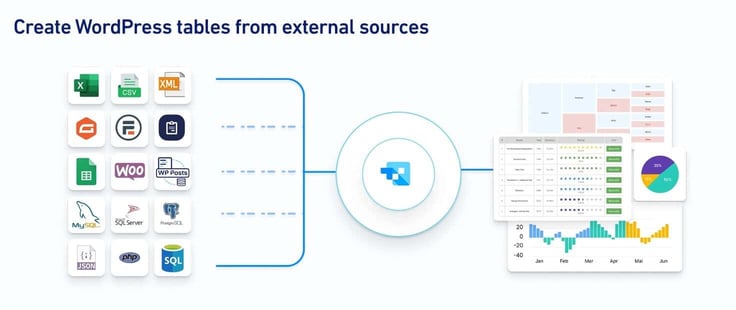
Instead of exporting submissions as PDFs or spreadsheets and then moving the data to a third-party tool, IvyForms routes form entries directly into wpDataTables, where they can immediately become tables, charts, and reports.
That removes several steps from an otherwise lengthy process. But if you ask me, the interesting part is that IvyForms and wpDataTables don’t actually have to depend on each other to work.
“IvyForms exists as a standalone product and as part of a broader integrated stack,” Idvorac explained. “And integration with wpDataTables allows users to link form submissions directly to tables, charts, and reports.”

This is not unheard of, but it’s not exactly commonplace, either. Another not-so-frequently-seen thing is that its first free version of IvyForms launched last year, and according to Idvorac, the paid version saw a noticeable wave of adoption during its first week.
Updates are coming as well. Idvorac told us that payment functionality is one of the most requested features so far, along with webhooks and Zapier integrations that would allow the plugin to connect to external tools and services, including Amelia, Melograno’s booking/scheduling platform.
Right now the plugin is sitting at version 0.9, with the first official 1.0 release expected soon. The update will introduce more styling controls, allowing users to customize form layouts, colors, fonts, and other design elements.
But the bigger idea here isn’t just another feature release, Idvorac emphasized to us. Melograno’s users were already collecting data through forms and analyzing it through wpDataTables. They just didn’t have a clean way to connect the two.
“I see IvyForms as the final touch of data management in our data management ecosystem,” Idvorac said. “So now we complete the cycle.”
