




Writer: Jordan Sprogis


Editor: Lillian Castro


Reviewer: Cristian Lopez

Key Takeaways
This time, it’s not Google or Amazon: The developer behind what may be the most power-thirsty data center campus approved in the U.S. is Kevin “Mr. Wonderful” O’Leary — the famous entrepreneur, investor, and celebrity host on “Shark Tank.”
His latest investment is a Utah data center campus on 40,000 acres of privately held land in Box Elder County in the northwestern boot of Utah. The campus, called Stratos, is going to be a 9.5 gigawatt data center reportedly expected to consume more than twice the power currently used by the entire state.
Utah isn’t actually O’Leary’s first attempt at building a hyperscale, gas-powered data center. He announced a near-identical project in December 2024 in Alberta, Canada: 14,000 acres in Alberta, sitting atop the Montney Formation, one of North America’s largest natural gas reservoirs.
It’s very on-brand for a celebrity investor worth $400 million to find a large piece of land near an energy source, find some authoritative figure willing to offer tax incentives, and plant their data center-shaped flag. Unfortunately for O’Leary, the Alberta project has stalled over environmental concerns.
Utah, by contrast, is moving much faster — maybe.
The Military Land Advantage
Stratos would sit near the Ruby Pipeline, a 680-mile interstate natural gas line running from Wyoming through northern Utah to Oregon, which is expected to supply the campus with power.
The land also bleeds into around 1,200 acres of the Utah Test and Training Range and National Guard property. The project received approval from Utah’s Military Installation Development Authority (MIDA) last week.
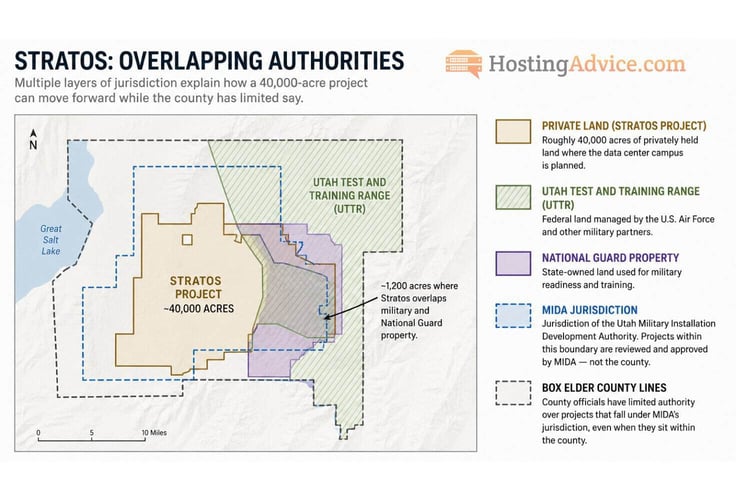
MIDA acts as the gatekeeper for who can build what around military installations — which means this exact location is a bit unclear, but it likely sits somewhere around the northern edges of Great Salt Lake.
But that’s no coincidence. MIDA cut the project’s energy use tax from 6% to 0.5% and agreed to rebate O’Leary’s infrastructure arm, O’Learly Digital, 80% of the property tax revenue generated. Box Elder County didn’t get a vote on any of it until well after MIDA had already approved the deal on April 25.
Box Elder County: “Not So Fast”
The location by the Ruby Pipeline may very well be why MIDA executive director Paul Morris promised county commissioners that the facility “will not take one electron” from the existing grid. (As in, the grid that taxpayers use and fund.)
The project could generate $30 million per year in taxes during its initial phase. Once completed, MIDA says it will add up to 2,000 permanent jobs and $250 million per year in state sales tax.
Like many others in the U.S. living near a data center project, Box Elder County isn’t buying it — not yet, at least.
“The thing that’s so frustrating for us, for commissioners, is all of a sudden, we’re brought this in the last hour, and we’re expected to hurry,” said Commission Chair Tyler Vincent.
On April 22, MIDA’s Morris spoke at a commission meeting arguing the project would create thousands of jobs. Then on April 27, the commission discussed it again and voted to table its decision, citing the many concerns raised by Box Elder residents.
When commissioners first learned of it, they were described as “a hard no.” And MIDA’s own project manager admitted that no impact studies had been conducted on traffic or the environment.
The county delayed its vote on the project. They’re rescheduled to try again on May 4.
