



Writer: Jordan Sprogis


Editor: Lillian Castro


Reviewer: Cristian Lopez

Key Takeaways
Hyperscalers are set to spend up to $690 billion on cloud infrastructure this year, according to a new analysis by Futurum. All the big players — Amazon, Microsoft, Google — are doubling down on data centers and improving their networking and AI infrastructure.
To put it in perspective, these very same hyperscalers were investing about $380 billion in 2025. Investment has doubled in the past year alone, so one would think with this level of investment, there should be fewer outages. But as reality would have it, that’s not quite what’s happening.
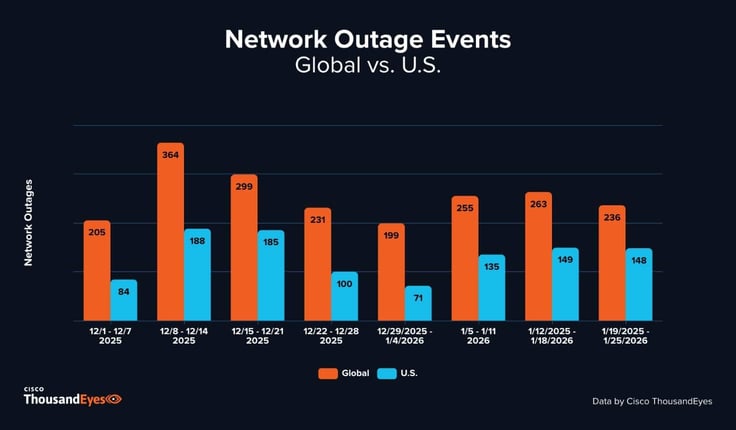
ThousandEyes — a network intelligence and observability platform by Cisco — found in its latest outage report that a lot of today’s networking failures don’t come from a single point of failure but instead follow something of a domino effect.
Just to add to the mix, these outages are apparently completely avoidable. The Uptime Institute found that 4 out of 5 operators say their most serious outages could have been prevented altogether with better management.
Too Many Cooks in the Kitchen
If you had to find a single common denominator, it looks like congestion in the stack. When something goes wrong, no matter how small, that’s automatically five different systems reacting to it at once.
It’s what happened to Cloudflare in its infamous November 2025 outage, which knocked millions of people offline for several hours in the middle of a workday. For such a massive outage, it turns out it was caused by something simple: a routine bot configuration.
This doesn’t just all stem from AI. Let’s walk down memory lane for a moment — just back to the mid-2000s when VMware really took off.
Instead of running directly on physical machines, everything started running through a virtual layer. That made it easier to scale and connect things (but it also added another layer nonetheless).
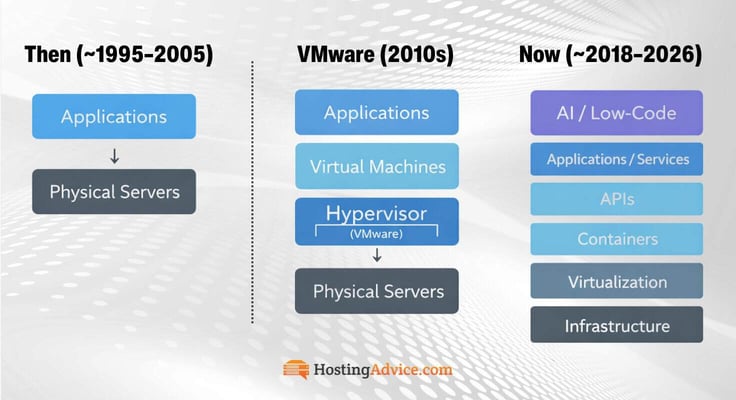
What used to look like checking the server for issues is now about checking the containers, VMs, hypervisors, edge/CDN networks… all of it. It’s like switching from a Quarter-Pounder to a Big Mac.
Now we’re building on top of that again. Organizations say they’re running an average of three or more observability tools at once, and many still say they don’t have full visibility into what’s actually happening inside of their systems.
This is all happening alongside new tech like vibe coding/AI-assisted development, with Gartner estimating that 70% of enterprise applications will use low-code or no-code technologies by 2025. That’s great for speed, and it opens the web to the masses.
But the more we expand that surface — the same way we’ve been doing with cloud infrastructure — fewer people will actually know what exactly they’re working with. Some still will, though: The Bureau of Labor Statistics projects a 25% growth for software developers through 2032.
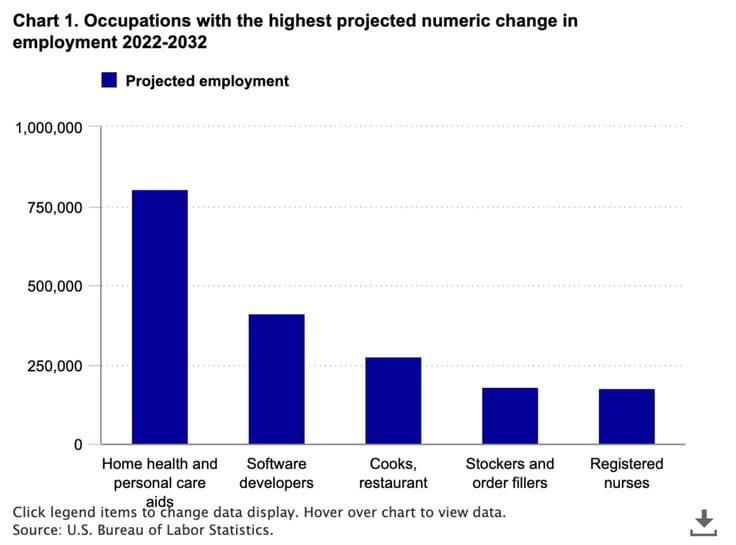
A lot of those more technical roles are likely to get pulled toward the hyperscalers. And it’ll happen as AI tools and low-code platforms take over more of the old-school day-to-day work, like building apps and getting sites live.
To be clear, it’s not “bad” to have AI systems as yet another layer, but it is another layer all the same.
Which helps explain why providers are starting to rethink that already overstuffed middle. Perhaps the mass move toward edge, serverless, and one-click setups is less of a trend and more like a major correction.
