




Writer: Jordan Sprogis


Editor: Lillian Castro


Reviewer: Cristian Lopez

Key Takeaways
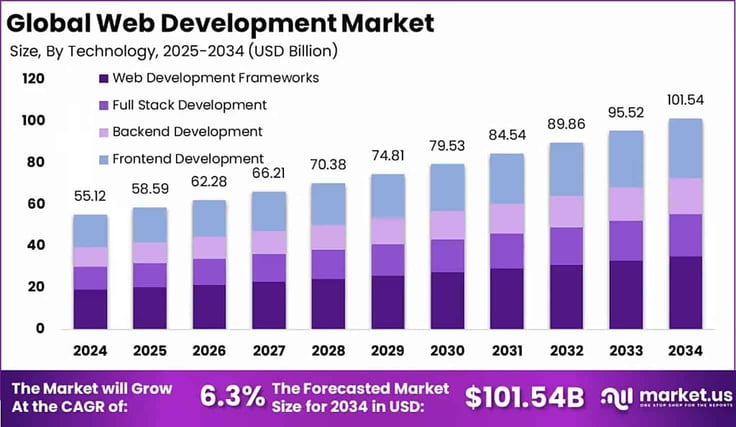
The global web development market is projected to reach $101.5 billion by 2034, growing at a 6.3% CAGR, according to Market.us.
Interestingly, it’s not just a growing web presence that’s driving market expansion; it’s the massive investments major providers are making into complex builds. People are talking about supporting custom Shopify storefronts, headless WordPress deployments, and more Next.js.
InMotion Hosting, which hosts more than 170,000 users, has recently seen this trend play out in real time, said Head of Product Trey Faison, adding: “We’re seeing real evolution in how websites are being built.”
Performance, Upgraded
Clients nowadays are more aware of where every dollar goes — and they want to make sure money is well-spent. The economy isn’t forgiving enough for anything less.
That’s why there’s constant pressure for better performance: The report shows devs and agencies are the ones leading the global web development market. After all, they’re building the sites that demand more from infrastructure.
“Agencies are focusing more on larger, more complex sites that demand performance and higher resources,” Faison said.
Developers are backing that up with their tech choices.
The report shows strong investment in framework-driven development (34.6%) and custom design services (24.9%) — clear signals of a shift from DIY builders to scalable, high-performance builds.
The Role of Low-Code and AI
While low-code builders remain popular (especially for simple projects with a quick turnaround), it’s a different story for high-performing sites. When it’s time to build for global companies, developers are more likely to lean on frameworks and custom builds.
One is not inherently better than the other, but even if it were, hosts still need to support both methods: Low-code supports speed and accessibility, while frameworks power the more complex, scalable projects.
“AI seems to be helping developers move faster,” Faison added. “We’re also seeing growth in low-code and no-code platforms, expanding what can be done outside traditional development workflows.”
In fact, the report found that the low-code/no-code development market reached $25.1 billion in 2023 and is projected to grow to $274 billion by 2033. No-code is also expected to make up more than 65% of app development by 2024.
Modern Problems = Modern Solutions
Headless builds may run more smoothly today, but powering them is still resource-intensive. Faison said InMotion is seeing that firsthand: “It gives developers so much more control over the front end, and we’re seeing more of these headless builds being published directly to our servers.”
One solution is going back to dedicated servers.
A Liquid Web report found that 45% of businesses expect dedicated servers to become more popular over the next five years.
Three words as to why: performance, control, and customization.
Devs want infrastructure that can handle modern workflows — and those workflows are more complex than ever because their clients expect constant innovation. Everyone wants to stay ahead of the next big thing.
Yes, today’s workflows are evolving faster than ever, but we finally have the technology to keep up. It’s just a matter of who actually does.
