



Writer: Jordan Sprogis


Editor: Lillian Castro


Reviewer: Cristian Lopez

Key Takeaways
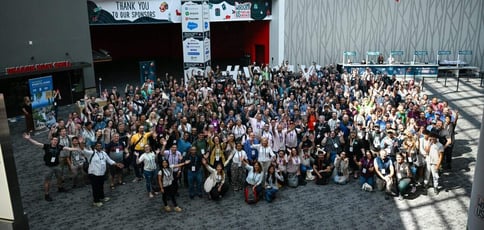
WordCamp U.S. (WCUS) 2025 made one thing clear for the hosting world: AI has moved from hype to implementation.
From Hostinger to WP Engine, hosting leaders at this year’s flagship WordPress event in Portland, Oregon, said the focus is no longer on whether to integrate AI into workflows, but how to make it practical for site owners and developers — a shift that could reshape hosting strategies around performance, interoperability, and content discoverability in the age of AI agents.
After WCUS 2025 closed out on Aug. 29, Hostinger, WP Engine, and WP Rocket shared insights with HostingAdvice about what they saw from this year’s event.
AI Is No Longer “If,” But “How”
The topic of AI was not avoided in the WordPress community last year, but it was approached with caution, clear that devs and users were still testing how (and why) it could be integrated.
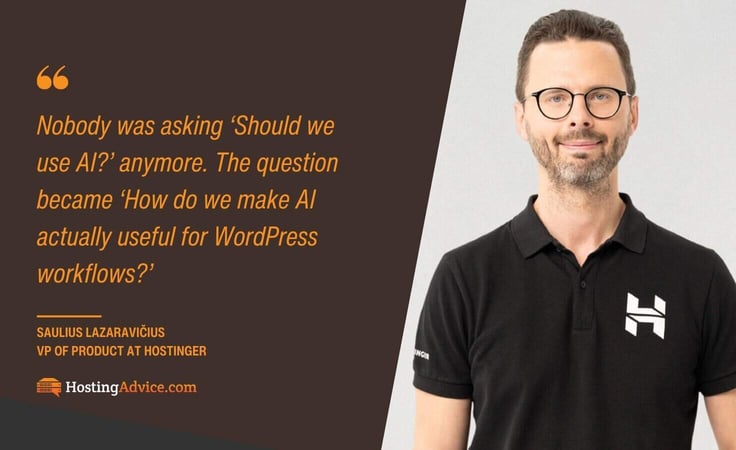
But Saulius Lazaravičius, VP of Product at Hostinger, told HostingAdvice that this year’s WCUS marked a turning point in that conversation.
“Nobody was asking ‘Should we use AI?’ anymore. The question became ‘How do we make AI actually useful for WordPress workflows?’” Lazaravičius said. “People want to see AI in action, not just hear about its potential. They need guidance, education, and hands-on experience to feel the difference it makes, not just understand it conceptually.”
One good example is WordPress’s Core AI team, which debuted in person since its formation in May. The team — James LePage, Felix Arntz, and Jeffrey Paul — led a presentation titled “Core AI: What We’re Building,” where they shared AI-WP implementation ideas, and discussed future plans before opening the floor for questions.
There, a SolidWP team member asked how hosts could make WordPress AI features accessible without the complications — as in, requiring users to handle API keys and external accounts.
“I acknowledge that it requires a technical foundation. You need to go get an API key, paste it somewhere, and that’s not super intuitive,” Arntz answered. “Looking ahead, as we get further with server-hosted and client-side models, we’ll reach a point where you don’t need to paste API credentials anymore. Things will just work immediately anyway, and that’s very promising.”
So what does that mean for developers and site owners?
According to Lazaravičius, the answer is surprisingly simple.
“Developers: focus on interoperability. Build tools that expose their capabilities in ways AI can consume,” he said. “Site owners: let AI handle the boring stuff — updates, testing, tweaks — so you can focus on what only you can do: the vision, the strategy, the human touch that makes your site matter.”
Hosting for Humans and Agents
Over the past few months, the industry has been grappling with the new reality of AI.
Customer sites have been seeing less and less traffic, and it’s because there’s a decline in traditional search. AI overviews and LLM agents aren’t just crawling anymore; they’re opening pages, pulling answers like a user, which means fewer click-throughs and traffic.
It’s exactly what’s sparked conversations about GEO, or Generative Engine Optimization.
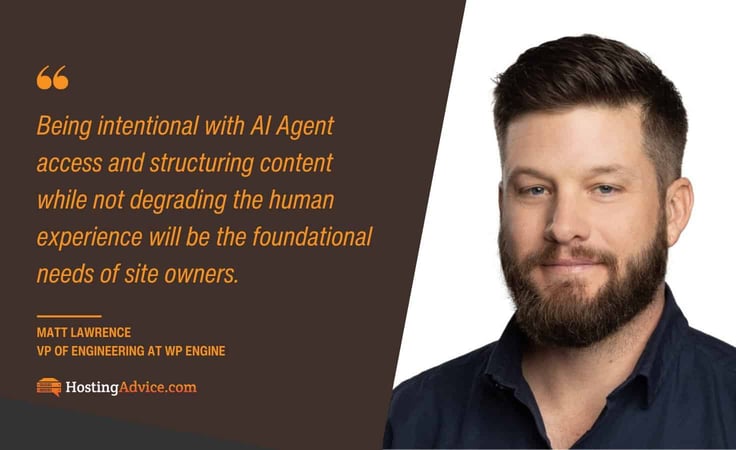
“Being intentional with AI Agent access and structuring content while not degrading the human experience will be the foundational needs of site owners,” Matt Lawrence, VP of Engineering at WP Engine, told HostingAdvice. “Site owners can take this a step further with GEO, which requires making sure that your content can be understood, trusted, and cited by AI Agents.”
In his session, “How (and why!) Google Search keeps evolving,” Danny Sullivan, former Google Public Liaison for Search, touched on this too.
“AI overviews…[are] probably the biggest evolution,” Sullivan said. “AI is enabling these new ways to seek information and people are developing expectations to want to get it presented in a different way.”
The issue with that is it means sites need to start working for an entirely different user.
“WordPress sites are serving new users in the form of AI agents, which is changing managed hosting customer needs, site traffic profiles, and even how human end users engage with content,” Lawrence added. “Structuring content for agents and giving site owners choices about access will become foundational.”
For hosts, it means being intentional about how their clients’ sites are found, like using semantic HTML, schema, and structured hierarchies to make content as appealing as possible to automatic agents.
A Thriving Community
Michael Cunningham, Video Content Creator at WP Rocket, argued that the fundamentals still matter — starting with speed. WCUS had plenty of sessions, including “The Site Speed Frontier with Performance Lab and Beyond” and “Building Experiences: Design Systems, User Experience, and Full Site Editing,” which were nut-and-bolt keynotes on speed and building.
“Performance continues to be a critical component of the web experience, now more than ever,” he said.
And with more hosts building caching and optimization into their platforms, he believes the push toward faster, simpler performance will only grow in the year ahead.
Cunningham also pushed back on familiar claims that WordPress is “dying.”
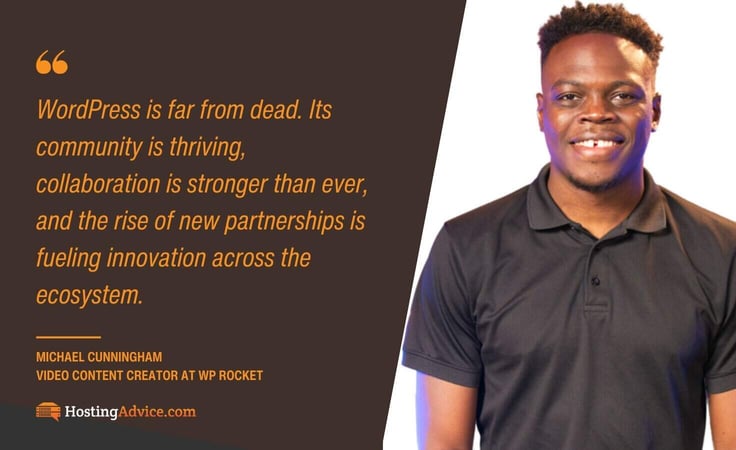
“My biggest takeaway is that, despite the rumors, WordPress is far from dead. Its community is thriving, collaboration is stronger than ever, and the rise of new partnerships is fueling innovation across the ecosystem,” he said. “It’s a good time to be a Word-Presser!”
It’s a concept that carried through to the event’s finale, when WordPress co-founder Matt Mullenweg delivered his closing keynote.
He reflected on how far the platform has come over the past 22 years, including today’s debates over AI, comparing it to the controversy surrounding WYSIWYG editors: unwanted at first, but ultimately necessary.
It’s actually just as Cunningham said to HostingAdvice: “The adoption of AI is the next challenge. It’s inevitable, but it has to be done thoughtfully, not just thrown together.”
The next WordCamp U.S. will take place August 16-19, 2026, in Phoenix.
