




Writer: Jordan Sprogis


Editor: Lillian Castro


Reviewer: Cristian Lopez

Key Takeaways
- Vultr’s new VX1 Cloud Compute plans claim nearly 80% better performance-per-dollar and 33% lower cost per virtual CPU compared to certain hyperscalers.
- Vultr's transparent pricing can help small and midsize hosts avoid the spend requirements and inbound/outbound surprises that are otherwise common with AWS and Azure.
Cloud computing company Vultr says its new VX1 Cloud Compute plans perform at the enterprise level but only cost what small-to-midsize plans do.
The new tier, which was just announced at the end of October, is a host’s dream. It comprises AMD EPYC processors, local NVMe storage, and up to 50 Gbps network throughput. And perhaps most importantly, it promises up to 77% better performance-per-dollar and 33% lower cost per vCPU than hyperscalers.
And one might ask: If you want enterprise-level perfromance, then you have to expect to pay enterprise-level prices, right? To that, Vultr said, “Nah.”

“Cloud infrastructure budgets are under strain as workload volumes grow, and new AI initiatives compete for resources,” said J.J. Kardwell, CEO of Vultr. “VX1 was purpose-built to change the economics of cloud computing and set a new performance-per-dollar standard.”
While the tier was built to address the growing need around more affordable cloud computing for enterprises, it works any cloud-native workload.
In fact, there’s a real story here for hosting providers. Through Vultr’s Partner Program, hosts can leverage VX1 just like any other Vultr instance and brand it as their own. And for those who already run on Vultr, this can act as a cost-effective upgrade.
Inside the VX1 Cloud Compute Plans
We took a look at Vultr’s new VX1 plans so you don’t have to (although you should if you’re considering its services). The good news is it’ll cost the same per vCPU whether deploying 10 or 10,000 servers. In other words, Vultr doesn’t penalize smaller buyers.
Here’s what Vultr’s pricing page looks like:
| vCPUs | Memory | Storage | Bandwidth | Hourly | Approx. Monthly* |
|---|---|---|---|---|---|
| 4 | 16 GB | 240 GB NVMe | 6 TB | $0.153/hr | $112/mo |
| 8 | 32 GB | 480 GB NVMe | 7 TB | $0.306/hr | $224/mo |
| 16 | 64 GB | 960 GB NVMe | 8 TB | $0.612/hr | $448/mo |
| 32 | 128 GB | 1.92 TB NVMe | 9 TB | $1.233/hr | $902/mo |
| 48 | 192 GB | 2.88 TB NVMe | 9 TB | $1.835/hr | $1,342/mo |
| 64 | 256 GB | 3.84 TB NVMe | 10 TB | $2.446/hr | $1,788/mo |
| 96 | 384 GB | 5.76 TB NVMe | 10 TB | $3.669/hr | $2,682/mo |
| 192 | 768 GB | 11.52 TB NVMe | 10 TB | $7.338/hr | $5,364/mo |
Let’s see how this might work in a reselling situation. Vultr’s VX1 line lists 4 vCPU/16 GB RAM/240 GB NVMe instance at about $112 per month. That works out to around $28 per vCPU.
Obviously, you can’t charge the same $112 to your customers. So when you layer typical expenses with your desired profit margin — maybe an extra 30% to 50%? — to find a good customer-facing price, you might be looking at around $150 to $170/month for that server.
Who’s Locking Out Smaller Hosts?
Hyperscalers — AWS, GCP, Azure — typically sell their cloud compute services with enterprise discounts. That means providers have to commit to minimum spend requirements, which can reach hundreds of thousands of dollars per year.
Look at AWS’s Enterprise Discount Program, which requires multiyear commitments and minimum annual spends around $1 million to unlock double-digit discounts. Azure’s Enterprise Agreement does the same with consumption thresholds.
It’s not something most can afford, and it’s effectively pricing out the smaller players in the web hosting space. According to Flexera’s State of the Cloud research, most small-to-mid hosting companies are spending less than $600,000 per year on cloud infrastructure, while the upper end of that group could reach $1 million to $12 million per year.
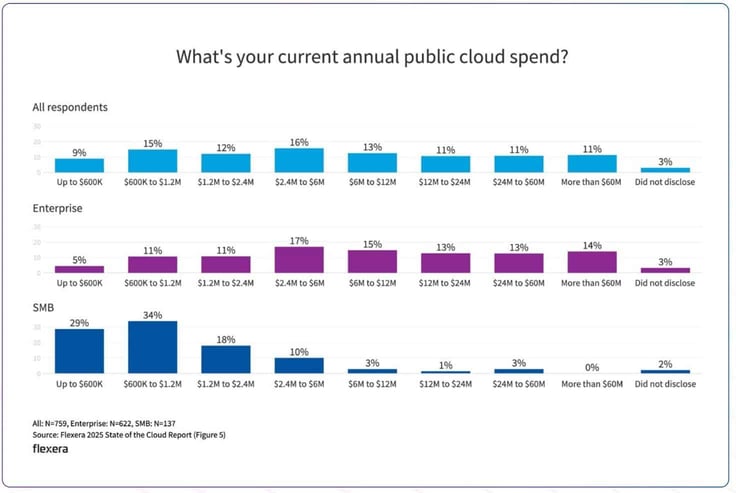
For many, that’s only a fraction of what’s required to qualify for AWS’s enterprise discounts.
And, for lack of a better term, hyperscalers “hide” costs in the fine print of each contract. It could come in the form of data egress, IP address fees, and storage-retrieval penalties.
For example, in AWS’s U.S.-based regions, egress data transfer typically starts around $0.08 for the first 10 TB/month and can go up to $0.12 per GB in certain regions or tiers. This doesn’t include other possible charges, such as IP address charges or cross-region transfers.
This is a model that undoubtedly punishes smaller hosts that can’t guarantee that kind of mass consumption. So for hosting companies, Vultr’s XV1 plans mean predictable margins, happy customers, reliable performance — and, of course, no surprise cloud bills at the end of each month.
