



Writer: Jordan Sprogis


Editor: Lillian Castro


Reviewer: Cristian Lopez

Key Takeaways
- Two senators sent a joint letter to the EIA last week demanding mandatory energy-use reporting from data centers.
- AI data centers are not the same as traditional facilities, and they are pulling from communities' pockets and resources.
- Tech companies have already made the clean energy pledges, and senators like Warren and Hawley just want proof they're actually keeping them.
Senators Elizabeth Warren and Josh Hawley — a Massachusetts progressive and a Missouri populist — sent a letter to the U.S. Energy Information Administration (EIA) demanding that they begin requiring mandatory annual energy-use reporting from data centers. The agency has until April 9 to respond.
The proposal gets into the specifics, requesting information on data centers’ hourly loads, peak demand, electricity rates paid, grid upgrade costs, and — perhaps most notably — a breakdown of AI workloads versus general cloud.
From Virginia to Texas to…You?
That last KPI is very important for the modern day hosting provider.
Forecasts are already indicating that AI operations alone may consume more than 40% of global data center power by the end of 2026, with states like Virginia, Ohio, and Texas at the epicenters.
Dr. Joshua D. Rhodes, a research scientist at UT of Austin, said that these regions aren’t just hotspots by chance.
“These regions are experiencing some of the highest datacenter growth and are under tremendous political pressure to make sure that these new loads are not increasing electricity cost for other ratepayers,” he explained.
Loudoun County, Virginia — known as Data Center Alley — already moves more than 70% of global web traffic across more than 200 facilities. On the outskirts of Abilene, Texas, a 4 million-square-foot complex is underway, predicted to consume the equivalent to powering 1 million homes. Ohio only recently lifted a moratorium on banning all new data center connections after regulators required they pay for their own power.
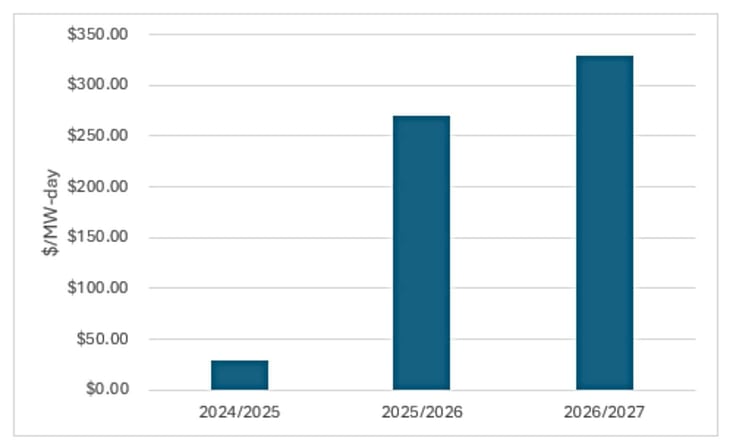
Look at the PJM market alone, which covers 13 states from Illinois to the mid-Atlantic. In the 2025-26 period, data centers pushed an estimated $9.3 billion in extra costs through PJM’s market. For Maryland households, that’s $18 more a month. For Ohio, it’s $16.
In areas near major data center activity — like Data Center Alley — wholesale electricity costs are already 267% higher than five years ago.
And don’t forget: Mid-size hosting providers in those regions are competing for power against the same hyperscalers driving those prices up.
Flying Blind on a Trillion-Dollar Industry
In March, AWS, Microsoft, Google, Oracle, and other major tech companies signed the administration’s “Ratepayer Protection Pledge,” which promises to cover the costs of the new power their data centers use:
“President Trump is calling on the leading United States hyperscalers and AI companies to build, bring, or buy all of the energy needed for building and operating data centers, paying the full cost of their energy and infrastructure, no matter what.”
It’s a strong promise, but without standardized reporting, there’s no real way to verify what “covering costs” actually means. Data center operators still have plenty of room to work around it, like restructuring expenses through rate-basing or leaning on PPAs that can’t fully account for the future strain.
Utility companies like Eversource Energy have historically followed these kinds of models. The company’s Smart Meter rollout, for example, is billed as a no-cost upgrade to customers in Massachusetts, Connecticut, and New Hampshire, but the program itself is folded into the cost of the service. Which means the ratepayer is paying after all.
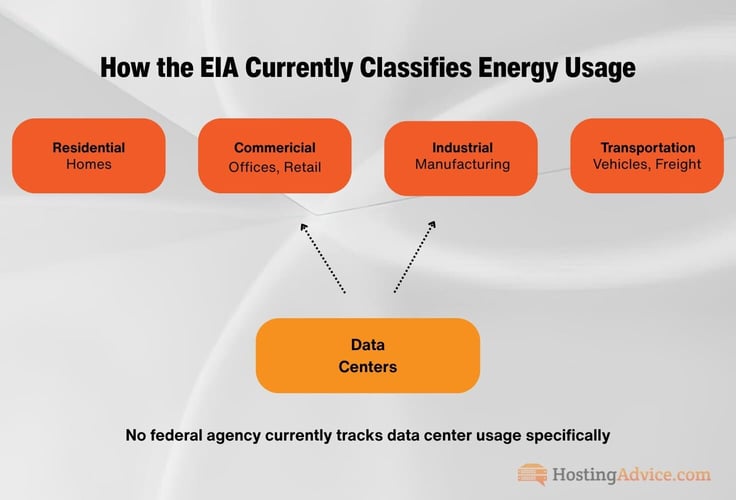
States acting independently are, at best, a loose patchwork, but there isn’t a federally run agency that tracks energy usage specifically for data centers. “You can’t manage what you don’t measure,” Dr. Rhodes said.
It should, theoretically, fall under the EIA’s purview.
Currently, the EIA organizes everything into four sections: residential, commercial, industrial, and transportation. Data centers likely fall somewhere between commercial and industrial.
The issue is many data centers are generating their own power on-site now. Whether that gets reported accurately to utilities or regulators is…probably open for interpretation. Contracts between data centers and utility companies are also often confidential, requiring NDAs.
The EIA already has these kinds of standards in place for those other sectors, mandating that industries including oil and gas and manufacturing provide regular energy data.
So it’s not impossible…it just also looks like data centers have slipped through the cracks. But even so, the hyperscalers haven’t been sitting still.
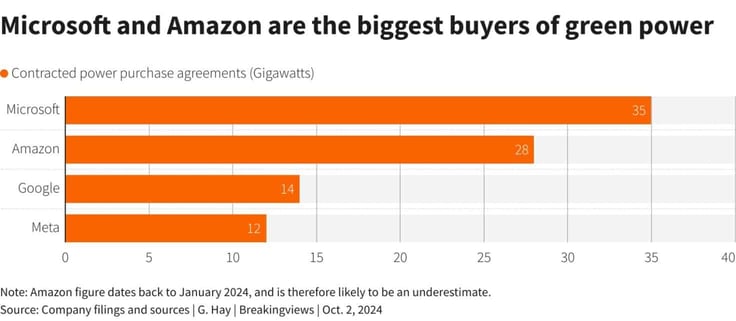
Amazon, Google, Microsoft, and Meta all report 100% renewable electricity purchases, with Microsoft reportedly surpassing Amazon as the largest buyer.
“Even though it’s voluntary, it does appear that the hyperscalers are trying to do everything they can to better their public perception,” Dr. Rhodes said.
Which makes Warren and Hawley’s request feel like a natural next step. But even if the answer is no or this gets delayed for another few years, it won’t be the last time Congress asks these questions.
