




Writer: Jordan Sprogis


Editor: Lillian Castro


Reviewer: Cristian Lopez

Key Takeaways
About half of hosting providers expect green hosting to rise over the next few years. But only 1 in 4 customers rank it as a priority, according to a new global survey by UpCloud. Buyers continue to care most about the basics: speed, uptime, and cost.
While some hosts are interested in sustainability, their customers are more focused on the things they have been for decades: No matter how advanced the market gets, they still want the best performance and the best pricing.
But there’s a silver lining for eco-curious hosts: Over the next few years, Gen-Z will continue entering the workforce in droves — and they just so happen to be the ones that value eco-friendly brands and products the most.
The Survey Says…
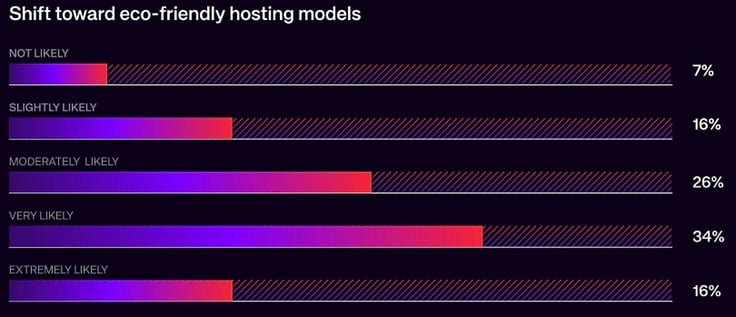
UpCloud’s survey found that 50% of providers said it’s likely the industry will see a notable pivot toward eco-friendly hosting within the next five years.
At the same time, those respondents said only 25% of their customers see sustainability as “very important,” compared to 44% who prioritize uptime, 40% who want faster performance, and 73% who call lower costs very or extremely important.

But Owen Rogers, the CTO of .eco, believes this may come down to a simple misunderstanding.
“Sustainable hosting doesn’t necessarily come at a higher price,” Rogers said. “There are many eco-friendly hosting options that are price- and performance-competitive.”
But that perception has ripple effects: If customers won’t pay for eco-friendly hosting, providers have little incentive to design greener services in the first place.
But the environment isn’t waiting for demand to catch up.
Data centers account for about 1.5% to 2% of the world’s electricity and heavily rely on nonrenewable energy resources. When powered by fossil fuels, they release carbon dioxide into the atmosphere, intensifying the greenhouse effect.
The pressure is intensifying with the rise of AI. Training large models and running billions of inference queries require fleets of GPUs that draw far more power than traditional servers.
Take Microsoft, which pledged carbon negativity and zero water cooling. Last year, the mega-giant reported a nearly 30% rise in emissions over the past five years, largely thanks to AI workloads.
The Gen Z Factor
While data shows sustainability isn’t yet a top customer priority, many providers are already making it part of their strategy. It’s just that it’s easier to showcase green credentials for those who can invest in it.
OVHcloud, for example, launched an Environmental Impact Tracker earlier this year, giving business leaders better visibility into Scope 1-3 emissions. Ultimately, what players like OVHcloud are trying to prove is exactly what Owen Rogers hinted at: Green hosting doesn’t have to mean paying green.
Smaller providers are in a tougher position. If budgets are tight, investing in green infrastructure is harder to justify, especially when customers are more likely to churn over cost and downtime than carbon.
The other side of the coin suggests that building the same kind of visibility into energy use or emissions can be tough, especially when their own customers still bolt at the first mention of ‘eco-friendly’ costs.
But there’s a chance the future could look very different with Gen Z, which is projected to make up nearly 30% of the global workforce by 2030.
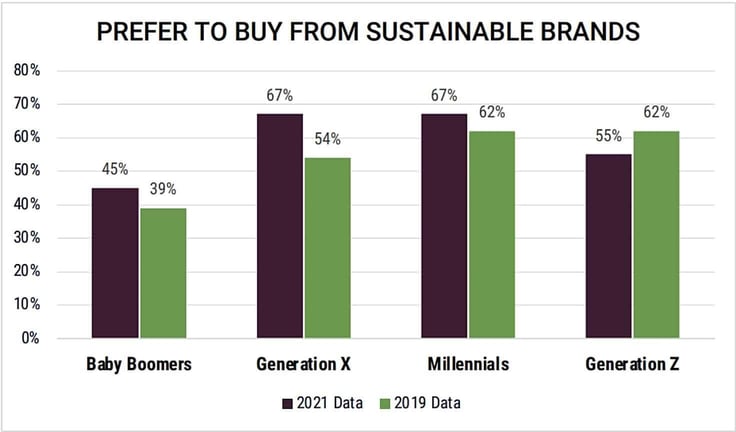
And unlike previous generations, they’re prioritizing sustainability as both employees and buyers: 75% of Gen Zers say they prefer sustainable purchases over brand names, compared to 71% of millennials and 65% of baby boomers.
Gen Z isn’t just a future consumer base, either. That demographic is already the most entrepreneurial generation, with about 40% of Gen Zers already running side hustles, and all of those need a web host.
It’s not unlike other industries where “green” became a selling point that also made financial sense. Hybrid cars save on emissions, but they also save drivers money on gas. Solar panels are eco-friendly, but they also lower utility bills and qualify for tax credits.
Combined, it’s the perfect storm for a new market — because while today’s customers may not prioritize sustainability, tomorrow’s business owners will.
