



Writer: Jordan Sprogis


Editor: Lillian Castro


Reviewer: Cristian Lopez

Key Takeaways
Nokia says today’s cloud infrastrucure still isn’t ready for large-scale AI workloads — which includes data centers that are already “AI-ready.”

In a recent analysis, Mark Vanderhaegen, who leads business development in the European region for the Nokia Webscale business unit, argued that while AI data centers have become more prepared for the AI age, their networks are behind because they’re still reliant on traditional cloud infrastructure.
It’s not exactly a revelation to cloud providers or infrastructure teams. They’ve warned for years that network congestion and traffic problems would continue to be major constraints as AI adoption grows.
The cloud, after all, was built for people clicking on websites, not for AI inferencing where thousands of GPUs are communicating nonstop with one another.
When around 65% of AI compute capacity in data centers already run on GPU-based servers — which depend on constant, high-volume data communication — it’s clearer why Nokia says the networking layer needs some serious reconsideration.
Why “AI-Ready” Isn’t So Simple
Traditional cloud traffic moves north-south. Data comes in, data goes out. It happens whenever a user clicks on a link, loads a webpage, or makes an API request.
AI traffic is a heck of a lot more complicated, though. It moves east-west, with machines communicating continuously with each other and leaving little room for delay.
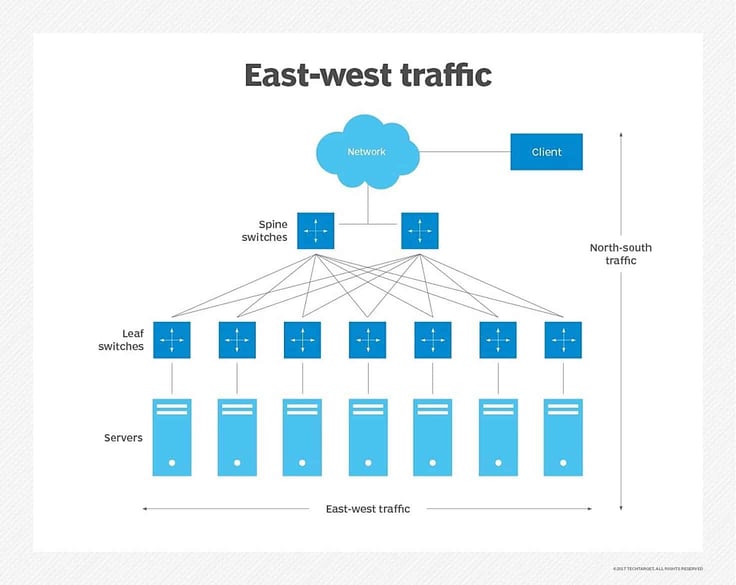
So the challenge, Nokia suggests, isn’t a lack of GPUs, but whether those GPUs can communicate without congestion turning the network into a highway rubbernecking situation.
Nokia, of course, isn’t alone. In some surveys, operators say AI and AI-adjacent workloads could dominate data center bandwidth within the next few years, ultimately exposing the limitations of traditional cloud infrastructure that’s optimized for north-south traffic.
Network architects at Cisco said the same thing in a recent Reddit AMA, arguing that the industry’s focus on GPUs has completely overshadowed the growing network problem.

“The industry is currently obsessed with GPU benchmarks, but … the network has become the biggest bottleneck to AI innovation,” Cisco engineers wrote, also noting that AI workloads introduce tail-latency spikes and microbursts that can “stall multi-million-dollar jobs and leave even the world’s most powerful chips idle due to network inefficiencies.”
As Cisco engineers explained in the same AMA, addressing tail latency and microbursts requires congestion-aware network designs, smarter traffic steering, better visibility, and tighter coordination across hardware and software, and not just more computing power.
Nokia actually pointed to Gcore as an early example of how this can work in actual practice. Through its AI Cloud Stack, Gcore has focused less on simply adding GPUs and more on building the network fabric underneath them, using a spine-leaf architecture designed to handle sustained east-west traffic inside the data center.
But the company’s final message in its analysis was less about architectural theory, and more about the commercial aspect: If cloud and hosting companies want to sell trusted AI services — especially with performance or pricing tiers — the underlying network has to support those guarantees.
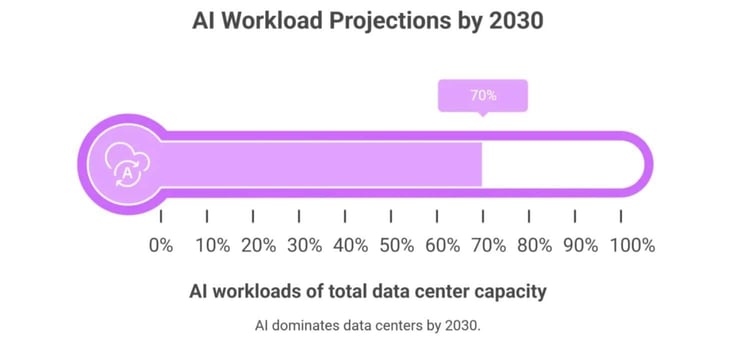
AllAboutAI suggests AI workloads could account for 70% of total data center capacity by 2030. That’s power consumption on par with the current output of the U.S. electrical grid.
It’s already difficult to promise consistent AI performance on infrastructure that degrades unpredictably during traffic spikes. Does this mean that, in the AI cloud era, networking reliability may become the new SLA?
Nokia certainly thinks so. After all, reliability has kind of always been their MO — just ask anyone who’s ever dropped one of their phones.
