



Writer: Jordan Sprogis


Editor: Lillian Castro


Reviewer: Cristian Lopez

Governor Kathy Hochul signed an executive order on July 14 which would pause permits for some new data centers New York State.
New York’s Department of Environmental Conservation will stop processing state permits for data centers that consume 50 MW or more (unless the application was already complete before the order took effect).
The moratorium lasts until the state finishes a Generic Environmental Impact Statement — a formal environmental review that covers energy demand, water use, air quality, noise, and impacts on disadvantaged communities — or a year passes, whichever comes first, according to Data Center Knowledge.
Some are exempt, including local permits, facilities used for research, education, medical care, and Empire AI, which is the state’s initiative to foster responsible AI research and development in the state.
Those who are also exempt is any data center running under 50 MW — because in reality, that’s a hyperscaler number: Meta’s Hyperion campus in Louisiana, for example, isn’t even measured in megawatts because it’s so grand. Most colocation or managed hosting infrastructure don’t even get near the Hyperion threshold of 500 MW or more.
And that’s exactly what raises an obvious question. If most data centers don’t even reach 50 MW, then why pause anything in the first place?
50 MW Is a Hyperscaler Number
Hochul’s executive order stated that nearly 12 GW — that’s 12,000 MW — of data center load requests were pending in New York’s queue as of May this year, with more than eight added in 2025 alone.
Hochul also said in the official press release: “As data center development threatens to hike up utility bills, deplete our natural resources, and create uncertainty for New Yorkers, it’s my responsibility to take action and lead.”
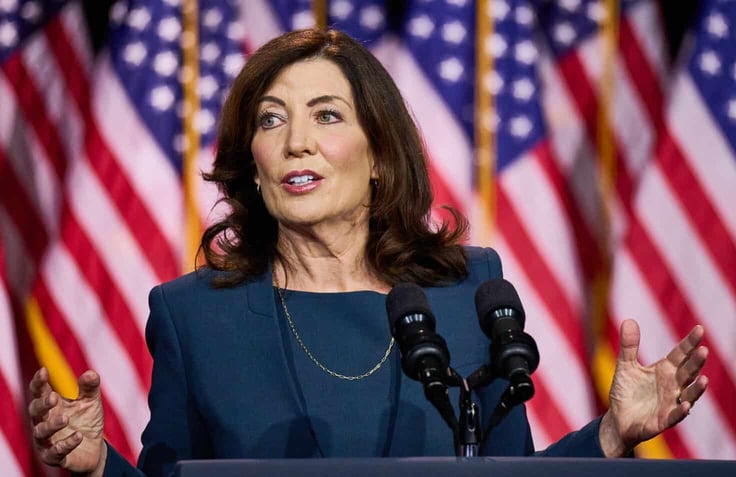
Hochul is, of course, referring to the argument that has been circling for years at this point: Massive data centers use an incredible amount of electricity and water, taking from communities’ local grids.
Just look at Data Center Alley, Virginia: Electricity rates rose by 25% in Henrico County, which is home to 37 data centers, which has reportedly added $5 million in annual costs across government facilities and schools. In an email last month, County Manager John Vithoulkas requested that public employees turn off lights, shut down computers, and adjust blinds to offset the costs, noting that these can cost the county $150 to $300 per year to run.
37 Data Centers Later, Henrico County's Electric Bill Jumps 25%
Similar stories are happening across the country, but not everyone is seeing them the same way.
President Trump pushed back on Hochul's decision, arguing that data centers create jobs and tax revenue, calling them "liquid gold", and that New York had made a mistake pausing them. He also argued that data centers already pay for their own water and power, and any leftover goes back to the state and local community.
If that's true, then what's the issue? Well, data centers currently aren't legally required to report their water consumption. Some governments have even signed NDAs with developers. Only Microsoft has publicly committed to covering its own electricity costs.
Additionally, according to Marketplace, Dany Bahar, a senior fellow at the Center for Global Development, also says that data centers can lower electricity costs for the grid by absorbing a share of the grid's fixed infrastructure costs. But that's not necessarily the case everywhere.
In the same article, Kasia Tarczynska, a senior research analyst at Good Jobs First, said it's not clear whether data centers actually bring long-term benefits — claiming there's evidence that they don't create many long-term jobs, and in most states, they receive exemptions from sales, property, and income tax.
What This Means for Hosts
Exactly how many of New York's current data centers fall under the 50 MW threshold isn't public information, but a Pew Research Center analysis puts New York at 148 operating data centers, the fifth-highest total in the U.S.
Another source, Baxtel, counts 120 across the state, run by 62 different providers, showing that the single largest facility in New York is Greenidge's site in Dresden, which tops out at 80 MW.
If you're a colocation provider or small data center for regional hosts, this moratorium is something you'll want to keep an eye on over the next year. For now, smaller providers are sitting pretty, with far more room to build in New York than hyperscalers have.
But two things could change that over the next year:
- First: The rules that come out of the state’s environmental review could eventually apply to data centers across New York, not just 50+ MW projects.
- Second: State lawmakers have already passed the Responsible Data Center Development Act, which would set a much lower 20 MW threshold. If Hochul signs it, many data centers currently exempt under the 50 MW cutoff could be subject to the moratorium, too.
In other words? The window to build in New York is wide open for smaller operators. For now, at least.
