




Writer: Jordan Sprogis


Editor: Lillian Castro


Reviewer: Cristian Lopez

Key Takeaways
A new consumer survey suggests that web hosting may still have an educational problem.
The survey, which was conducted by All About Cookies, polled 1,000 U.S. adults and found that 40% of respondents said they have a “general idea” of what web hosting is and 24% said they don’t know what the term means at all.
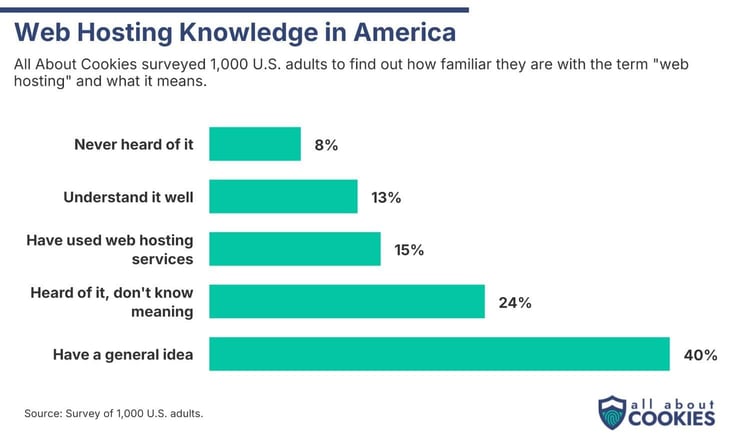
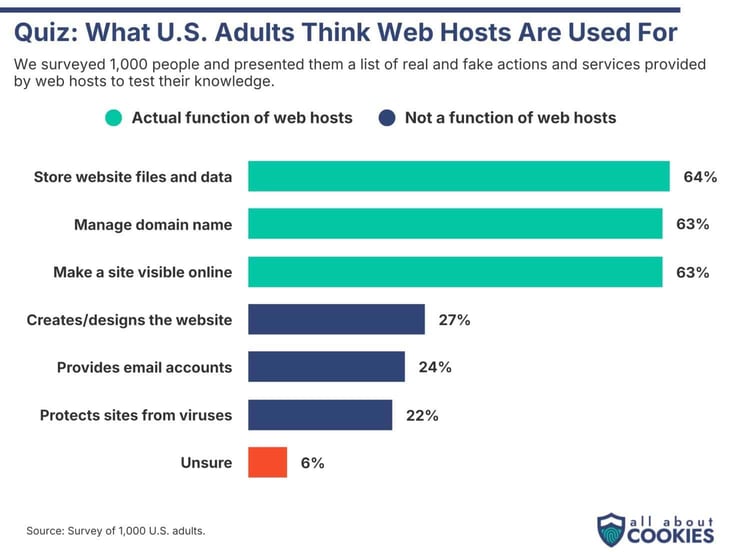
Even those who claimed familiarity, most of them correctly identified the basics of web hosting, like storing files and managing domains. Still, more than 1 in 5 confused hosting with web design (27%), email (24%), and security tools (22%).
This survey may be small but it explains so much about the direction the web hosting industry is taking: Why builders and bundles keep trending. Why customer churn in hosting is so high. Why hosts are expected to take care of every aspect of a customer site.
It’s not unlike how people buy smartphones without understanding the microprocessor inside of them. Like hosting, there are two markets to consider: One wants to see the outcome, and the other wants to understand the specs.
Which goes to show just how in demand web hosting is. The problem is that both of those groups start at the same place and have completely different expectations.
Tending to the “Outcomes > Infrastructure” Group
If users don’t clearly understand what hosting does, it makes sense that they’re naturally drawn to platforms that tell them they can build a site in minutes. That’s easier to grasp than handing them a control panel and server.
“[Customers] keep asking, ‘What can I accomplish?’ rather than ‘How many CPUs do I get?’” SiteGround’s Daniel Kanchev told HostingAdvice. “This is why AI website builders, eCommerce-in-minutes solutions, and built-in AI marketing tools are becoming decisive differentiators.”
No kidding. Look at the past two years and every host — even enterprise-facing ones — are simplifying their language to be better understood by the masses. It’s why 74% of those who have built a website start on website builders like Wix and Squarespace.
It also explains why so many support tickets start at what we call “square one.”
More and more, support isn’t answering technical questions, but really simple ones. In 2024, 75% of service reps reported the highest volume of tickets, saying that most customers were repeatedly asking questions about basic issues as opposed to more in-depth technical problems.
“We noticed a pattern in support inquiries: they were mostly quick, easy fixes that could be resolved by understanding the cause and following a few steps,” CEO Wayne Diamond from Hosted.com told us. “Clients are becoming more knowledgeable about what they are doing.”
And today’s consumers aren’t polite, either. Most of us are aware of that. When they’re confused or frustrated, their frustration may escalate, but they’re also likely to churn. PwC found that 32% of customers will abandon a brand after a single bad experience.
The thing is, a “bad experience” is very subjective.
When users don’t really know what their host is responsible for, they judge it by results anyway. They’re asking: “Did it work? Did it help?” and that’s usually it. And that’s how you end up with builders everywhere and support queues full of those basic questions.
